
- Education
- Certificates & Valuations
- AGS Diamond Report Explained: The 0–10 Scale, Cut Grades and How to Verify One
Certificates & Valuations
AGS Diamond Report Explained: The 0–10 Scale, Cut Grades and How to Verify One
An AGS diamond report uses numbers where most labs use words, and its cut grade is among the strictest ever issued. Here is how to read one, how it compares with GIA and IGI, and how to check that the report matches the diamond in front of you.
 Reviewed by Raj Sood, Graduate Gemologist (GIA), AJP (GIA)Founder and Graduate Gemologist (GIA) · reviewed 16 November 2026
Quick answer
An AGS diamond report is a grading document from the American Gem Society Laboratories, which graded colour, clarity and cut on a 0–10 scale, with 0 the top grade. It is best known for strict, light-performance-based cut grades, including for fancy shapes. AGS stopped issuing new reports around 2022, but existing reports remain valid and can be verified.
What is an AGS diamond report?
An AGS diamond report is an independent grading document issued by the American Gem Society Laboratories (AGSL), the laboratory arm of the American Gem Society. The Society itself is a US trade organisation founded in 1934 by Robert M. Shipley, the same man who founded the Gemological Institute of America (GIA) a few years earlier. The laboratory opened in 1996, and it built its reputation on one thing above all: a scientific, light-based way of grading diamond cut.
A grading report is not a valuation, and it makes no promise about price or future condition. It is a record of what the lab measured and observed on the day: shape, measurements, carat weight, colour, clarity, cut, polish, symmetry and fluorescence. If you are new to the whole idea of lab paperwork, start with our overview of how diamond certificates and jewellery reports work, then come back here for the AGS detail.
AGS Laboratories became part of GIA in 2013, and around 2022 the lab stopped accepting new diamonds for grading. That does not make existing AGS reports worthless. A diamond graded by AGS in 2018 is still the same diamond, and the report still describes it accurately, provided the stone has not been recut or damaged since. You will keep seeing AGS reports on natural diamonds in the trade for years, particularly on well-cut rounds and princess cuts that were sent to AGS specifically for its cut grade.
Every term in this guide that you have not met before, from pavilion angle to fluorescence, is also defined in our plain-English jewellery glossary.
How does the AGS diamond grading scale work?
Most labs grade colour with letters (D to Z) and clarity with abbreviations (IF, VVS1, VS2 and so on). AGS used a single 0–10 numeric scale for cut, colour and clarity, where 0 is the best and 10 the lowest. Many AGS reports print the familiar GIA-style term beside the number, so a report might read "Colour: 1.5 (G)" or "Clarity: 4 (VS2)". Once you know the conversion, an AGS report is quick to read.
| AGS number | Colour (GIA equivalent) | Clarity (GIA equivalent) | Cut grade name |
|---|---|---|---|
| 0 | D | Flawless / Internally Flawless | Ideal |
| 0.5 | E | — | — |
| 1 | F | VVS1 | Excellent |
| 1.5 | G | — | — |
| 2 | H | VVS2 | Very Good |
| 2.5 | I | — | — |
| 3 | J | VS1 | Good (3–4) |
| 4 | L | VS2 | Good |
| 5 | N | SI1 | Fair (5–7) |
| 6 | P | SI2 | Fair |
| 7 | R | I1 | Fair |
| 8–10 | T–Z | I2–I3 | Poor (8–10) |
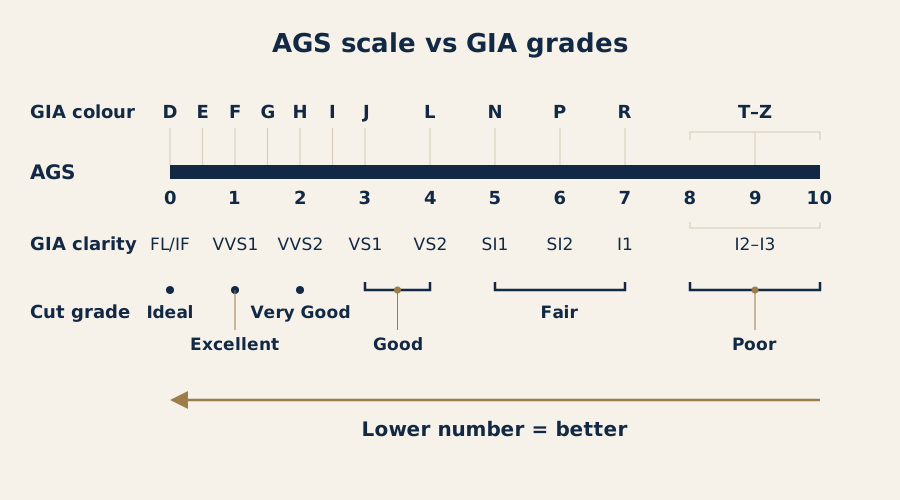
Colour moves in half steps (each 0.5 is one letter grade), while clarity moves in whole steps. The practical point: an AGS 1.5 colour, 4 clarity diamond is the same quality band as a GIA G VS2. Both labs trace their colour and clarity methods back to the same roots, so for these two Cs the grades are broadly comparable, though no two labs grade every stone identically.
Cut is where the scale matters most. GIA gives five cut grades (Excellent to Poor) and only for standard round brilliants. AGS split cut into ten-plus steps and, crucially, graded cut on several fancy shapes as well. That finer scale is why you will see dealers describe a stone as "AGS Ideal 0" or "triple zero", meaning 0 for light performance, polish and symmetry.
Why is the AGS cut grade considered so strict?
Most cut grading works by checking whether a diamond's proportions (table size, crown angle, pavilion angle, girdle thickness) fall inside set ranges. AGS went further. Its cut grade is built on light performance: a computer model traces how light enters the diamond, bounces between the facets and returns to the viewer, using the diamond's actual 3D scan. The final cut grade is the lowest of three parts: light performance, proportion factors (such as weight ratio and durability of the girdle) and finish (polish and symmetry).
That "lowest grade wins" rule is what makes AGS strict. A round with excellent proportions but a girdle that is too thin at one point, or a crown slightly too heavy for its weight, drops out of Ideal. As a guide, many AGS Ideal 0 rounds pair a pavilion angle of roughly 40.6–41.0° with a crown angle of roughly 34–35°, but AGS judged the combination rather than any single number, so a stone outside those figures could still grade Ideal if its light return was strong.
The other big difference is fancy shapes. AGS issued light-performance cut grades for shapes such as princess, oval, cushion and emerald cuts, which GIA does not grade for cut at all. For a princess cut, an AGS Ideal 0 is one of the few independent signs that the stone was cut for brightness rather than for weight.
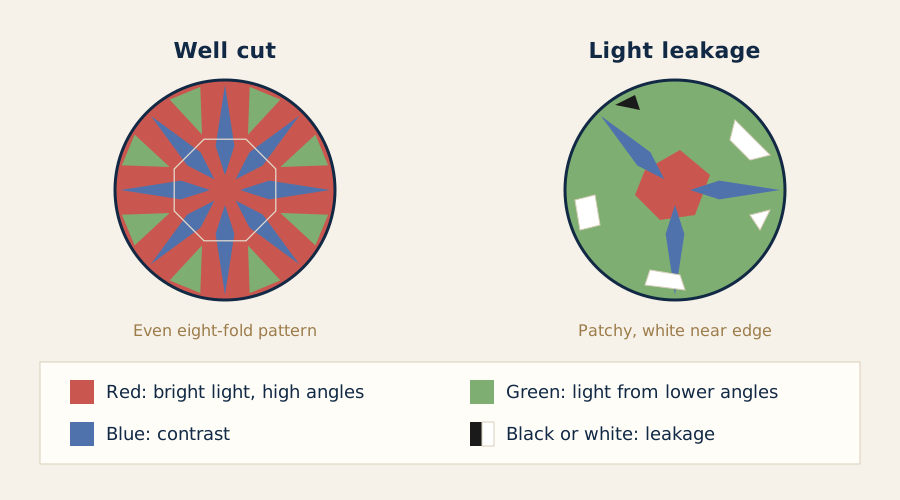
Platinum Light Performance reports also carried an ASET image (Angular Spectrum Evaluation Tool), a colour map of the diamond seen face-up. Red areas return light from high overhead, the brightest kind; green areas return light from lower angles; blue areas show contrast, which is the reflection of your own head and is needed for sparkle; and black or white areas show leakage, where light escapes out the bottom. A well-cut round shows mostly red with an even, symmetrical pattern of green and blue. Light-performance grading is a field of its own, and our guide to light performance reports such as GCAL covers how other labs approach it.
What does an AGS diamond report include?
AGS issued several report formats over the years. Layouts changed, but a full AGS diamond report typically includes:
- Report number and date: the number is often also laser-inscribed on the girdle (the thin outer edge of the diamond).
- Shape and measurements: in millimetres to two decimal places, for example 6.45 – 6.48 × 3.99 mm for a round.
- Carat weight: to two decimal places (1 carat = 0.2 grams).
- Colour and clarity: as AGS numbers, usually with the GIA-style equivalent.
- Cut grade: the overall cut grade plus separate light performance, polish and symmetry grades.
- Proportions diagram: table, crown angle, pavilion angle, girdle thickness, culet and total depth.
- Fluorescence: how strongly the diamond glows under ultraviolet light, with the colour of the glow.
- Clarity plot: a map showing where inclusions (internal features) and blemishes (surface features) sit.
- Comments: extra notes, such as inscriptions, extra facets or treatments.
- ASET image: on Platinum Light Performance reports.
| Report type | What it adds | Typical use |
|---|---|---|
| Platinum Light Performance report | Full grading, light-performance cut grade, ASET map, proportions and plot | Larger and premium-cut diamonds |
| Diamond Quality Document (DQD) | Full grading with cut grade and plot, no ASET map on most versions | The standard AGS grading report |
| Diamond Quality Report / compact formats | Condensed grading on a smaller card | Smaller diamonds and jewellery |
If you are used to GIA paperwork, the layout will feel familiar. GIA's full report and its smaller Dossier split along similar lines; see our comparison of the GIA Dossier and full grading report for how that works on the GIA side.
Related guideGCAL and Light Performance ReportsNot sure which one is right?
Send us the stones you are looking at and our gemologist will tell you which to choose and why.
AGS vs GIA, IGI and HRD: which diamond report is strictest?
The labs people ask about most can be compared on the same handful of points. Strictness here means how consistently and conservatively a lab grades colour, clarity and cut, based on broad trade experience rather than one published study.
| AGS | GIA | IGI | HRD | GSI / EGL | |
|---|---|---|---|---|---|
| Grading scale | 0–10 numbers | Letters and names | Letters and names | Letters and names | Letters and names |
| Cut grade on fancy shapes | Yes, light-based | No (rounds only) | Rounds; some fancy-shape notes | Rounds | Varies |
| Light performance map | ASET on Platinum reports | No | No | No | No |
| Reputation for colour and clarity | Consistent, in line with GIA | The trade reference | Generally reliable; slightly softer in some reports | Respected, European focus | Often softer; check carefully |
| Issuing new reports | No (stopped around 2022) | Yes | Yes | Yes | Yes |
| Common in Australia | Occasionally, older natural stock | Most natural diamonds | Most lab-grown diamonds | Occasionally | Occasionally |
For colour and clarity, AGS and GIA are usually treated as equals: an AGS 2 (H) colour and a GIA H are expected to look the same. Where AGS stands apart is cut. A GIA Excellent round covers a wider range of proportions than AGS Ideal 0, so an AGS Ideal round is, in effect, a narrower selection from within the Excellent band. Our guide on reading a GIA grading report line by line shows the GIA layout for comparison.
For the other labs, read our separate guides: the HRD Antwerp report explained, the IGI report for natural diamonds, and what to know about GSI and EGL grading before you rely on one of those reports for a price comparison.
Which diamond reports do Australian diamonds come with?
In Australia, most natural diamonds of about 0.30 carat and above are sold with a GIA report. Most lab-grown (laboratory-grown) diamonds come with an IGI report, and our guide to reading an IGI lab-grown diamond report explains that layout. AGS reports turn up mainly on natural diamonds sourced from the US market, often rounds and princess cuts that a cutter sent to AGS for its Ideal cut grade.
Because AGS no longer grades new stones, every AGS diamond on the market today was graded at least a few years ago. That is fine for colour and clarity, which do not change. It is worth a closer look for damage: a small chip on the girdle or a worn facet edge since grading could affect the stone and would not be on the report.
Natural and lab-grown reports also differ in what they must disclose, such as growth method and any post-growth treatment. The differences are set out in our guide to how natural and lab-grown diamond reports differ.
Shop natural diamonds graded by AGS
Is an AGS diamond report reliable, and what doesn't it tell you?
Yes, an AGS diamond report is regarded as reliable, with grading consistency in line with GIA. But like any grading report, it describes the diamond, not its story or its worth. An AGS report does not tell you:
- Where the diamond was mined: AGS grading reports do not state country of origin. That needs a separate document; see how diamond origin reports work.
- What it is worth: there is no price or value on a grading report.
- How it looks in a ring: the report cannot show you whether an eye-visible inclusion sits under a claw or in plain view.
- Whether anything has changed since grading: chips, wear or recutting after the report date are not recorded.
- Whether the setting is sound: claws, metal and workmanship are outside the lab's scope.
For the full list of gaps, see our guide to the limits of any diamond grading report. And if you need a document for your insurer, that is a valuation, not a grading report; our page on what an insurance valuation covers explains how the two fit together.
How do you verify an AGS diamond report?
Verifying a report means confirming two things: that the report is genuine, and that it belongs to the diamond you are looking at. The process is similar to checking a GIA report number online, with an AGS twist.
- Find the report number. It is printed at the top of the report, usually as a long number starting with digits only.
- Look it up online. Enter the number into the AGS or GIA report lookup service and compare every line with the paper or PDF report you were given.
- Check the laser inscription. Under a 10× loupe or microscope, look for "AGS" and the report number on the girdle. Not every AGS stone is inscribed, so a missing inscription is a question, not proof of a problem.
- Match the measurements. Measure the diamond with a gauge; length, width and depth should agree with the report to within about 0.01–0.02 mm.
- Match the weight. A loose stone should weigh within 0.01 carat of the report figure.
- Compare the clarity plot. Find two or three of the plotted inclusions under magnification. Inclusions are like a fingerprint, and this is the most convincing check of all.
- Check for damage since grading. Look for girdle chips and worn facet junctions, since the report only records the stone as it was on the grading date.
Lab-grown diamonds have their own verification steps, including inscriptions that state the stone is laboratory-grown; see verifying a lab-grown report and its girdle inscription. A gemmologist can do all of these checks for you in a few minutes with the right equipment.
Buying a graded diamond? See GIA diamonds in Melbourne for GIA-graded stones in stock with today's prices, and loose diamonds in Melbourne for the wider range. Raj Sood, Graduate Gemologist (GIA), can go through a GIA report with you before you decide. Please check the lab report before you commit. Related pages: engagement rings in Melbourne, custom engagement rings in Melbourne and lab-grown diamonds in Melbourne. Raj Sood, Graduate Gemologist (GIA), sees clients by appointment at Unit 903/125 Swanston St, Melbourne VIC 3000.
Free consultation
Talk to a gemologist
Compare stones in person or online with Raj Sood, Graduate Gemologist (GIA), AJP (GIA).
Book a consultationShop this shape
FAQ
Common questions
What does AGS stand for on a diamond report?
AGS stands for the American Gem Society, a US trade organisation founded in 1934. Its laboratory, AGS Laboratories, graded diamonds from 1996 until it stopped issuing new reports around 2022.
What does AGS Ideal 0 mean?
Ideal 0 is the top AGS cut grade, based on how well the diamond returns light. "Triple zero" means the diamond also scored 0 for polish and symmetry.
Is an AGS report as good as a GIA report?
For colour and clarity, the two labs are generally considered equally consistent. AGS cut grading is more detailed than GIA's and covers several fancy shapes, while GIA is far more widely used and still issues new reports.
Are AGS reports still valid now that the lab has stopped grading?
Yes. The report still describes the diamond as it was graded, and the number can still be looked up. Just check the stone for any chips or wear since the report date.
How do I convert AGS grades to GIA grades?
For colour, each 0.5 step is one letter: 0 is D, 1.5 is G, 2 is H. For clarity, 0 is Flawless or Internally Flawless, 4 is VS2 and 5 is SI1.
Does an AGS report show where a diamond came from?
No. An AGS grading report does not state the country or mine of origin. Origin needs a separate origin report or documented supply chain.
Ask a gemologist
Not sure which diamond to choose?
Raj Sood is a Graduate Gemologist (GIA) who works alongside our master jewellers. Bring the stones you are considering, or send the reports, and he will tell you honestly which one is better and why.
Keep learning
Related guides
 Certificates & ValuationsHow to Read a GIA Diamond Report
 Certificates & ValuationsGCAL and Light Performance Reports
 Certificates & ValuationsWhat a Diamond Report Doesn't Tell YouCertificates & ValuationsHRD Diamond Report ExplainedCertificates & ValuationsDiamond Certificates & Jewellery Reports
 Certificates & ValuationsDiamond Origin Reports ExplainedCertificates & ValuationsGSI and EGL Diamond Reports: What to KnowCertificates & ValuationsNatural vs Lab-Grown Diamond Reports
Explore more
More guides on this topic
Education