
Jewellery services in Melbourne
Pearl Stringing & Bead Restringing
A pearl strand is only as strong as its thread. When the thread stretches, frays or breaks, we check every pearl and the clasp, then restring and knot the strand so it drapes properly again.
 Reviewed by Raj Sood, Graduate Gemologist (GIA), AJP (GIA)Founder and Graduate Gemologist (GIA) · reviewed 17 November 2026
Quick answer
GemTrove restrings pearl and bead necklaces and bracelets at our Melbourne CBD showroom, Unit 903/125 Swanston St, Melbourne VIC 3000. Strands are rethreaded and knotted, and the pearls, drill holes and clasp are checked before the work. Raj Sood, a Graduate Gemologist (GIA), inspects each strand first, and you get a quote before anything is cut. Allow up to 5 weeks; some jobs take a day or two.
What is pearl stringing and bead restringing?
Pearl stringing is threading pearls onto a new strand and securing them to a clasp. Restringing is the same work done on a strand that already exists: the old thread is cut away, the pearls are checked and cleaned, and they are threaded again in their original order.
- Pearl necklaces: single strands, graduated strands and chokers.
- Multi-strand pieces, where each row has to hang evenly beside the others.
- Pearl bracelets, which take more wear than necklaces.
- Bead necklaces in gemstone, glass or other beads.
- Broken strands, including strands with pearls missing.
- Inherited strands that have not been worn in years.
For how pearls are formed, graded and cared for, see pearl care and restringing, types of pearls and pearl grading.
Which pearls, beads and strands do we restring?
Every kind of pearl and every kind of bead, on whatever the strand needs: silk, nylon, wire or elastic.
| Strand | How it is usually restrung |
|---|---|
| Akoya, freshwater, South Sea and Tahitian pearls | On silk or nylon thread, knotted between each pearl, in a colour matched to the pearls |
| Baroque, keshi and coin pearls | Knotted, with the spacing set by eye because no two pearls are alike |
| Graduated strands | Laid out in order first, so the largest pearl sits at the centre |
| Double, triple and twisted (torsade) strands | Each strand restrung to the right length so they nest and do not gap |
| Opera and rope-length strands | Knotted throughout; can be divided into a necklace and a bracelet |
| Gemstone beads: jade, lapis, coral, amber, turquoise, onyx, garnet | Knotted on thread, or strung on coated wire where the beads are heavy or sharp-edged |
| Gold and silver beads | On wire or foxtail chain, which metal beads do not cut |
| Crystal and glass beads | On wire or strong thread, with the bead edges checked for chips |
| Prayer beads: mala, rosary, tasbih and worry beads | Restrung in the correct order and count, with the guru bead, tassel or cross kept |
| Stretch and elastic bracelets | New elastic, with the knot hidden inside a bead |
| Children's and christening pearls | Short strands knotted and fitted with a secure clasp |
| Vintage and inherited strands | The old thread kept only as a guide to the original length; any original clasp reused where it is sound |
Not sure what yours are? Our pearl identification guide covers Akoya, freshwater, South Sea, Tahitian and keshi pearls.
What else can be done while a strand is restrung?
- A new clasp: a fish-hook, box, ball, magnetic or hidden clasp, or a diamond-set clasp worn at the front.
- A safety chain, for a valuable strand.
- Shortening, with the spare pearls returned to you or made into earrings.
- Lengthening, with matched pearls added at the back where they show least, or with gold beads or spacers.
- One long strand into two, or a necklace and a matching bracelet.
- Two strands joined into one longer strand.
- Replacing a lost or damaged pearl with the closest match in size, colour and lustre.
- Cleaning each pearl gently before it goes back on the thread.
- Re-drilling a hole that has worn, where the pearl allows it.
- Re-pegging a pearl that has come off a ring, an earring or a pendant.
- An enhancer or pendant loop, so a pendant can be clipped on and taken off.
For looking after pearls between restringings, see pearl care and restringing.
How do you know a pearl strand needs restringing?
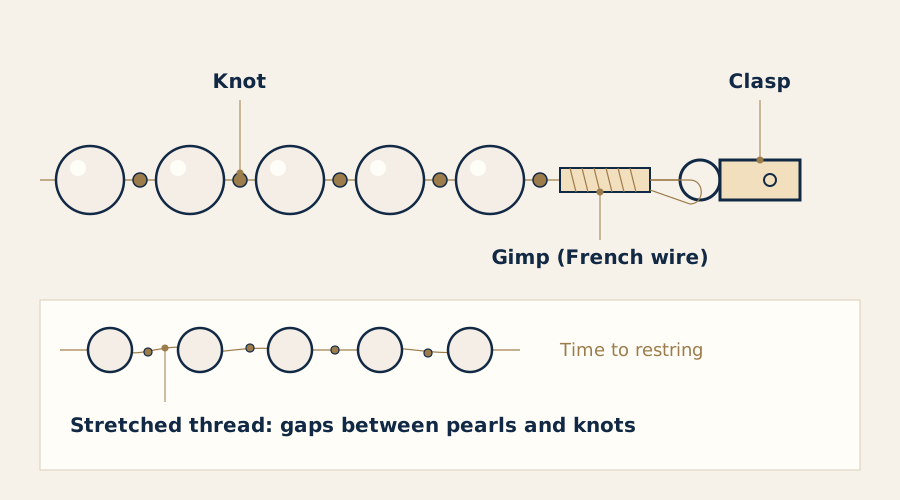
Pearl and bead necklaces should be restrung when the silk or thread shows stretching, fraying or staining. Look for these signs:
- Gaps. You can see thread between the pearls, or between a pearl and its knot.
- Slack. The pearls slide along the strand when you hold it up.
- Discoloured thread, usually darkest near the clasp where it touches the skin.
- Fraying next to the clasp or at a knot.
- A strand that hangs in a tired curve instead of an even drape.
- A break. If the strand has broken once, the rest of the thread is the same age.
Not sure what your piece needs?
Bring it in, or send us clear photos, and our gemologist will tell you what needs doing, what can wait and what we would leave alone.
Why are pearls knotted, and should yours be?
On a knotted strand there is a small knot between each pearl. Knotting between pearls reduces rubbing, because the pearls do not grind against each other at the drill holes, and it limits the loss if the strand breaks: one pearl falls, not all of them.
| Strand | Usual approach |
|---|---|
| Fine pearl necklace | Knotted between every pearl |
| Very small pearls | Often knotted at intervals, or unknotted |
| Graduated strand | Knotted, and kept in its original order |
| Heavy gemstone beads | Stronger thread or wire, sometimes with spacers |
| Multi-strand piece | Each row measured so the rows sit evenly |
Knots add length. A strand restrung with knots where it had none will be longer, and one restrung without them will be shorter. We tell you the finished length before the work: see the necklace length guide and, for bracelets, the bracelet size guide.
How much does it cost to restring pearls in Melbourne?
There is no set price for restringing, because strands differ in length, in how they are knotted and in what else they need. You get a quote after we have looked at the strand, and nothing is cut until you agree. These are the things that move the price:
- The length. A longer strand has more pearls to thread and more knots to tie.
- Knotted or not. A knot between every pearl is slower, more careful work than straight threading.
- The number of strands. A two or three row piece is more than two or three single strands, because the rows must match.
- The clasp. A worn clasp is repaired or replaced at the same time. See chain and clasp repair.
- Missing or damaged pearls. A replacement has to be matched for size, colour and lustre.
- Changing the length. Adding or removing pearls is extra work.
If the strand is not worth restringing as it is, we will say so, and tell you whether the good pearls could be used another way.
How long does pearl restringing take?
Allow up to 5 weeks. Many jobs are finished much sooner, and some simple ones take a day or two. The time depends on the work itself, the metal, and whether a stone or a part has to be sourced.
We confirm the time for your strand with the quote, before any work begins. If you need it back for a date, tell us when you book and we will tell you honestly whether it can be done.
What do GemTrove customers say?
These are Google reviews from GemTrove customers, quoted word for word.
5.0 on Google
★★★★★
“We got the sizing dramatically wrong and Raj was patient… He had it fixed quickly and delivered an excellent ring.”
Richard L.
Google review · ring sizing corrected
★★★★★
“… His prompt communication and willingness to help made what could have been a stressful situation completely hassle-free. The craftsmanship, attention to detail, and level of care provided by Neeraj and the Gemtrove team exceeded my expectations. …”
Seno R.
Google review · engagement ring
★★★★★
“… Trusts isn't something that can be written in a few words, it is something to be earned. Buying something with not only high monetary value but of sentimental value depends on a lot of trusts. …”
Whiz
Google review · anniversary ring upgrade
★★★★★
“… His deep knowledge of diamonds and the do's and don'ts of ring design was invaluable. … The craftsmanship and attention to detail are outstanding, and the rings turned out even more beautiful than we imagined. …”
Tanveer D.
Google review · engagement and wedding rings
★★★★★
“Raj is very friendly and knowledgeable on all things diamonds. I went to him to make an engagement ring for me after seeing all his positive reviews. He helped me design the perfect ring. He listened to everything I was looking for and gave me great advice along the way.”
The Adsta
Google review · engagement ring
Read all GemTrove reviews on Google
What happens from drop-off to pick-up?
- Book a visit. Book an appointment and bring the strand. If it has broken, bring every pearl you can find, in a soft pouch or sealed bag.
- We inspect. The pearls, the drill holes, the thread and the clasp are checked, and the pearls are counted and measured with you.
- We agree the details. Knotted or not, the finished length, the thread colour and anything to be done to the clasp.
- You get a quote. Nothing is cut until you agree.
- The strand is restrung. Pearls are kept in order, wiped clean, rethreaded and knotted, and the clasp is attached.
- It is checked. The strand is checked for even tension and drape, and the pearl count is confirmed.
- You collect it. We show you the strand and explain how to wear and store it.
What is checked while the strand is apart?
Clasps, drill holes and bead edges are checked during restringing, because a rough edge will cut through new thread as quickly as it cut through the old.
- Drill holes. Worn or chipped holes let a pearl sit crooked and wear the thread.
- Nacre. Thin or peeling nacre around the hole shows a pearl nearing the end of its life. See natural vs cultured pearls.
- The clasp. The spring, the tongue and the rings that hold the thread all wear.
- The match. Pearls that have discoloured or lost lustre stand out once the strand is clean.
Different pearls have different nacre and different needs: see Akoya pearls, freshwater pearls, South Sea pearls, Tahitian pearls and Broome South Sea pearls.
What can restringing not fix?
- Worn nacre. Once the pearl's surface has worn through or peeled, it cannot be restored. The pearl is replaced or the strand is shortened.
- Cracked pearls. A cracked pearl will not hold on a knot.
- Flaking imitation pearls. A coating that is lifting will keep lifting. We tell you what the strand is before quoting.
- An exact match for a lost pearl. A replacement is matched as closely as possible for size, colour, overtone and lustre, and placed where it shows least.
- Pearls dulled by perfume or hairspray. Cleaning helps; it does not bring back lost lustre.
If a strand is past saving as a necklace, the best pearls can become a shorter necklace, a bracelet or earrings: see our jewellery remodelling and custom earrings pages, and keshi and mabé pearls for other pearl styles.
How do you make a restrung strand last?
- Put pearls on last, after perfume, hairspray and sunscreen. See sunscreen, chlorine and your jewellery.
- Wipe the strand with a soft, slightly damp cloth after wearing.
- Never soak a strand or hang it to dry: wet thread stretches.
- Store pearls flat, in a soft pouch, away from harder jewellery. See how to store jewellery.
- Keep pearls out of ultrasonic and steam cleaners. See which stones can go in an ultrasonic cleaner.
- Have a strand you wear often checked once a year.
Pearls are an organic gem and are softer than almost anything else in a jewellery box. See gemstone care by stone and pearl as the June birthstone.
Where can you have pearls restrung in Melbourne?
At our showroom on Swanston Street, opposite Melbourne Town Hall, by appointment. GemTrove has been in business since 2008 and our family has been in the jewellery trade since 1984. Restringing is quoted once we have seen the strand; we do not quote a price over the phone. Allow up to 5 weeks; many jobs are ready sooner, and some take a day or two.
- Showroom: Unit 903/125 Swanston St, Melbourne VIC 3000 (Level 9), opposite Melbourne Town Hall, by appointment.
- Hours: Monday to Friday 9:30 am to 5:30 pm, Saturday 11:30 am to 1:00 pm, Sunday closed.
- Phone: 0488 878 000.
- Book: book a restringing visit. Bring the strand and any loose pearls in a soft pouch.
Free consultation
Talk to a gemologist
Compare stones in person or online with Raj Sood, Graduate Gemologist (GIA), AJP (GIA).
Book a consultationFAQ
Common questions
How much should it cost to restring pearls?
It depends on the length of the strand, whether it is knotted, how many rows it has and whether the clasp or any pearls need replacing. GemTrove quotes after looking at the strand, and nothing is cut until you agree.
Can a jeweller restring a pearl necklace?
Yes. The old thread is removed, the pearls and clasp are checked, and the strand is rethreaded and knotted in its original order.
How long does pearl restringing take?
Allow up to 5 weeks. Many jobs are finished much sooner, and some simple ones take a day or two. We confirm the time with your quote, before any work begins.
How often should pearls be restrung?
There is no fixed interval. It depends on how often the strand is worn. Restring when you see gaps, slack, fraying or discoloured thread. See pearl care and restringing.
Should pearls be knotted between each pearl?
For most fine pearl necklaces, yes. Knots stop the pearls rubbing each other and mean only one pearl is lost if the strand breaks.
Can a broken pearl necklace be repaired?
Yes, as long as you have most of the pearls. Bring every pearl you can find. Missing ones can be matched, or the strand can be made slightly shorter.
Can you restring gemstone bead necklaces?
Yes. Heavier beads often need stronger thread or wire, and beads with sharp drill holes need protecting so they do not cut the new strand.
Do you restring beads as well as pearls?
Yes. We restring gemstone beads, gold and silver beads, crystal, prayer beads and elastic bracelets, as well as every kind of pearl.
Terms in this guide

Ask a gemologist
Not sure whether to repair, restore or remake?
Raj Sood is a Graduate Gemologist (GIA) who works alongside our master jewellers. Bring the piece in and he will tell you honestly what it needs, what it does not, and what we would advise against.
Keep learning
Related guides
 PearlsPearl Care and RestringingPearlsTypes of Pearls and Pearl Identification GuidePearlsPearl Grading: Lustre, Nacre, Surface, Shape, Size
 Jewellery TypesNecklace Length GuidePearlsAkoya Pearls
 Jewellery TypesBracelet Size GuidePearlsBroome South Sea Pearls (Australian)
 GemstonesCan Every Gemstone Go in an Ultrasonic Cleaner?
Explore more
More guides on this topic
Education