
- Education
- Care, Repairs & Remodelling
- Chain Repair Melbourne
Jewellery repairs in Melbourne
Chain Repair Melbourne
A snapped chain, a clasp that won't close or a pendant bail that has opened: we inspect the chain first, tell you whether it will repair strongly, and give you a quote before any work begins.
 Reviewed by Raj Sood, Graduate Gemologist (GIA), AJP (GIA)Founder and Graduate Gemologist (GIA) · reviewed 17 November 2026
Quick answer
GemTrove repairs broken chains, necklace clasps, bracelet links, jump rings and pendant bails at our Melbourne CBD showroom, Unit 903/125 Swanston St, Melbourne VIC 3000. We inspect the chain first, because metal, link style and wear decide whether it will repair strongly, then quote before any work begins. Allow up to 5 weeks; many jobs are finished sooner, some in a day or two.
What chain repairs can GemTrove do?
- Broken chain soldering: rejoining a chain that has snapped at one point, where the link structure allows a secure join.
- Clasp replacement: a new clasp when the old one no longer closes or its spring has failed. A new clasp is often safer than repairing a worn mechanism.
- Jump ring replacement: a stronger end ring when the old one has opened, thinned or broken.
- Pendant bail repair: closing, repairing or replacing a bail that is open, cracked or thin, to protect the pendant.
- Bracelet chains: the same repairs on bracelet links and clasps.
- Shortening: taking a necklace up to a new length.
- Untangling: careful handling of knotted fine chains, which can snap if pulled.
For rings, earrings and other pieces, see our jewellery repairs service and our ring repair page.
Which kinds of chain do we repair?
Every kind. A chain is not one thing: each style is built differently, breaks differently and is put back together differently. Tell us the style if you know it, or simply bring it in and we will tell you. Our guide to the types of necklace chains shows each one.
| Chain style | How it usually fails | How it is repaired |
|---|---|---|
| Cable and trace | A single link opens or wears through | The link is closed and soldered, or a matching link is made |
| Belcher (rolo) | Wear where the round links rub | Worn links are replaced; the join is rounded to match |
| Curb and Cuban | A link snaps at the twist, often near the clasp | The link is soldered, then filed flat so it lies with the others |
| Figaro | A break at one of the long links | A new long or short link is made to keep the pattern |
| Rope | Strands part and the twist unravels | The strands are re-woven and soldered, so the twist runs on |
| Box (Venetian) | A box link pulls open | The link is re-formed and soldered square |
| Wheat (spiga) and foxtail | A plait link breaks inside the weave | The weave is rejoined link by link |
| Singapore and twisted curb | A kink or a break at the twist | Rejoined and re-twisted so the sparkle runs evenly |
| Snake and omega | A kink, or the chain parts at an end cap | End caps are refitted; a kink can be eased but may still show |
| Herringbone | A kink across the flat links | Eased where possible; we tell you first how it will look |
| Ball (bead) chain | A connector between beads pulls out | The connector is replaced or the beads are rejoined |
| Paperclip and long-link | A long link opens or bends | The link is reshaped and soldered closed |
| Tennis and stone-set chains | A hinge pin or a setting link wears | The link is rebuilt and every setting checked |
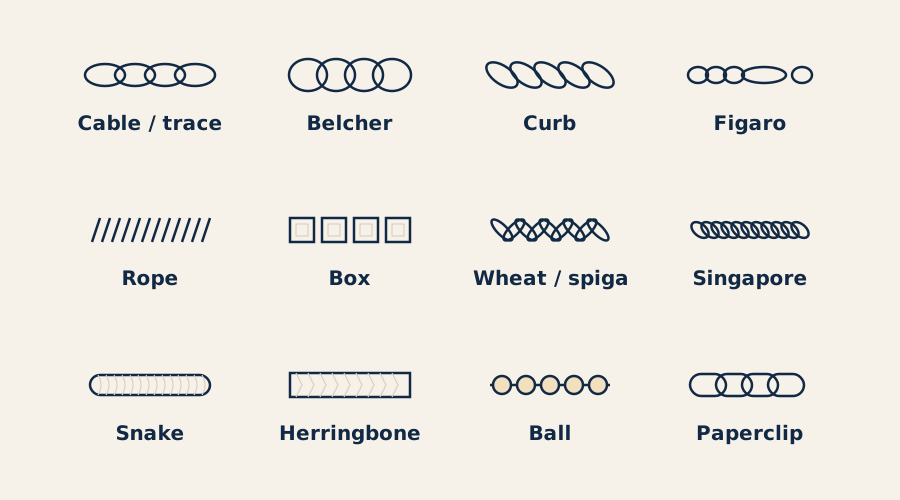
The same goes for what the chain is made of and who wears it: fine pendant chains, heavy men's chains, children's and christening chains, anklets, bracelet chains, watch safety chains, glasses chains, rosary and prayer-bead chains, and the chain of a locket or a cross. We repair yellow, white and rose gold in 9ct, 14ct, 18ct and 22ct, platinum and sterling silver, in solid, hollow and diamond-cut chain.
Which clasps and fittings do we repair or replace?
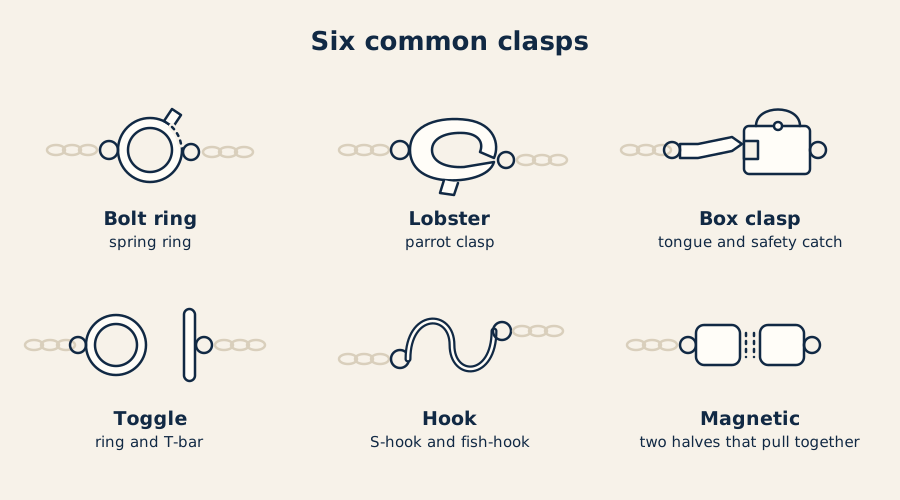
The clasp does the most work on any chain, so it is usually the first part to fail. Most worn clasps are replaced, not repaired, because a new spring is stronger than a mended one. We keep the same type where you like how it works, or fit a stronger or easier one where you do not.
- Bolt ring (spring ring): the small round clasp on most fine chains. The spring tires; a new bolt ring is fitted and soldered.
- Lobster (parrot) clasp: stronger and easier to use, and a common upgrade for a chain that carries a pendant.
- Box clasp and tongue: found on tennis bracelets, pearls and flat chains. The tongue is re-tensioned or remade so it clicks shut.
- Safety catch and figure-eight latch: the second lock on a box clasp. Added, tightened or replaced.
- Toggle and T-bar: the bar or ring is remade, or the length adjusted so the bar cannot slip back through.
- Hook, S-hook and fish-hook clasps: reshaped, re-hardened or replaced.
- Barrel and screw clasps: worn threads mean a new clasp.
- Magnetic clasps: fitted for hands that find small clasps hard to work, with a safety chain where the piece is valuable.
- Slider and bolo adjusters: the silicone or spring inside wears; the slider is replaced.
- Jump rings, end caps and tags: every unsoldered jump ring is a weak point. We solder them closed.
- Extension chains: a short length added so one chain can be worn at two lengths.
- Pendant bails and enhancers: a worn bail is rebuilt or replaced, or changed to a hinged bail that opens.
Can a tangled or knotted chain be fixed?
Yes. Fine chains knot themselves in a drawer, a travel pouch or a jewellery box, and two or three chains worn together can lock into one knot. Pulling at it tightens the knot and can stretch or snap the links.
- A single knotted chain: the knot is opened under magnification with fine points, link by link, without stretching the chain.
- Several chains knotted together: each is freed in turn, then checked for stretched links.
- A knot that will not open: on a very fine chain it is sometimes kinder to open one link at the knot, clear it and solder the link closed again. We ask you first.
- A chain kinked by the knot: the kink is eased; on snake and herringbone chains a mark may remain, and we tell you before we start.
- Pendants and charms caught in the knot: removed first so nothing is scratched, then put back.
To stop it happening again, fasten the clasp before you put a chain away and store each chain on its own. See how to store jewellery.
Not sure what your piece needs?
Bring it in, or send us clear photos, and our gemologist will tell you what needs doing, what can wait and what we would leave alone.
What else can be done to a chain?
- Shortening: links are removed and the end remade, and the offcut is yours to keep.
- Lengthening: matching chain is added, or an extension fitted. See our necklace length guide for where each length sits.
- Joining two chains, or making one long chain into a necklace and a bracelet.
- Adding a safety chain to a bracelet or a valuable necklace.
- Fitting a stronger chain to a pendant that has outgrown the one it came on.
- Cleaning and polishing a dull or tarnished chain, and rhodium plating white gold.
- Re-attaching charms, lockets, crosses and medals, with the rings soldered closed.
- Replacing a section of worn chain with new chain matched as closely as it can be.
Why does every chain need inspecting before it's repaired?
A broken chain looks simple, but every repair depends on the chain type, the metal, its thickness, earlier repairs, how worn it is and where it broke. Fine chains, hollow chains, rope chains and heavily worn links need a closer look before we can say whether a repair will be strong.
Some very fine, hollow, stretched or badly worn chains won't repair strongly. In that case a new chain, or remaking the piece, can be safer than repeated solder joins. Our guide to what can be reused safely explains the options.
What happens during a chain repair?
- Inspection. We look at the whole chain, not just the break: link wear, earlier repairs, the clasp and the jump rings.
- Options and quote. We explain what will hold, what may show, and what it will cost, before any work begins.
- Repair. A solder join, a new clasp, a new jump ring or a bail repair, depending on what failed.
- Check the rest. Thin links and tired clasps nearby are pointed out, so a second break doesn't surprise you.
- Finish. The repaired area is cleaned and finished to match the chain, and the clasp is tested.
- Care advice. You leave knowing how to wear and store the chain so it lasts.
Can bracelet and anklet chains be repaired?
Yes, with the same repairs as necklaces. Bracelet chains usually wear faster than necklaces, because they knock against desks, doors and bag straps and move every time your wrist does. Clasps on bracelets work harder too, so we check them carefully. Anklets are often very fine and can catch on shoes and fabric, so a light chain may be better replaced with a slightly heavier one if it keeps breaking.
How much does a chain repair cost in Melbourne?
We do not publish a set price for chain repairs, because the same break can be a quick join on one chain and delicate work on another. You get a quote after we have looked at the whole chain, and nothing is done until you agree. These are the things that move the price:
- The metal. Gold, platinum and silver are joined differently, and any metal added has its own cost. See 9ct vs 18ct gold.
- Solid or hollow. Hollow links are thin and need much more care than solid ones.
- The link style. A cable or curb link is simple to rejoin. Rope, snake, box and herringbone chains are not.
- How many weak points. One break in a sound chain is a small job. A chain stretched thin along its length is not.
- A new clasp or jump ring. The part itself is a cost, and it is chosen to suit the weight of the chain.
- Plating. A plated chain may need replating after a repair. See plated, filled and solid gold.
If the chain is worn all over, we will tell you whether a repair is worth it or whether a new chain for the same pendant makes more sense.
How long does a chain repair take?
Allow up to 5 weeks. Many jobs are finished much sooner, and some simple ones take a day or two. The time depends on the work itself, the metal, and whether a stone or a part has to be sourced.
We confirm the time for your chain with the quote, before any work begins. If you need it back for a date, tell us when you book and we will tell you honestly whether it can be done.
What do GemTrove customers say?
These are Google reviews from GemTrove customers, quoted word for word.
5.0 on Google
★★★★★
“We got the sizing dramatically wrong and Raj was patient… He had it fixed quickly and delivered an excellent ring.”
Richard L.
Google review · ring sizing corrected
★★★★★
“… His prompt communication and willingness to help made what could have been a stressful situation completely hassle-free. The craftsmanship, attention to detail, and level of care provided by Neeraj and the Gemtrove team exceeded my expectations. …”
Seno R.
Google review · engagement ring
★★★★★
“… Trusts isn't something that can be written in a few words, it is something to be earned. Buying something with not only high monetary value but of sentimental value depends on a lot of trusts. …”
Whiz
Google review · anniversary ring upgrade
★★★★★
“… His deep knowledge of diamonds and the do's and don'ts of ring design was invaluable. … The craftsmanship and attention to detail are outstanding, and the rings turned out even more beautiful than we imagined. …”
Tanveer D.
Google review · engagement and wedding rings
★★★★★
“Raj is very friendly and knowledgeable on all things diamonds. I went to him to make an engagement ring for me after seeing all his positive reviews. He helped me design the perfect ring. He listened to everything I was looking for and gave me great advice along the way.”
The Adsta
Google review · engagement ring
Read all GemTrove reviews on Google
Repair, replace or remake?
Repair is the right choice when the chain is in good condition apart from one break. Replacement makes more sense when the links are worn thin all over, when a hollow chain has dents and splits, or when a chain has been repaired many times. If the chain is sentimental, we can often keep the pendant and fit a new chain, or remake part of the piece. Our guide to repair vs replace uses the same thinking for rings.
Whatever you choose, we tell you honestly. A repair that won't last isn't good value, however cheap it is.
Which chain types repair well?
- Cable and belcher chains: often simple to repair if the links aren't too worn.
- Curb chains: repairs are usually strong when the chain has enough thickness.
- Box chains: can be difficult if the links are crushed or thin.
- Rope chains: repairs can be visible and complex, and fine rope chains may not repair strongly.
- Snake chains: often difficult if kinked, crushed or snapped. Replacement is sometimes the better choice.
- Hollow chains: light and lovely, but thin walls make strong repairs harder.
Not sure what style you have? Our guide to the types of necklace chains shows each one, and the necklace length guide helps if you are shortening a chain.
Does the metal change how a chain is repaired?
Yes. Solid gold, platinum and sterling silver can be soldered and refinished. Gold-plated and gold-filled chains are harder, because heat and polishing can damage the thin gold layer; see gold-plated, gold-filled and solid gold. The stamp near the clasp usually tells us the metal; see Australian hallmarks and metal stamps.
- Gold: the karat affects colour and strength. See 9k vs 18k gold, 14k gold and 22k and 24k gold.
- Platinum: dense and durable. See platinum jewellery.
- Silver: repairable, and it tarnishes over time. See sterling silver jewellery and silver tarnish and patina.
When should a clasp be replaced instead of repaired?
When its spring has failed, its tongue no longer clicks shut, or it has worn thin. A clasp is the part most likely to fail, and a worn clasp is the most common reason a chain and pendant are lost. Replacing it costs far less than replacing a lost pendant. If the pendant itself has a loose stone, see loose stones and stone tightening and pendant settings.
How do you stop a chain from breaking again?
- Take it off to sleep and exercise. Chains catch on pillows and clothing. See sleeping and working out in jewellery.
- Store chains flat or hanging, fastened. That stops tangles and kinks. See how to store jewellery.
- Keep it away from chlorine. See sunscreen, chlorine and your jewellery.
- Clean it gently. See professional vs home cleaning and how to clean silver jewellery.
- Travel with it on. See travelling with fine jewellery.
Our jewellery care and maintenance guide covers everything you wear every day.
Should you insure a valuable chain?
If it would be expensive to replace, yes. Heavy gold chains carry real metal value, which moves with the gold price; see how gold prices affect jewellery prices and jewellery valuations for insurance. We also provide jewellery valuations.
What should you bring to a chain repair?
- Every piece of the chain, including any loose links, jump rings and the clasp. Original parts match best.
- The pendant or charms, so we can check the bail and make sure the repaired chain still fits through it.
- The length you want, if you'd like it shortened at the same time.
- Any history you know of, such as earlier repairs, because old solder joins affect where we can work.
Put the pieces in a small sealed bag rather than wrapping them in a tissue, which is easily thrown away by mistake. If the chain is knotted, don't pull at it; bring it as it is and we'll untangle it carefully.
Which chain repairs would we advise against?
- A kinked herringbone or snake chain. The kink can be eased, but it rarely disappears and usually returns.
- A crushed hollow chain. Thin hollow links split when they are reshaped.
- A chain worn thin along its whole length. It will break again beside the repair. Replacing it is the honest answer.
- Costume and base-metal chains. They often cannot take the heat of a solder join, and the plating does not survive it.
- A chain too fine for its pendant. The repair is to fit a stronger chain. See pendant and solitaire necklace settings.
For a broken ring, earring or bracelet clasp, see jewellery repairs in Melbourne. Pearl and bead strands are restrung, not soldered: see pearl stringing and bead restringing.
Where can you get a chain repaired in Melbourne CBD?
At our showroom on Swanston Street. GemTrove has been in business since 2008, and our family has been in the jewellery trade since 1984. Every chain is different, so we quote once we have seen it. For a price, ask us for a quote. Allow up to 5 weeks; many jobs are ready sooner, and some take a day or two.
- Showroom: Unit 903/125 Swanston St, Melbourne VIC 3000 (Level 9), by appointment.
- Hours: Monday to Friday 9:30 am to 5:30 pm, Saturday 11:30 am to 1:00 pm, Sunday closed.
- Phone: 0488 878 000.
- Book: book a repair visit and bring every piece of the chain, including any broken links.
Free consultation
Talk to a gemologist
Compare stones in person or online with Raj Sood, Graduate Gemologist (GIA), AJP (GIA).
Book a consultationFAQ
Common questions
How much does a chain repair cost?
It depends on the chain, the metal, the link style and the repair. GemTrove quotes after looking at the whole chain, and nothing is done until you agree.
How long does a chain repair take?
Allow up to 5 weeks. Many jobs are finished much sooner, and some simple ones take a day or two. We confirm the time with your quote, before any work begins.
Can every broken chain be fixed?
Most can, but very fine, hollow, stretched or badly worn chains may not repair strongly. We tell you honestly if a new chain would be the safer choice.
Can you repair a gold-plated chain?
Sometimes, but heat and polishing can damage the thin gold layer, so the repair may show. We inspect it and explain what to expect first.
Will a repaired chain show where it was fixed?
On many chains the join is very hard to see. On rope, snake and some fine chains a repair can be visible, and we tell you before we start.
Can you shorten my necklace?
Yes, in most cases. Bring the necklace and tell us the length you want.
Can you fix a pendant bail that keeps opening?
Yes. An open or thin bail can usually be closed, rebuilt or replaced, which protects the pendant from slipping off the chain. We check the pendant's setting at the same time.
Can you untangle a knotted necklace?
Yes. We open the knot under magnification without stretching the links, and check the chain afterwards. Bring it as it is; pulling at a knot makes it tighter.
Do you repair rope, curb, box and snake chains?
Yes. We repair every chain style in gold, platinum and silver. Each style is rejoined in its own way, and we tell you first if a repair on a snake or herringbone chain will still show.
Terms in this guide
Ask a gemologist
Not sure whether to repair, restore or remake?
Raj Sood is a Graduate Gemologist (GIA) who works alongside our master jewellers. Bring the piece in and he will tell you honestly what it needs, what it does not, and what we would advise against.
Keep learning
Related guides
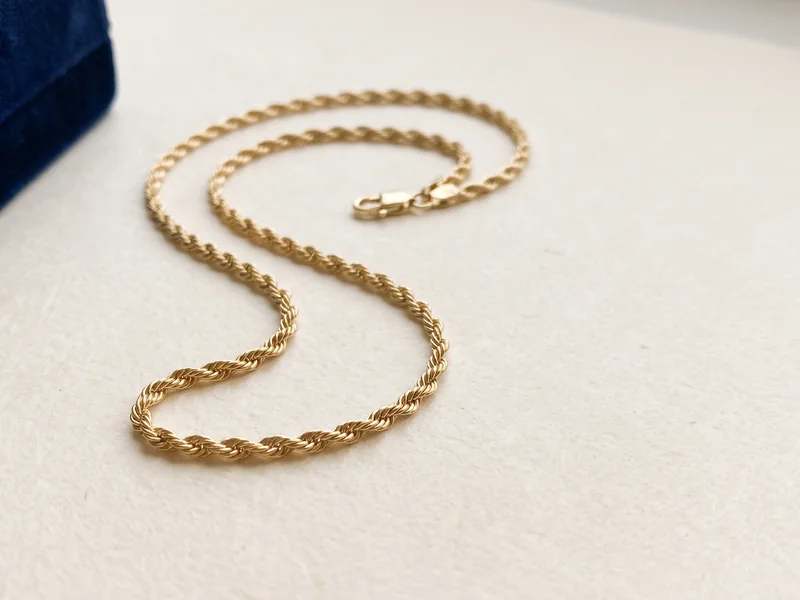 Jewellery TypesTypes of Necklace ChainsCare, Repairs & RemodellingJewellery Care and Maintenance
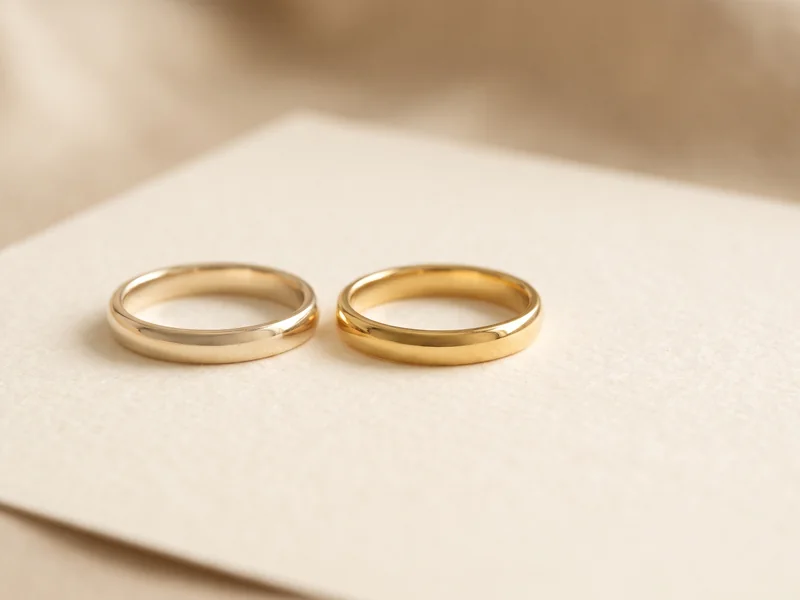 MetalsGold Plated vs Gold Filled vs Solid Gold
 Care, Repairs & RemodellingHow to Store Jewellery
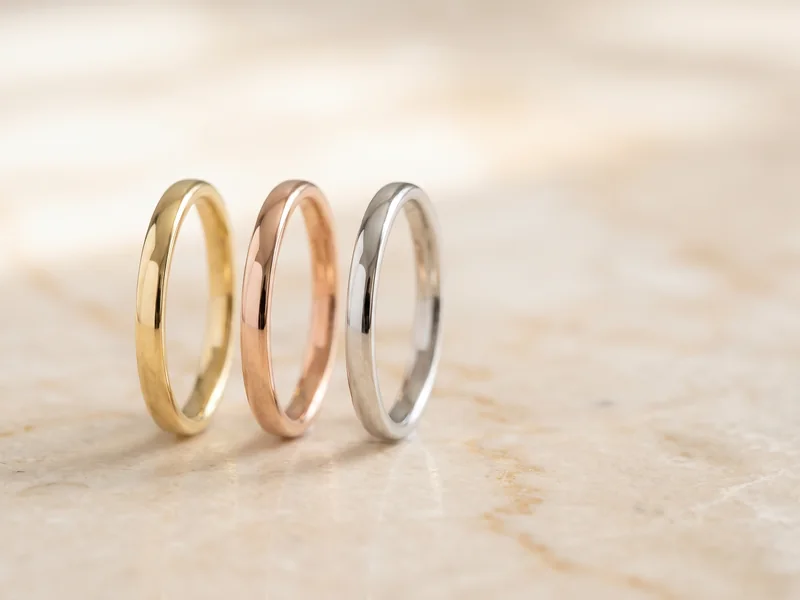 Metals14K Gold Explained
 Metals22K and 24K Gold JewelleryMetals9K vs 18K Gold: Which Gold Is Better for Jewellery?
 MetalsAustralian Hallmarks and Metal Stamps
Explore more
More guides on this topic
Education