
- Education
- Care, Repairs & Remodelling
- Gemstone and Diamond Repair Melbourne
Stone repairs in Melbourne
Gemstone and Diamond Repair Melbourne
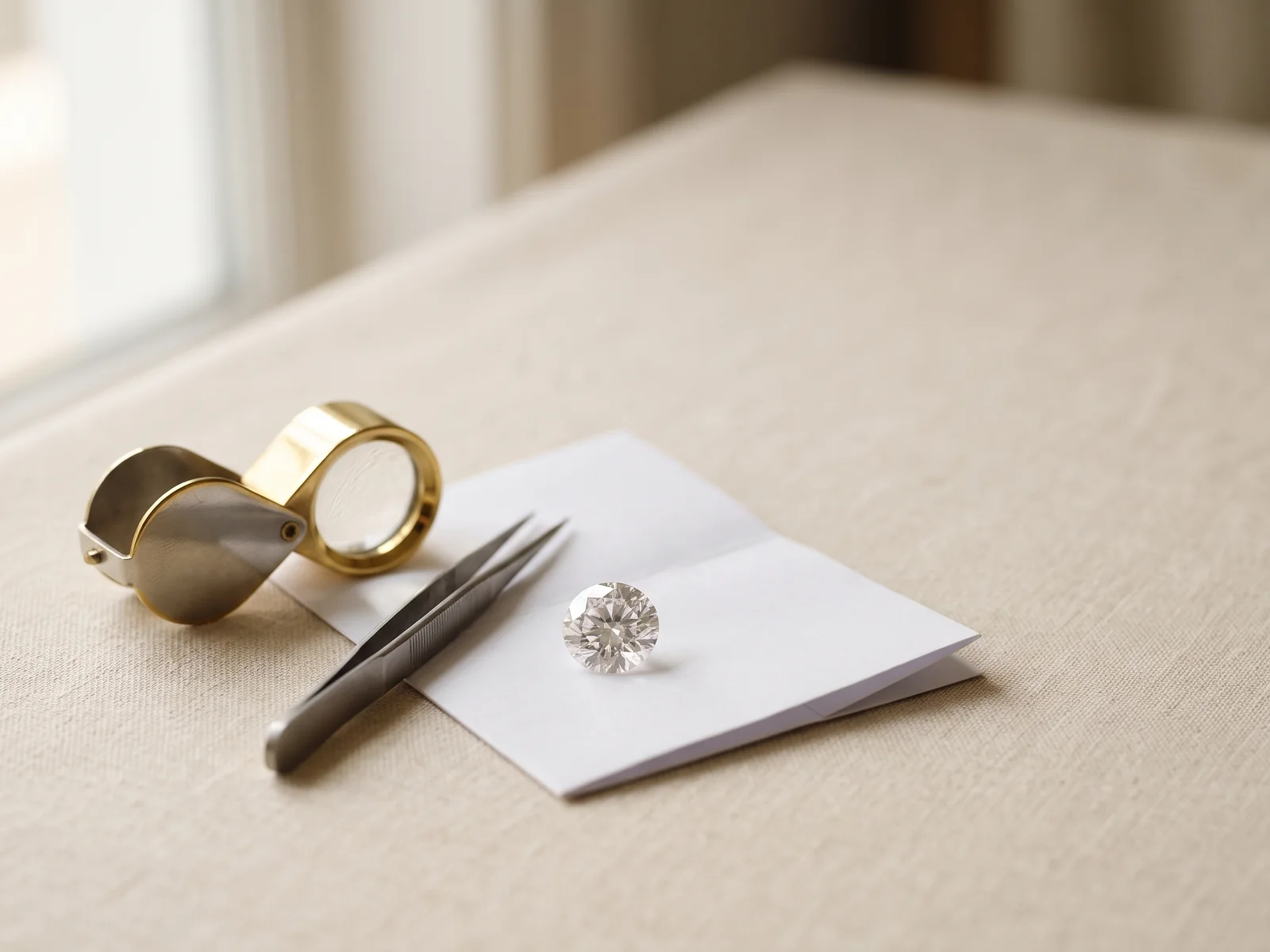
A chipped edge, a scratched table or a worn facet doesn't always mean a stone is ruined. We inspect it under magnification, explain whether repolishing or recutting will genuinely help, and tell you what it will change before any work begins.
 Reviewed by Raj Sood, Graduate Gemologist (GIA), AJP (GIA)Founder and Graduate Gemologist (GIA) · reviewed 17 November 2026
Quick answer
GemTrove assesses chipped, scratched and worn diamonds and gemstones at our Melbourne CBD showroom, Unit 903/125 Swanston St, Melbourne VIC 3000. Depending on the damage, a stone may be repolished, refaced, refaceted or recut. We inspect it first and explain the expected weight loss, risks and cost before recommending repair, replacement or resetting. Allow up to 5 weeks; many jobs are finished sooner, some in a day or two.
Can a damaged gemstone or diamond be repaired?
Often, yes. Some chipped diamonds and damaged gemstones can be improved by repolishing, refacing, refaceting or recutting. Every stone needs inspecting first, because the right repair depends on the stone type, any treatment, its durability, its value, the risk of removing it from its setting, and how much weight it will lose.
A small surface scratch may only need repolishing. A deeper chip near the girdle, culet, a corner or a facet junction may need refaceting or a fuller recut. Sometimes the honest answer is that a repair won't improve the stone enough to be worth it, and resetting the stone to hide the damage is the better choice.
Repolish, reface, refacet or recut: what's the difference?
- Repolishing: lightly polishing the existing facets to improve the surface. Best for minor scratches, dull facets and small abrasions.
- Refacing: restoring one damaged face or area, such as a scratched table or a worn pavilion facet.
- Refaceting: recutting several facets to remove deeper damage while keeping the stone's shape.
- Recutting: reshaping more of the stone to remove serious chips or to improve poor proportions. This removes the most weight.
Cutting quality affects how a stone looks, so a recut is also a chance to improve a badly cut stone. See diamond cut grades, polish and symmetry and proportions beyond the cut grade.
What kinds of damage can be repaired?
- Chipped girdle: the thin outer edge, often chipped by knocks. See why worn claws expose edges.
- Chipped corner or point: common on princess, pear, marquise and heart shapes.
- Scratched or abraded table: the large top facet, often scuffed on softer gemstones.
- Worn facet junctions: rounded edges where facets meet, common on older and softer stones.
- Broken culet: damage to the point at the bottom of the stone.
Softer gemstones wear faster and are repolished more often. See the gemstone hardness guide and gemstone durability for everyday rings.
Damage usually comes from everyday knocks: a ring hitting a bench, a doorframe or a gym bar. Stones sitting high in their settings, and pointed shapes with exposed tips, are the most likely to chip. If a stone has chipped once, a lower or more protective setting can stop it happening again after the repair.
Which stones and which cuts can be repaired?
We need to see the stone before we decide what can be done. As a rule, diamonds, sapphires and rubies can be repaired; emeralds sometimes; aquamarine, tanzanite, amethyst and opal most of the time. What is possible depends on how hard the stone is, how it has been treated and how deep the damage goes.
| Stone | Can it be repaired? |
|---|---|
| Diamond, natural or lab-grown | Yes. A chipped girdle, corner or culet recut; a scratched facet repolished; an old cut left as it is or recut for more life |
| Sapphire and ruby | Yes. Worn facet edges and a scratched table repolished; chips recut |
| Emerald | Sometimes. Light repolishing with great care; the stone's oil or resin may need renewing afterwards |
| Aquamarine, morganite and other beryl | Most of the time. Scratches and worn facets repolished; chips recut |
| Tanzanite, tourmaline, garnet, spinel and topaz | Most of the time. Worn facets repolished; chips recut, with care for heat and cleavage |
| Amethyst, citrine and other quartz | Most of the time. Scratched and dulled surfaces repolished; chips recut |
| Opal | Most of the time. A dull or scratched surface repolished; a crazed or cracked opal cannot be mended |
| Jade, lapis, onyx, turquoise and other cabochons | The dome repolished; a chipped edge reshaped |
| Pearl | Cannot be recut or repolished; a damaged pearl is replaced or re-pegged |
| Moissanite and synthetic stones | Treated like the stone they copy; often replaced instead of recut |
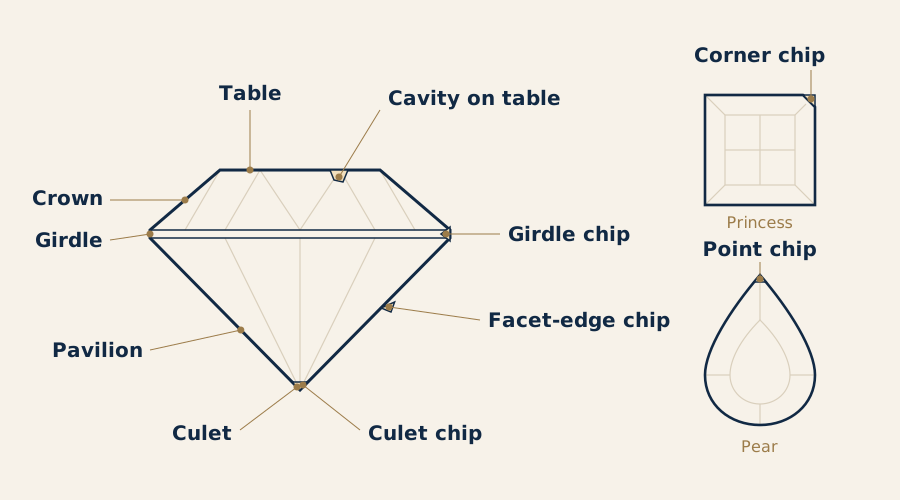
Shape matters too. Pointed shapes chip at their points: the tip of a pear or a marquise, the cleft and point of a heart, the four corners of a princess cut. Step cuts such as emerald and Asscher show a scratched table more than a brilliant cut does. See protecting the point of a pear diamond, princess cut corner protection and gemstone care by stone.
Not sure the stone can be saved?
Bring it in and our gemologist will examine it under magnification and tell you what repair would cost the stone in weight and shape.
The full list of stone repairs
- Repolishing a scratched or abraded stone, on one facet or the whole stone.
- Recutting a chipped diamond to remove the chip, keeping as much weight as possible.
- Recutting to a new shape, for example a badly chipped round into a smaller round, or a damaged corner into a cut-corner shape.
- Recutting an old cut for more brightness, or leaving it as it is where its character matters more.
- Re-doming a cabochon that has worn flat or dull.
- Repolishing an opal that has lost its surface.
- Re-oiling an emerald where the stone's treatment has dried out, through a specialist, and always disclosed.
- Hiding a small chip under a claw or a bezel, where recutting would cost too much weight.
- Replacing a stone that is past repair with one matched by size, colour and cut.
- Unsetting and resetting the stone, before the work and again afterwards, with the setting checked.
- A new laboratory report for a diamond whose weight and measurements have changed.
- Laser inscription re-applied to a recut diamond's girdle. See personalised diamond engraving.
Cutting is carried out by specialist diamond and gemstone cutters; you deal with GemTrove throughout, and a gemologist checks the stone before it goes and when it comes back.
Will repairing a stone change its weight and look?
Usually, yes. Recutting or refaceting removes material, so the stone gets lighter and its measurements and proportions change, sometimes its look too. A diamond that drops below a round number, such as just under 1 carat, can change in value; see carat weight explained.
A graded diamond may need a new laboratory report after recutting, because its weight, measurements and possibly its grades will no longer match the original. Any laser inscription on the girdle may also be removed. See what a laser inscription proves and how to read a GIA report.
How much does gemstone or diamond repair cost?
There is no set price for repairing a stone, because every damaged stone is a different problem. You get a quote after the stone has been examined under magnification, and nothing is done until you agree. These are the things that move the price:
- What the stone is. Diamond is cut with different tools and skills from sapphire, emerald or opal. See the gemstone hardness guide.
- How deep the damage goes. A surface scratch is repolished. A chip may mean reshaping part of the stone.
- Repolish or recut. Touching up a few facets is a small job; recutting the whole stone is a large one.
- The size of the stone. Larger stones take longer and carry more at stake.
- Unsetting and resetting. Most stones come out of the setting for the work, and the setting may need adjusting afterwards.
- A new report. A recut diamond no longer matches its old grading report. See how to read a GIA diamond report.
We also tell you what the repair will cost the stone: how much weight it is likely to lose and how its shape will change. Sometimes a new setting that hides the damage is the better spend.
How long does a gemstone or diamond repair take?
Allow up to 5 weeks. Many jobs are finished much sooner, and some simple ones take a day or two. The time depends on the work itself, the metal, and whether a stone or a part has to be sourced.
We confirm the time for your stone with the quote, before any work begins. If you need it back for a date, tell us when you book and we will tell you honestly whether it can be done.
Recutting takes longer than repolishing, and a stone that needs a new laboratory report after cutting takes longer again.
What do GemTrove customers say?
These are Google reviews from GemTrove customers, quoted word for word.
5.0 on Google
★★★★★
“… We wanted to pick out our preferred stone with GIA certification and then the setting (custom made). … Raj acted with efficient communications to ensure for the transaction to move forward. …”
Whiz
Google review · GIA-certified diamond and custom setting
★★★★★
“… His deep knowledge of diamonds and the do's and don'ts of ring design was invaluable. … The craftsmanship and attention to detail are outstanding, and the rings turned out even more beautiful than we imagined. …”
Tanveer D.
Google review · engagement and wedding rings
★★★★★
“Raj is very friendly and knowledgeable on all things diamonds. I went to him to make an engagement ring for me after seeing all his positive reviews. He helped me design the perfect ring. He listened to everything I was looking for and gave me great advice along the way.”
The Adsta
Google review · engagement ring
★★★★★
“… His prompt communication and willingness to help made what could have been a stressful situation completely hassle-free. The craftsmanship, attention to detail, and level of care provided by Neeraj and the Gemtrove team exceeded my expectations. …”
Seno R.
Google review · engagement ring
★★★★★
“… Trusts isn't something that can be written in a few words, it is something to be earned. Buying something with not only high monetary value but of sentimental value depends on a lot of trusts. …”
Whiz
Google review · anniversary ring upgrade
Read all GemTrove reviews on Google
Why do treatments matter before a stone is repaired?
Many gemstones are treated, and some treatments don't survive heat, polishing or cleaning. Fracture-filled and glass-filled stones can be damaged by the heat of a repair; oiled emeralds can lose their filler. So we check for treatments before any work. See glass filling and fracture filling, emerald clarity enhancement, clarity-enhanced diamonds and heated vs unheated gemstones.
Opals, pearls and other delicate gems need particular care, or may not be suitable for cutting at all. See opal care and gemstone care by stone.
Does the stone have to come out of its setting?
For recutting and most refaceting, yes. Removing and resetting a stone carries its own small risk, especially for fragile stones, so it is part of the assessment. A tiny chip that sits where a claw or bezel can cover it may be better hidden than cut away. See bezel vs claw settings and loose stones and stone tightening.
How is a stone assessed for repair?
- Identify the stone, and check for any treatment.
- Map the damage under magnification: where it is, how deep it goes, and whether it is a chip, a scratch or a fracture.
- Check the setting, and whether the stone must come out.
- Estimate the result: the expected weight loss, the new measurements and how the stone will look.
- Compare the options: repair, reset, replace or upgrade, with the cost of each.
- Confirm with you before any work begins.
Which stones are hardest to repair?
Soft and fragile gemstones need the most care. Opal, pearl, turquoise and many treated stones can't take much heat or pressure. Emeralds are often fissured and filled, so cutting can open hidden fractures. Some stones split easily along one direction, which makes recutting risky. Diamond, sapphire and ruby are hard and usually repolish well, though a diamond can still split if a chip runs along its grain. Our gemstone properties guide explains hardness, toughness and stability.
Repair, replace or reset?
- Repair when the damage is small and the stone will clearly look better afterwards.
- Reset when a new setting can protect or hide the damaged area.
- Replace when the repair would cost too much weight, or the stone is inexpensive and easily matched.
- Upgrade when you would rather choose a new, larger or better stone. See upgrading your diamond.
If you are reusing stones in a new design, see what can be reused safely and scanning stones for CAD remodelling.
Do you need to know what the stone is first?
Yes. A stone has to be identified before it is repaired, because diamond, sapphire, glass and lab-created stones are all handled differently. Old pieces sometimes contain simulants or lab-created gems their owners didn't know about. See natural, synthetic and simulant gemstones and gemstone properties.
Should a repaired stone be revalued?
If it is insured, yes. A recut changes the stone's weight and description, so the old valuation no longer matches it. See valuations for insurance or our valuation service.
What can stone repair not do?
- Put weight back. Repolishing and recutting remove material. The stone is always a little smaller afterwards.
- Close a fracture. A crack running through a stone cannot be polished out, and cutting near it can extend it.
- Keep the old paperwork valid. A recut diamond has new measurements and needs a new report. Please check the lab report before you commit to any work on a graded stone.
- Be done safely on every treated stone. Filled, coated and some heated stones react badly to cutting or heat. See gemstone treatments A to Z.
- Guarantee the stone still fits its setting. A stone that is smaller or a different shape may need its setting adjusted or remade.
Where the risk to the stone outweighs the gain, we tell you, and explain the other options: a protective setting, a replacement, or leaving it as it is. See lost stone replacement and setting your own stone.
Where can you get a gemstone or diamond repaired in Melbourne?
Start at our showroom on Swanston Street. GemTrove has been in business since 2008, and our family has been in the jewellery trade since 1984. Every stone is different, so we quote once we have seen it. For a price, ask us for a quote. Allow up to 5 weeks; many jobs are ready sooner, and some take a day or two.
- Showroom: Unit 903/125 Swanston St, Melbourne VIC 3000 (Level 9), by appointment.
- Hours: Monday to Friday 9:30 am to 5:30 pm, Saturday 11:30 am to 1:00 pm, Sunday closed.
- Phone: 0488 878 000.
- Book: book a stone assessment, and bring any report for the stone.
Free consultation
Talk to a gemologist
Compare stones in person or online with Raj Sood, Graduate Gemologist (GIA), AJP (GIA).
Book a consultationFAQ
Common questions
Can a chipped diamond be fixed?
Often. A small chip can be polished out or refaceted, and a larger one may need a recut. The stone loses some weight, and we tell you how much before any work begins.
How long does a gemstone or diamond repair take?
Allow up to 5 weeks. Many jobs are finished much sooner, and some simple ones take a day or two. We confirm the time with your quote, before any work begins.
How much does gemstone recutting cost?
It depends on the stone, how deep the damage is and how much has to be recut. GemTrove quotes after examining the stone under magnification.
Will my diamond need a new certificate after recutting?
Usually, if it has a laboratory report. Recutting changes the weight and measurements, and sometimes the grades, so the old report no longer matches.
Can scratched gemstones be polished?
Yes, in most cases. Light scratches on the table and facets can be repolished, which removes very little material.
Is it safe to recut a treated gemstone?
Not always. Filled and some treated stones can be damaged by heat or polishing, so we check for treatments first and tell you the risks.
Can you match a replacement gemstone?
Often, yes. If a stone can't be repaired, we can look for a replacement that matches its size, shape and colour.
Can a chipped sapphire be repaired?
Often, yes. Sapphire is hard and tough, so chips and worn facets usually repolish or refacet well, with some weight loss. We check for heat or other treatments first.
Why did my diamond chip if diamond is so hard?
Hardness resists scratching, not knocks. A sharp blow on a thin edge or point, or along the diamond's grain, can chip it. Protective settings reduce the risk.
Can a scratched sapphire, emerald or opal be repolished?
Often, yes. Sapphires repolish well. Emeralds and opals can be repolished with great care, and we tell you the risk for your stone before any work begins.
Terms in this guide
Ask a gemologist
Not sure whether to repair, restore or remake?
Raj Sood is a Graduate Gemologist (GIA) who works alongside our master jewellers. Bring the piece in and he will tell you honestly what it needs, what it does not, and what we would advise against.
Keep learning
Related guides
 GemstonesGlass Filling and Fracture Filling Explained
 GemstonesGemstone Hardness Guide
 Care, Repairs & RemodellingUpgrading Your DiamondCare, Repairs & RemodellingLoose Stones and Stone Tightening
 GemstonesAustralian Opal Engagement Rings: Wearability and Care
 Engagement Rings & SettingsBezel vs Claw Settings for Everyday Wear
 Engagement Rings & SettingsBring Your Own Diamond or Gemstone Setting
 Diamond 4Cs & GradingClarity-Enhanced Diamonds: Laser Drilling and Fracture Filling
Explore more
More guides on this topic
Education