
- Education
- Fancy Colour Diamonds
- Blue Diamonds: What Causes the Colour, How They Are Graded and What They Cost
Fancy Colour Diamonds
Blue Diamonds: What Causes the Colour, How They Are Graded and What They Cost
Blue diamonds are among the rarest gems on earth, and the same blue can be natural, laboratory-grown or treated. Here is how the colour forms, how it is graded and how to read the report before you choose.
 Reviewed by Raj Sood, Graduate Gemologist (GIA), AJP (GIA)Founder and Graduate Gemologist (GIA) · reviewed 16 November 2026
Quick answer
Blue diamonds get their colour from trace boron (type IIb) or, in rarer cases, hydrogen or radiation. GIA grades them from Faint to Fancy Vivid and Fancy Deep. Natural blues are among the rarest diamonds, often costing hundreds of thousands of dollars per carat; lab-grown and treated blues look similar and cost far less, but must be disclosed.
What are blue diamonds?
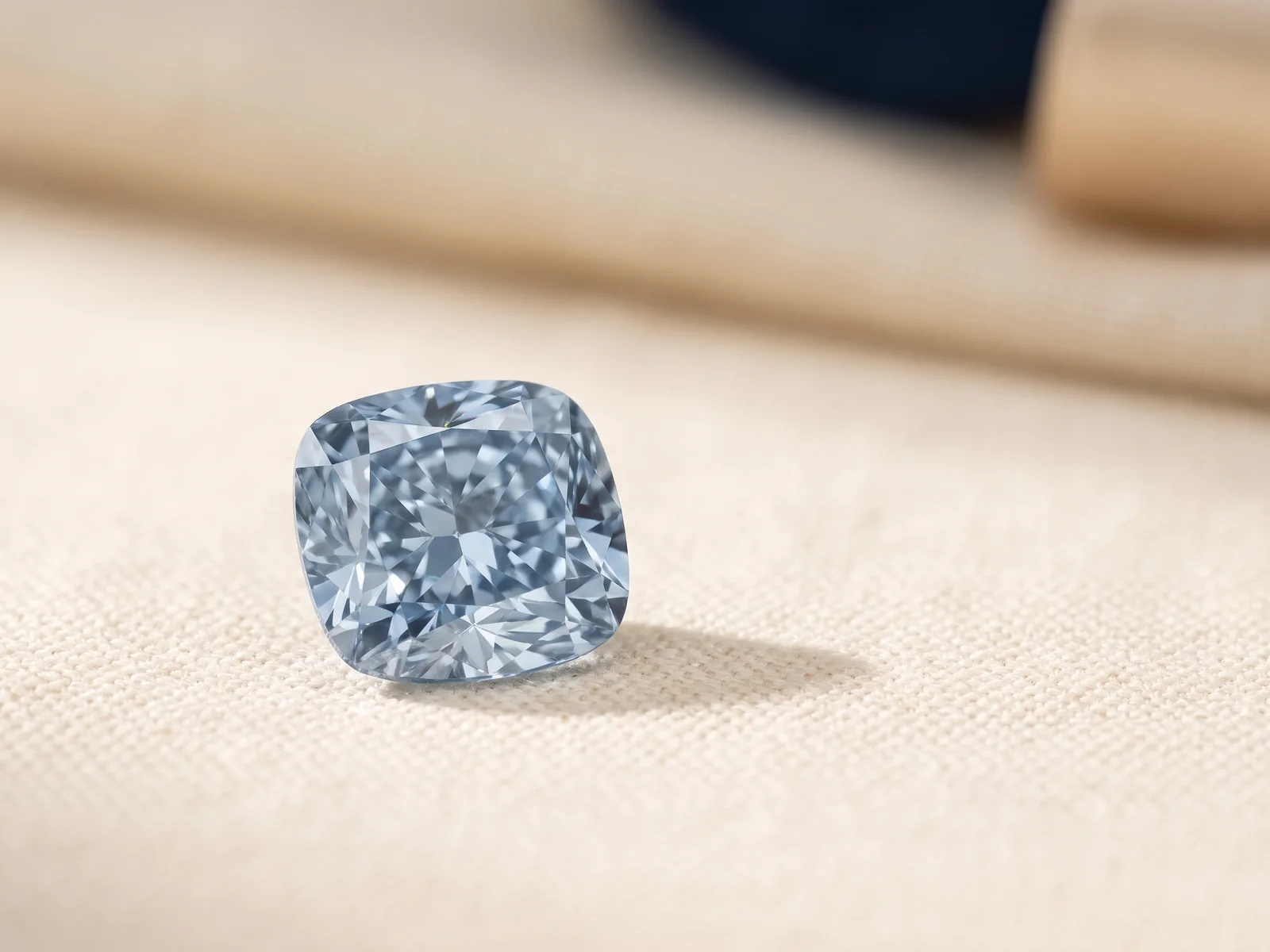
Blue diamonds are diamonds with a visible blue body colour, from a faint icy tint to a deep, saturated blue. They sit in the fancy colour category, meaning their colour is strong enough to be graded on a separate scale rather than the D-to-Z scale used for white diamonds. Our overview of how fancy colour diamonds are graded and priced explains that system across every hue.
Chemically, a blue diamond is the same as any other: pure carbon, 10 on the Mohs hardness scale, with a refractive index (how strongly it bends light) of about 2.42. What changes the colour is a tiny amount of another element, or a defect in the crystal, that absorbs part of the light spectrum. In most natural blues that element is boron, present at no more than a few parts per million, often less than one.
Blue is not the same as a blue nuance. Some near-colourless diamonds show a faint steely or bluish cast without ever reaching fancy colour; our guide to faint blue and grey nuance in near-colourless stones covers those. If any term on this page is new to you, the definitions in our jewellery glossary will help.
What causes blue colour in diamonds?
Gemmologists sort diamonds into types based on the impurities in the crystal. Nearly all natural diamonds contain nitrogen (type I). A very small group contains almost no nitrogen (type II), and within that group, the ones carrying boron are called type IIb. Boron absorbs red, orange and yellow light, so the light that reaches your eye looks blue.
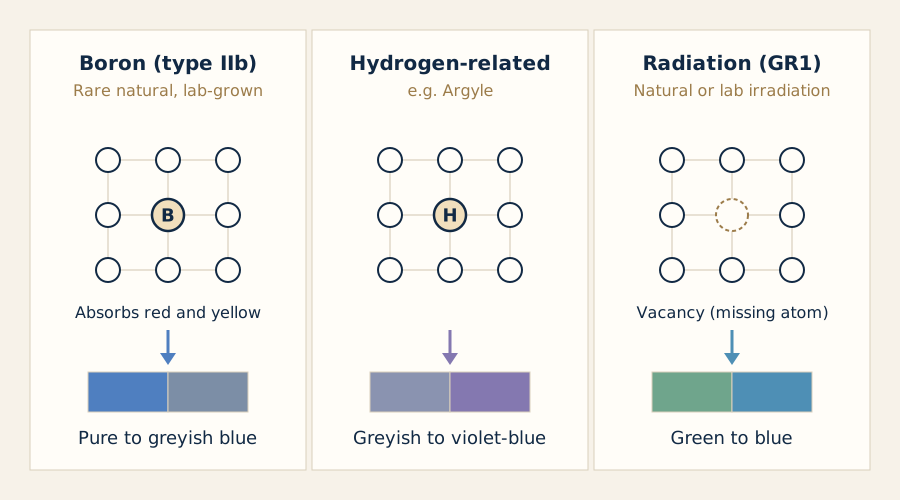
| Cause | Diamond type | Typical look | Where you find it |
|---|---|---|---|
| Boron | Type IIb | Pure blue to greyish blue | Natural (rare), lab-grown |
| Hydrogen-related defects | Usually type Ia | Greyish blue to violet-blue | Natural only; Argyle is the best-known source |
| Natural radiation (GR1 centre) | Any | Green to blue-green, rarely pure blue | Natural, very rare |
| Laboratory irradiation | Any | Blue to green-blue, often bright | Treated natural or lab-grown |
Type IIb diamonds have a curious side effect: boron lets them conduct electricity, which almost no other diamond does. Many also glow (phosphoresce) after ultraviolet light is switched off; the Hope Diamond, a 45.52 carat natural blue in the Smithsonian, glows red. Conductivity once helped separate natural blue from treated blue, but it no longer proves origin, because boron-doped lab-grown diamonds conduct too.
Blue also sits close to other rare colours. Hydrogen-related diamonds can drift towards violet, covered in our page on violet and purple diamonds, and many blues carry a grey modifier, a link to the grey and salt-and-pepper diamond family.
How are blue diamonds graded for colour?
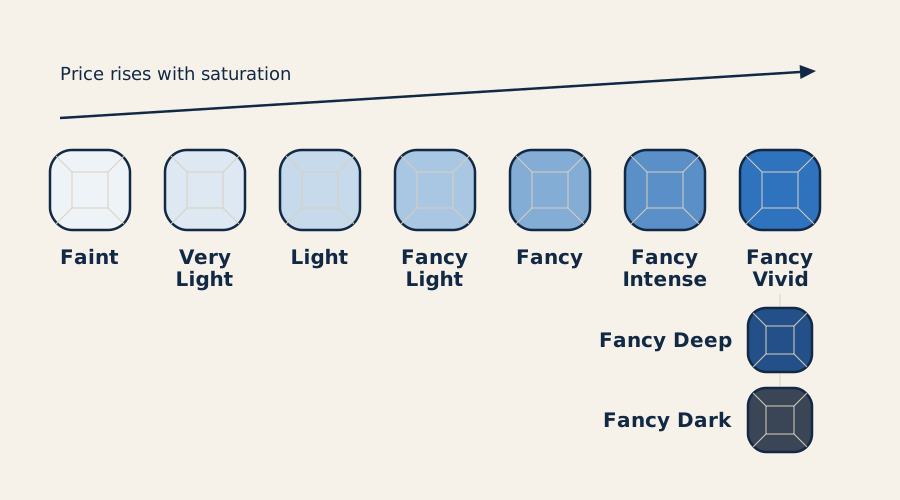
GIA describes a fancy colour by three things: hue (the colour itself, such as blue, greenish blue or violetish blue), tone (how light or dark it is) and saturation (how strong it is). It then combines tone and saturation into an intensity grade. The grade is judged face-up, looking at the overall colour of the stone, not at its brightest flashes.
| GIA intensity grade | How a blue looks | Notes |
|---|---|---|
| Faint, Very Light, Light | A gentle icy tint | Blue shows at low strength, so these grades are used for blues |
| Fancy Light | Clearly pale blue | Often the entry point for natural blue jewellery |
| Fancy | Definite medium blue | A noticeable step up in price |
| Fancy Intense | Strong, clear blue | Highly sought after |
| Fancy Vivid | Very strong, bright blue | The rarest and most valued combination |
| Fancy Deep | Strong and dark | Rich, can look inky in low light |
| Fancy Dark | Dark, often greyish | Less brightness, usually lower price |
Modifiers matter as much as the grade. A "Fancy Intense Blue" usually costs much more than a "Fancy Intense Greyish Blue" or "Greenish Blue", because grey dulls the colour and green moves it away from pure blue. Many natural blues have some grey, which is normal for boron-coloured stones.
Cut shape changes how strong the colour looks. Radiant, cushion and pear cuts hold light inside the stone longer and concentrate colour, which is why most coloured diamonds are cut in these shapes. A round brilliant returns more white sparkle and can look paler. The same pattern applies to yellow and canary diamonds and to orange diamonds.
What were Argyle blue diamonds?
The Argyle mine in the Kimberley region of Western Australia is famous for pink diamonds, and our page on Argyle and other pink diamonds tells that story. Fewer people know Argyle also produced a very small number of blue and violet diamonds. These were not boron blues. Their colour is linked to hydrogen in the crystal, which gives a greyish blue to violet-blue look quite unlike the steely blue of a type IIb stone.
Argyle blues and violets were mostly small, often well under half a carat, and a handful of the finest were offered each year in Argyle's invitation-only tender alongside the pinks. The best-known violet is the Argyle Violet, a 2.83 carat oval graded Fancy Deep Greyish Bluish Violet. Since the mine closed in 2020 there is no new supply, so Argyle blues now only come from existing jewellery and collections.
If you are offered an Argyle blue, ask for the documentation that ties the stone to the mine as well as an independent grading report. A grade with a grey or violet modifier is expected and is part of what makes these stones distinctly Australian.
Not sure which one is right?
Send us the stones you are looking at and our gemologist will tell you which to choose and why.
Natural, lab-grown or treated blue diamond: how can you tell?
A blue diamond can reach you in three ways, and to the naked eye they can look the same. Only lab testing reliably tells them apart, so the grading report is the single most important document.
- Natural blue diamond: mined, with the colour formed in the earth. Historically from India's Golconda region and, today, mainly South Africa's Cullinan mine, with smaller numbers elsewhere.
- Lab-grown blue diamond: real diamond grown in a laboratory by HPHT (high pressure, high temperature) or CVD (chemical vapour deposition), with boron added during growth. Some lab-grown blues are also treated after growth to adjust the colour.
- Treated blue diamond: a natural or lab-grown diamond turned blue after it was formed, usually by irradiation (often followed by gentle heating, called annealing). Surface coatings also exist, but they are thin and can wear or scratch off.
| Natural blue | Lab-grown blue | Treated blue | |
|---|---|---|---|
| Cause of colour | Boron, hydrogen or natural radiation | Boron added during growth, sometimes treated after | Irradiation (and annealing) or coating |
| Report wording | Origin of colour: Natural | Laboratory-grown, with any post-growth treatment noted | Origin of colour: Treated |
| Rarity | Extremely rare | Widely available | Widely available |
| Colour stability | Permanent | Permanent | Irradiation stable in normal wear; coatings are not |
| Price for 1 ct (AUD, approx.) | From six figures upwards | About $1,500–$6,000 | About $2,000–$7,000 |
On a GIA coloured diamond report for a natural stone, look for the line stating the origin of colour. "Natural" means the blue formed in the earth. "Treated" means it was altered, and the report may say how. A lab-grown stone is issued a separate laboratory-grown report, and its girdle (the thin outer edge) is usually laser-inscribed to say so. A natural Fancy Intense Blue and a treated Fancy Intense Blue might look alike, but they sit in entirely different price brackets.
Boron is also why some colourless lab-grown diamonds show a hint of blue; see why HPHT lab-grown diamonds can carry a blue tint. That trace blue is a by-product of growth, not a fancy colour.
Related guideFancy Colour Diamonds GuideHow rare are natural blue diamonds and what do they cost?
Type IIb diamonds make up well under 0.1% of natural diamond production, and only a fraction of those are cut into a strong, clean blue. That is why a natural blue costs many times more per carat than a colourless diamond, and why large Fancy Vivid blues are sold at international auction rather than in shops.
| Blue diamond | Approximate price range (AUD) |
|---|---|
| Natural, 0.10–0.30 ct, Fancy Light to Fancy | about $10,000–$80,000 per stone |
| Natural, around 1 ct, Fancy Intense | about $300,000 to well over $1 million |
| Treated (irradiated), around 1 ct | about $2,000–$7,000 |
| Lab-grown, around 1 ct | about $1,500–$6,000 |
These are broad ranges only. Natural blue pricing depends heavily on the exact hue, any grey or green modifier, intensity and size, and very few comparable sales exist. Within natural blues, moving one intensity grade can change the price more than adding weight. Lab-grown and treated blues follow normal diamond pricing far more closely, and lab-grown prices have been falling.
Other fancy colours sit at very different points: champagne and cognac diamonds are common and modestly priced, and black diamonds are mostly treated and inexpensive, while natural blues sit near the top of the market with pinks and reds.
Shop blue diamonds: natural and lab-grown
What is the best setting and metal for a blue diamond engagement ring?
Metal colour reflects up through a diamond, so it changes how a blue reads. As a general guide:
- Platinum or white gold: keeps the blue cool and clean. The usual choice for most blues, especially paler grades.
- Yellow gold: reflects warmth, which can push a light blue towards green. Use it only on the band, with white-metal claws holding the stone.
- Rose gold: a soft contrast that suits greyish and violet-blue stones, such as Argyle-type blues.
- Halo of white diamonds: frames the colour so it reads more strongly, and makes a small blue look larger.
- Bezel in white metal: a rim of metal that can make colour look a touch deeper and protects the edge.
Diamond is hard but can chip along its cleavage planes, so pointed shapes such as pears need a V-claw on the tip. Small natural blues are often used as accent stones either side of a white centre diamond, or as a single colour detail inside a wedding band, which brings the colour within reach at a lower cost.
What are the alternatives to a blue diamond?
If you want blue for everyday wear without the price of a natural blue diamond, several gemstones offer strong colour with good durability.
| Gem | Mohs hardness | Refractive index | Colour | 1 ct price range (AUD, approx.) |
|---|---|---|---|---|
| Blue diamond (natural) | 10 | about 2.42 | Light to vivid, often greyish | Six figures upwards |
| Blue diamond (lab-grown) | 10 | about 2.42 | Light to deep | about $1,500–$6,000 |
| Blue sapphire | 9 | about 1.76–1.78 | Light to deep, can be vivid | about $500–$10,000+ |
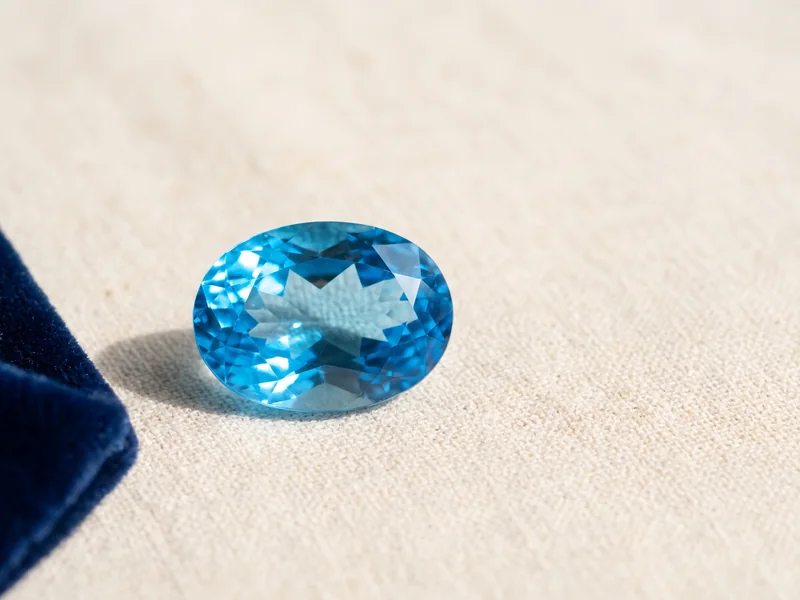
| Blue topaz | 8 | about 1.61–1.63 | Sky, Swiss and London blue | about $20–$200 |
| Aquamarine | 7.5–8 | about 1.57–1.58 | Pale to medium sea blue | about $100–$1,500 |
Sapphire is the closest match for strong blue and toughness; our guide to judging blue sapphire colour and clarity covers what to look for, and teal versus blue sapphire for engagement rings helps if you like a greener blue. For a lighter, lower-cost blue, see blue topaz shades and pricing, our aquamarine and blue topaz comparison, and how blue topaz is treated and cared for. Lab-created sapphire is another option: the same material as natural sapphire, grown in a laboratory.
How do you choose a blue diamond? Step by step
- Decide on origin first. Natural, lab-grown or treated blue each suit a different budget; knowing which you want narrows the search straight away.
- Get an independent report. For natural blues, a GIA coloured diamond report showing the origin of colour; for lab-grown, a laboratory-grown report that notes any post-growth treatment.
- Read the full colour grade. Check the intensity and every modifier: "Greyish", "Greenish" or "Violetish" changes both the look and the price.
- View it in different light. Compare the stone beside a white diamond in daylight and warm indoor light, in person or on video.
- Compare like with like. Price per carat only makes sense between stones of the same origin, hue, modifier and intensity.
- Plan the setting. Choose white-metal claws or a white halo to keep the blue clean, and protect any points or thin edges.
Looking at real stones? Our loose diamonds in Melbourne page shows certified diamonds in stock with today's prices by carat. Compare GIA diamonds in Melbourne as well, then pick a loose diamond to view in our showroom or have delivered by tracked post within Australia. Related pages: engagement rings in Melbourne and custom engagement rings in Melbourne. Raj Sood, Graduate Gemologist (GIA), sees clients by appointment at Unit 903/125 Swanston St, Melbourne VIC 3000.
Free consultation
Talk to a gemologist
Compare stones in person or online with Raj Sood, Graduate Gemologist (GIA), AJP (GIA).
Book a consultationShop this shape
FAQ
Common questions
Are blue diamonds real diamonds?
Yes. Natural, lab-grown and treated blue diamonds are all real diamond, with the same hardness of 10 and refractive index of about 2.42. What differs is the origin of the diamond and of its colour, which the grading report states.
What makes a diamond blue?
Most blue diamonds contain a trace of boron, which absorbs red and yellow light. Rarer natural blues get their colour from hydrogen-related defects or natural radiation, and treated blues are usually irradiated.
How much is a natural blue diamond worth in Australia?
Small natural blues of 0.10–0.30 carat typically cost around $10,000–$80,000 AUD, and a 1 carat Fancy Intense blue can run well into six or seven figures. Prices depend heavily on intensity and modifiers, so treat any figure as a rough guide.
Did the Argyle mine produce blue diamonds?
Yes, in very small numbers. Argyle blues and violets are usually small, greyish to violet-blue and coloured by hydrogen rather than boron, and no new ones are being mined since Argyle closed in 2020.
Is a treated blue diamond a bad choice?
Not if it is disclosed and priced as treated. Irradiated colour is stable in normal wear, though it may change if the stone is exposed to high heat during jewellery repairs, so tell your jeweller before any work.
Can you tell a lab-grown blue diamond from a natural one by eye?
No. Most natural blues and all lab-grown blues are boron-coloured, and they can look identical. Only lab testing separates them, which is why a report and the laser inscription on the girdle matter.
Terms in this guide
Ask a gemologist
Not sure which diamond to choose?
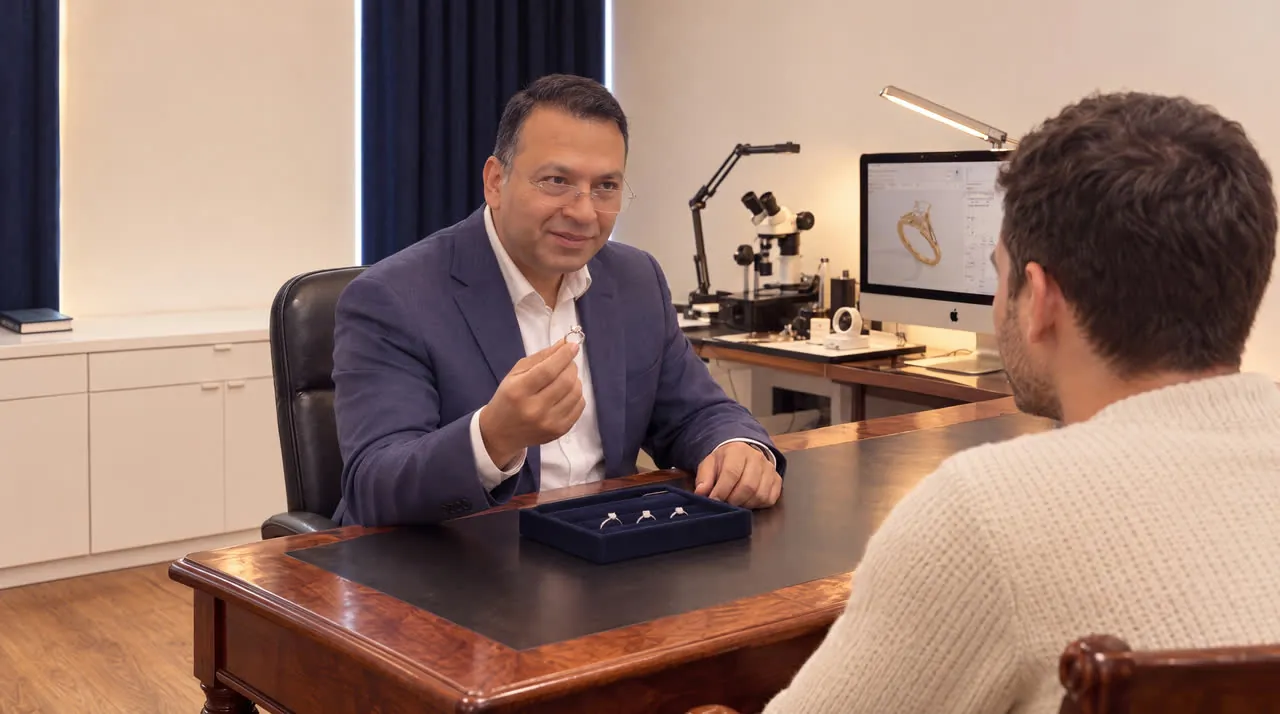
Raj Sood is a Graduate Gemologist (GIA) who works alongside our master jewellers. Bring the stones you are considering, or send the reports, and he will tell you honestly which one is better and why.
Keep learning
Related guides
 Fancy Colour DiamondsPink Diamonds
 GemstonesHow to Judge Blue Sapphire Quality
 Lab-Grown DiamondsBlue Nuance in HPHT Lab-Grown Diamonds
 GemstonesBlue Topaz
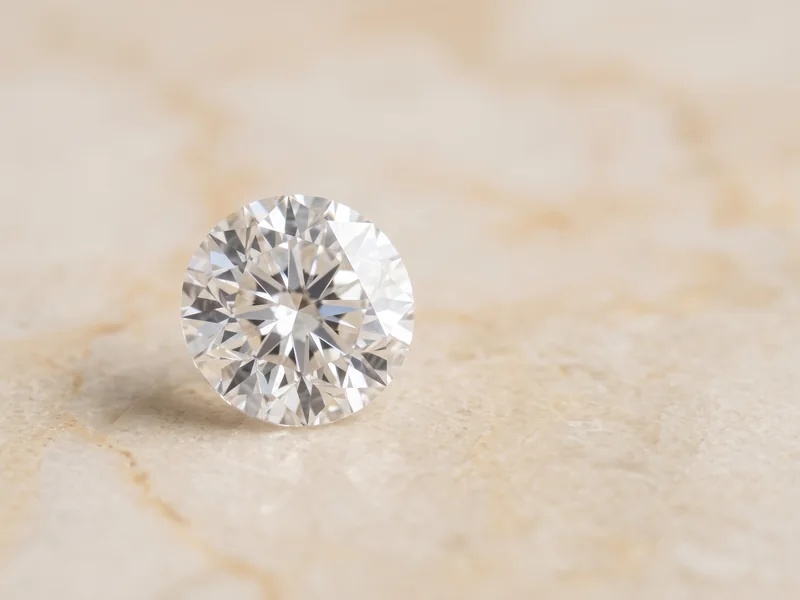 Diamond 4Cs & GradingBrown, Grey and Blue Nuance in Colourless-Looking Diamonds
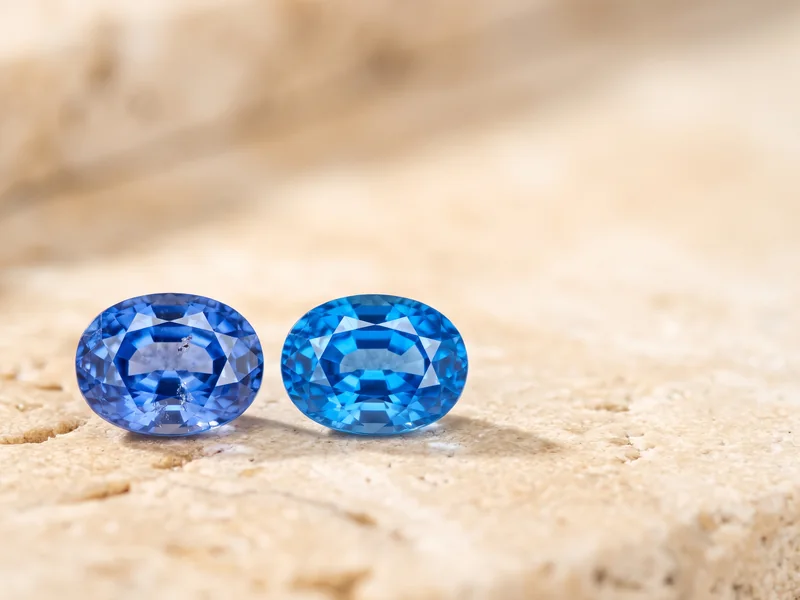 GemstonesAquamarine vs Blue TopazGemstonesBlue Topaz Jewellery: Treatment and Care
Explore more
More guides on this topic
Education