
- Education
- Fancy Colour Diamonds
- Green Diamonds Guide: Colour, Rarity, Treatment and Settings
Fancy Colour Diamonds
Green Diamonds Guide: Colour, Rarity, Treatment and Settings
Green diamonds are among the rarest colours, and the hardest to prove natural. Before you fall for one, it helps to know where the green comes from and what the grading report is really telling you.
 Reviewed by Raj Sood, Graduate Gemologist (GIA), AJP (GIA)Founder and Graduate Gemologist (GIA) · reviewed 16 November 2026
Quick answer
Green diamonds get their colour mainly from natural radiation that displaced carbon atoms over millions of years. They are among the rarest fancy colours, and most natural greens grade Fancy Light to Fancy. Many green diamonds on the market are lab-grown or treated by irradiation, so always check the report's colour-origin line: Natural, Treated or Undetermined.
What are green diamonds?
Green diamonds are fancy colour diamonds: stones whose colour is strong enough, or rare enough, to be graded on a separate colour scale rather than the D-to-Z scale used for white diamonds. Our introduction to all the fancy colour diamonds explains how that scale works across every hue, from yellow to red.
A green diamond is still diamond in every physical sense. It is pure carbon, 10 on the Mohs hardness scale, with a refractive index (how strongly it bends light) of about 2.42. The only difference from a colourless stone is a tiny number of defects in the crystal that absorb part of the light passing through it. In green diamonds, those defects absorb red and some yellow light, so what reaches your eye looks green.
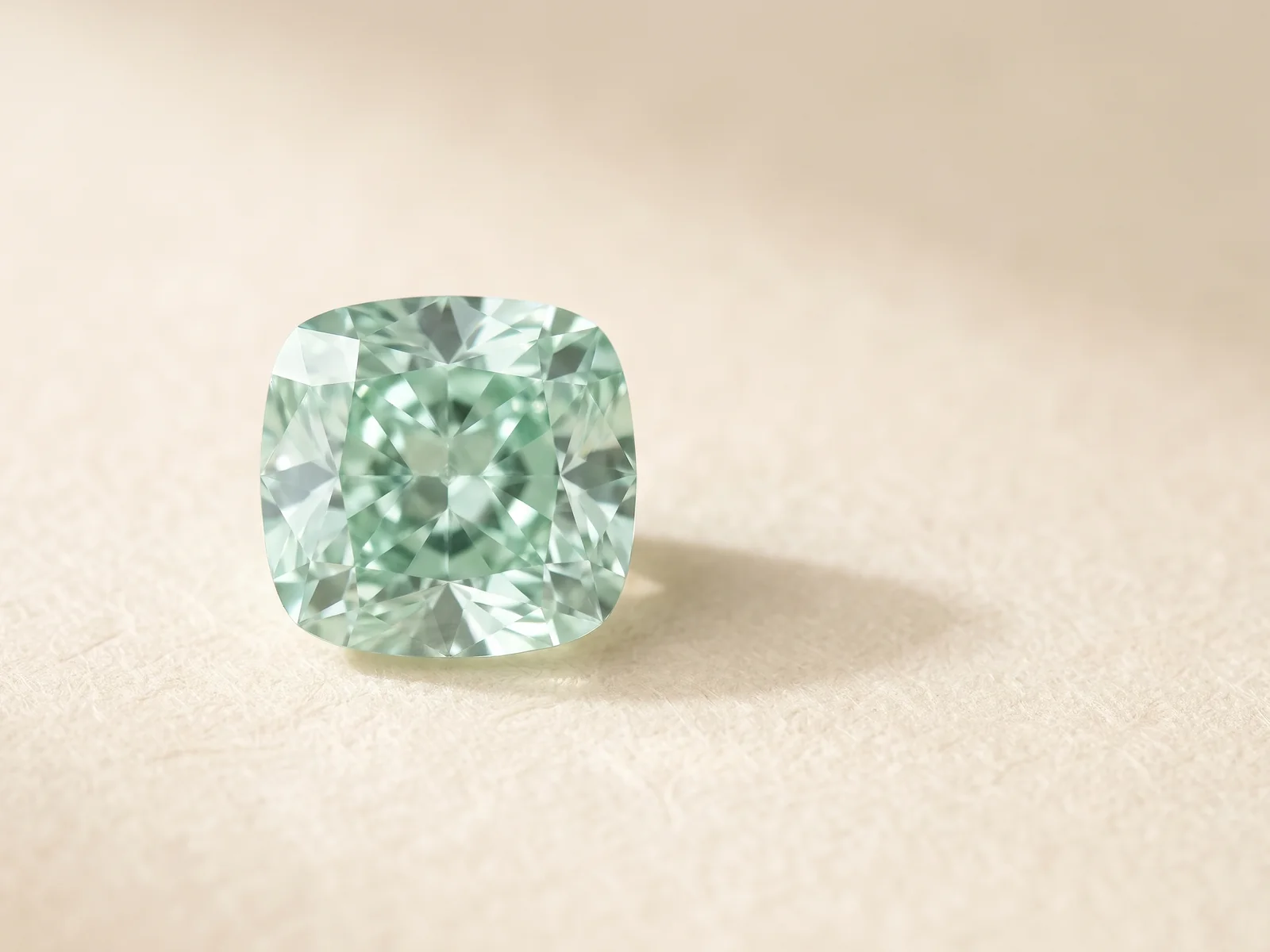
Natural green diamonds rarely look like an emerald. Most are soft, slightly greyish or yellowish greens, sometimes described as mint, olive or sea green. Pure, saturated greens with no secondary tint are exceptionally rare. You will also meet green diamonds that are lab-grown, and natural diamonds that have been treated to turn them green, so the first job is always to work out which of the three you are looking at. Any unfamiliar term on this page is also explained in our plain-English jewellery glossary.
What causes the colour in green diamonds?
Most green colour comes from radiation. Over millions of years, some diamonds sat close to rocks or groundwater carrying naturally radioactive elements such as uranium and thorium. Alpha, beta or gamma radiation knocked carbon atoms out of place, leaving gaps called vacancies. A neutral vacancy is known to gemmologists as the GR1 centre, and it absorbs red light, which leaves the stone looking green or bluish green.
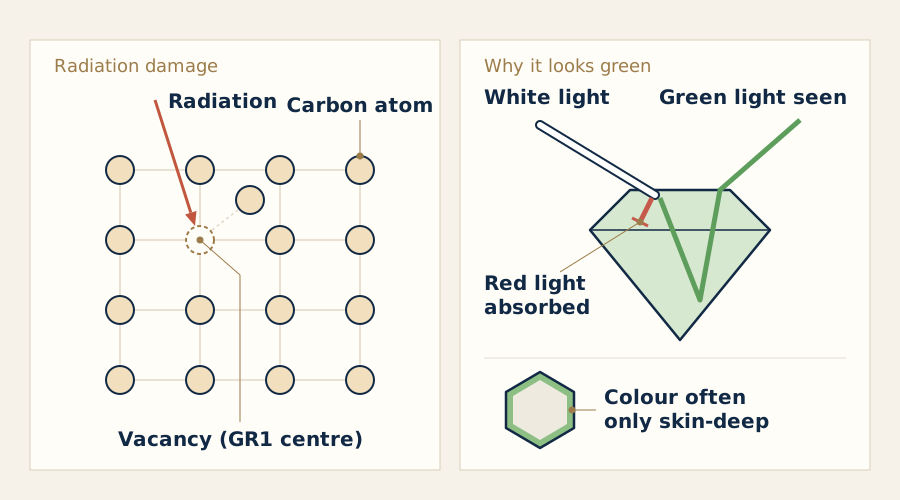
Radiation from alpha particles only travels a tiny distance into the stone, so in many rough diamonds the green is just a thin skin, sometimes with small green or brown radiation stains on the surface. When the stone is cut, much of that skin is polished away and the green can disappear. This is one reason a strongly green polished natural diamond is so rare. Cutters often leave a small patch of original skin, called a natural, on the girdle (the thin outer edge) as evidence of where the colour began.
A few other causes produce green too:
- Hydrogen and nickel: some greyish or yellowish green diamonds owe their colour to hydrogen- or nickel-related defects rather than radiation.
- Green transmitters: certain yellow diamonds have strong green fluorescence (a glow under ultraviolet light, including daylight) that makes them look greenish. Our guide to yellow and canary diamonds covers nitrogen, the cause of the yellow base.
- Chameleon diamonds: olive or greyish green stones that temporarily turn yellow when gently heated or kept in the dark, then return to green. The cause is still studied, but hydrogen and nitrogen defects are involved.
It is worth comparing green with blue, its neighbour on the colour wheel. Most natural blue diamonds get their colour from boron, a trace element, while green usually comes from radiation damage. Some bluish green diamonds owe their colour to radiation rather than boron, which is why the exact hue name on the report matters.
How are green diamonds graded for colour?
GIA grades fancy colour diamonds face-up (looking down through the top, the way you see them in a ring) on three things: hue (the colour itself), tone (how light or dark it is) and saturation (how strong it is). These are combined into an intensity grade:
| GIA intensity grade | What a green diamond looks like |
|---|---|
| Faint, Very Light, Light | A barely noticeable green tint; graded on GIA's coloured diamond scale, but without the word Fancy |
| Fancy Light | A soft, pale mint or sea green |
| Fancy | Clearly green, still gentle |
| Fancy Intense | Strong, obvious green |
| Fancy Vivid | Saturated, bright green; extremely rare in natural greens |
| Fancy Deep | Rich green with darker tone |
| Fancy Dark | Dark green, often with grey or brown |
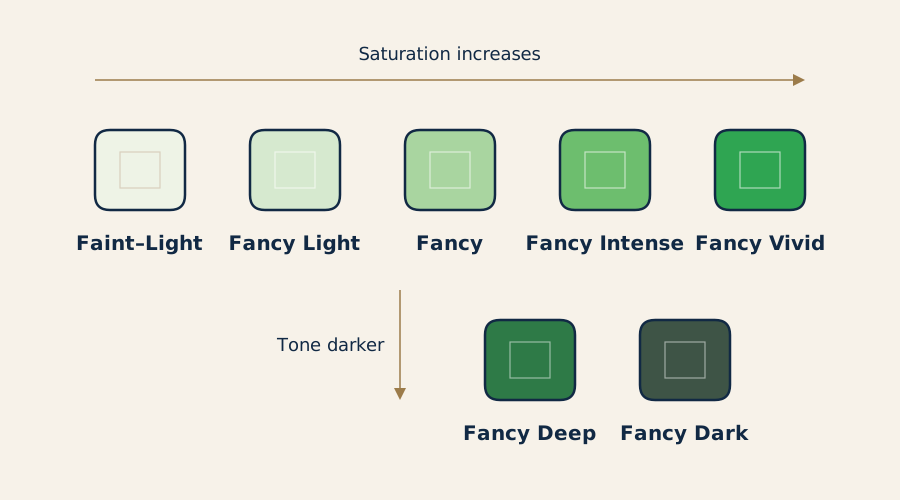
The report also names the hue precisely, often with modifiers such as yellowish green, bluish green or greyish green. The last word is the main colour; the words before it describe secondary tints. A "Fancy Light Greyish Yellowish Green" is mostly green, with yellow and a grey softening. Grey modifiers usually lower the price, and our page on grey and salt-and-pepper diamonds shows how grey changes the look of a stone.
Most natural green diamonds sit at Fancy Light or Fancy, with grey or yellow modifiers. Pure Fancy Intense and Fancy Vivid greens appear only a handful of times a year at international auctions.
How can you tell if a green diamond is natural, treated or lab-grown?
This is the most important question for green, because laboratories can create exactly the same GR1 defect that nature does. Diamonds can be irradiated with electrons or neutrons in a reactor or accelerator, sometimes followed by annealing (controlled heating), to produce green, blue-green or yellow-green. HPHT treatment (high pressure, high temperature) can also push some stones towards yellowish green. Our guide to how HPHT and irradiation change diamond colour explains each process.
| Natural green | Treated natural green | Lab-grown green | |
|---|---|---|---|
| Origin of diamond | Mined | Mined | Grown in a laboratory (CVD or HPHT) |
| Origin of colour | Natural radiation or trace elements | Artificial irradiation, HPHT or coating | Usually created after growth, often by irradiation |
| Typical colour | Soft, often greyish or yellowish | Often brighter, more even | Can be strong and even |
| Report wording | Colour origin: Natural | Colour origin: Treated (method may be stated) | Clearly states laboratory-grown |
| Rarity | Extremely rare | Common | Widely available |
| Relative price | Very high | Moderate | Lowest |
GIA reports on coloured diamonds include a colour origin line with one of three results. Here is what each means in practice:
- Natural: GIA found enough evidence, such as natural radiation stains on a girdle natural or a defect pattern it can confirm, that the colour formed in the earth.
- Treated: GIA detected that the colour was created or changed by people; the comments may mention irradiation or HPHT.
- Undetermined: current testing cannot say for sure. This result is more common for green than almost any other colour, because natural and artificial radiation leave such similar traces.
If a report says Undetermined, it does not mean the stone is treated; it means nobody can prove either way. These stones generally sell for far less than confirmed natural greens. Treatment also explains another colour: many treated black diamonds are heavily irradiated stones whose green is so dark it reads as black.
Lab-grown green diamonds are real diamond, grown from carbon in a laboratory rather than mined, with the same hardness and sparkle. Their reports must say laboratory-grown, and labs such as IGI and GIA laser-inscribe that on the girdle. They are a sensible way to get a strong, even green at a fraction of a natural green's price.
Not sure which one is right?
Send us the stones you are looking at and our gemologist will tell you which to choose and why.
How rare are natural green diamonds, and where do they come from?
Natural green diamonds with a confirmed natural colour origin are among the rarest of all fancy colours, alongside true red diamonds and saturated purples. Most greens of any strength sell through specialist dealers and auction houses rather than ordinary retail.
The best-known example is the Dresden Green, a natural green of about 41 carats held in Dresden, Germany, for centuries. Its even, apple-green colour came from natural radiation, and gemmologists still use it as a reference for what a natural green can look like. More recently, the 5.03 carat Aurora Green, graded Fancy Vivid Green, sold at auction in Hong Kong in 2016 for a record price for a green diamond.
Australia has its own place in the coloured diamond story. The Argyle mine in the Kimberley region of Western Australia produced most of its output as brown diamonds, which became the champagne and cognac diamonds marketed from Argyle, and it was the world's main source of natural pink diamonds until it closed in 2020. Argyle also produced rare blue and violet stones. Green was never an Argyle speciality, though: natural greens have historically come in tiny numbers from mines in Brazil and parts of Africa, wherever diamonds sat near radioactive minerals.
For a sense of where green sits among the rarest colours, compare it with natural purple and violet diamonds and the warmer pure orange diamonds, both of which are also seen only rarely in strong grades.
Related guideFancy Coloured Diamond Engagement RingsGreen diamond vs green sapphire, emerald and peridot: which suits you?
If you want a green ring for everyday wear, a green diamond is one of several options. They differ a lot in hardness, sparkle and price:
| Green diamond | Green sapphire | Emerald | Peridot | |
|---|---|---|---|---|
| Mohs hardness | 10 | 9 | 7.5–8 | 6.5–7 |
| Refractive index | about 2.42 | about 1.76–1.77 | about 1.57–1.58 | about 1.65–1.69 |
| Typical look | Soft to strong green, high sparkle | Teal to leaf green | Rich, deep green, often with inclusions | Bright yellowish green |
| Everyday wear | Excellent | Excellent | Needs care; can chip | Needs care; can scratch |
| Price per carat | Natural: very high; lab-grown: modest | Moderate | Low to very high | Low |
For a durable green on a budget, a green sapphire's teal-to-leaf colours are durable and far easier to find than a natural green diamond. Peridot's bright lime colour comes from iron, not radiation, which is explained in our look at why peridot's green is different. A green diamond offers more sparkle and the hardest, most scratch-resistant surface of any of these.
What are the best settings and metals for green diamonds?
The metal around a green diamond changes how its colour reads, because light bounces off the metal and back into the stone:
- Yellow gold: warms the stone; flattering for yellowish green and olive greens, but can make a bluish green look duller.
- White gold or platinum: keeps cool, bluish and mint greens crisp and fresh.
- Rose gold: a softer contrast that suits pale, Fancy Light greens.
- Mixed metals: a white band with yellow gold claws under the stone can lift a pale green without warming the whole ring.
Many jewellers frame pale natural greens with a halo of small white diamonds, which makes the centre's colour look stronger by contrast. Bezel settings (a thin rim of metal around the edge) protect the girdle and suit everyday rings. Cuts with lots of facets, such as radiant and cushion cuts, tend to concentrate colour, which is why so many fancy colours are cut that way. Our guide to choosing metals and settings for coloured diamonds goes through more combinations, and the page on designing a fancy coloured engagement ring covers ring styles.
How much do green diamonds cost in Australia?
Green diamond prices span an enormous range, more than almost any other colour, because the same green can be natural, treated or lab-grown. As a rough guide for a 1 carat stone:
| 1 ct green diamond | Approximate price range (AUD) |
|---|---|
| Lab-grown (colour usually created after growth) | about $800–$4,000 |
| Natural diamond, treated green (irradiated) | about $2,000–$8,000 |
| Natural, colour origin Undetermined | varies widely; usually well below confirmed natural |
| Natural colour, Fancy Light to Fancy | about $40,000–$200,000 or more |
| Natural colour, Fancy Intense to Vivid | often hundreds of thousands to over $1 million |
These are broad ranges only, and natural greens in particular are priced stone by stone. Within each group, the price moves most with intensity, the purity of the hue (fewer grey or brown modifiers), carat weight and the colour-origin result. Clarity matters less than in white diamonds, because colour carries most of the value.
Shop green diamonds: natural and lab-grown
How do you choose a green diamond? Step by step
- Decide on natural, treated or lab-grown. This sets your budget more than any other choice.
- Ask for the full grading report. For coloured stones, a GIA or IGI report should state the colour grade, hue and whether the diamond is natural or laboratory-grown.
- Read the colour-origin line. Natural, Treated or Undetermined; price and compare stones within the same category.
- Check the hue name and modifiers. Decide whether you prefer bluish, pure or yellowish green, and how much grey you will accept.
- View it in different light. Daylight, warm indoor light and on the hand, ideally with a 360° video if buying remotely.
- Choose the metal to suit the hue. White metals for cool greens, yellow or rose gold for warm greens, and a setting that protects the edge.
Looking at real stones? Our loose diamonds in Melbourne page shows certified diamonds in stock with today's prices by carat. Compare GIA diamonds in Melbourne as well, then pick a loose diamond to view in our showroom or have delivered by tracked post within Australia. Related pages: engagement rings in Melbourne and custom engagement rings in Melbourne. Raj Sood, Graduate Gemologist (GIA), sees clients by appointment at Unit 903/125 Swanston St, Melbourne VIC 3000.
Free consultation
Talk to a gemologist
Compare stones in person or online with Raj Sood, Graduate Gemologist (GIA), AJP (GIA).
Book a consultationShop this shape
FAQ
Common questions
Are green diamonds real diamonds?
Yes. Natural, treated and lab-grown green diamonds are all real diamond, with a hardness of 10 and the same sparkle. The difference is where the diamond formed and how the colour was created.
Why are natural green diamonds so rare?
Most natural green comes from radiation that only reaches a thin layer of the rough crystal, so much of the colour is lost when it is cut. Strong, evenly coloured natural greens are therefore exceptionally scarce.
What does 'colour origin undetermined' mean on a green diamond report?
It means the laboratory could not prove whether the green formed naturally or was created by treatment. It is common with green diamonds because natural and artificial radiation leave very similar traces.
Can you get a lab-grown green diamond?
Yes. Lab-grown green diamonds are widely available, usually have their colour created after growth and cost a small fraction of a natural green. The report will clearly state that the diamond is laboratory-grown.
Is a green diamond good for an engagement ring?
Yes. At 10 on the Mohs scale it is the hardest gem for daily wear, and a bezel or claw setting with protected edges suits an everyday green diamond ring.
What is a chameleon diamond?
A chameleon diamond is usually an olive or greyish green stone that temporarily turns yellow when warmed or kept in the dark, then returns to green. It is a natural, rare effect linked to hydrogen and nitrogen defects.
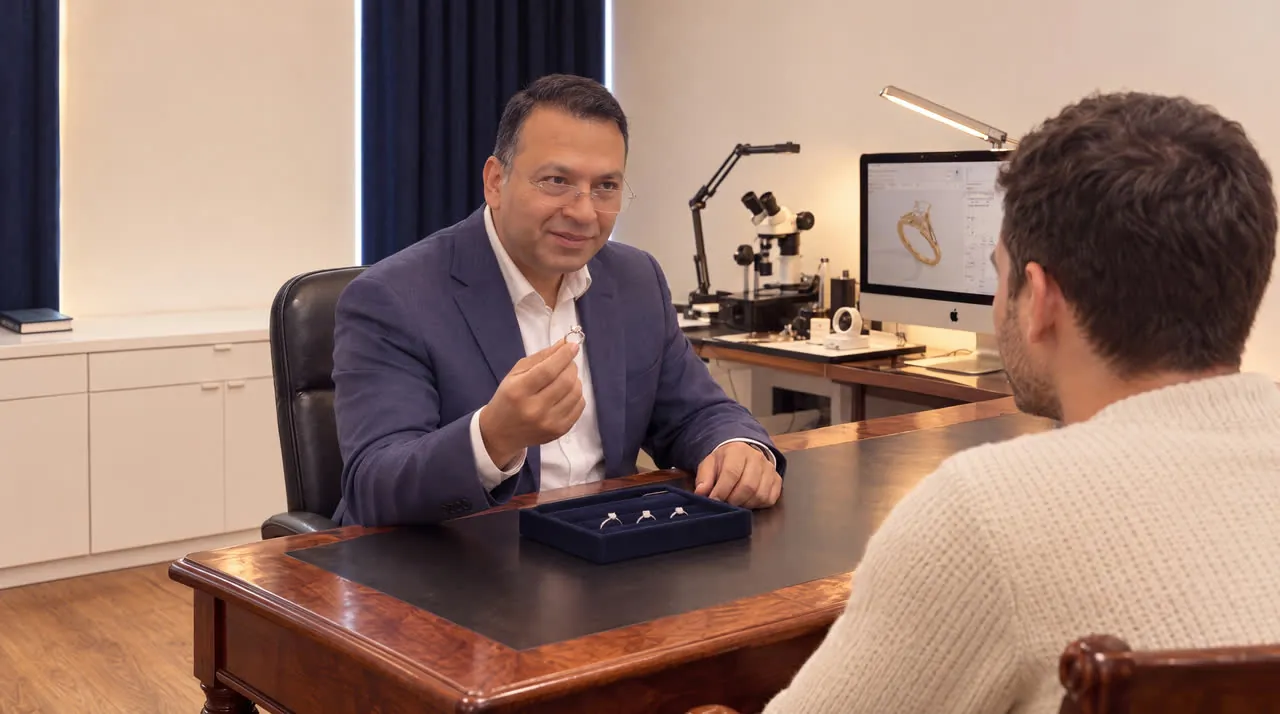
Ask a gemologist
Not sure which diamond to choose?
Raj Sood is a Graduate Gemologist (GIA) who works alongside our master jewellers. Bring the stones you are considering, or send the reports, and he will tell you honestly which one is better and why.
Keep learning
Related guides
 Fancy Colour DiamondsTreated Colour Diamonds (HPHT and Irradiation)
 Fancy Colour DiamondsBest Settings and Metals for Coloured Diamonds
 Fancy Colour DiamondsBlue Diamonds
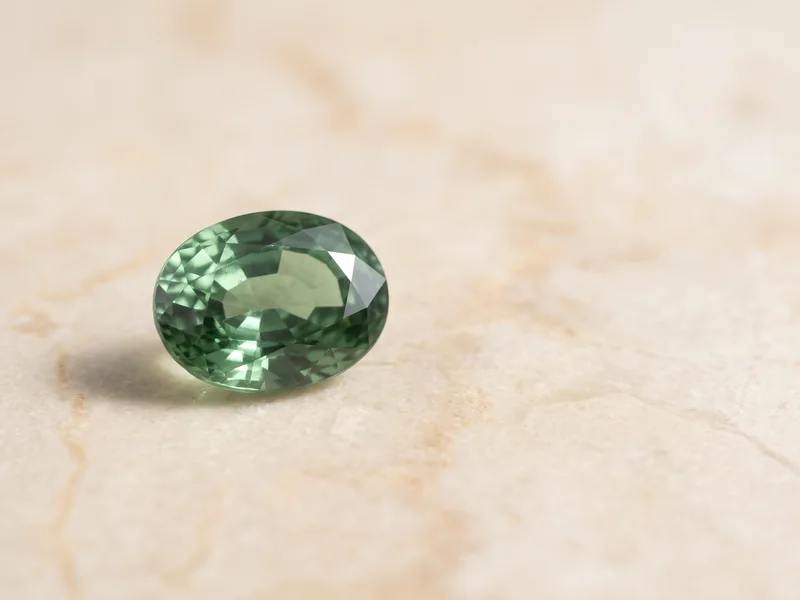 GemstonesGreen Sapphire
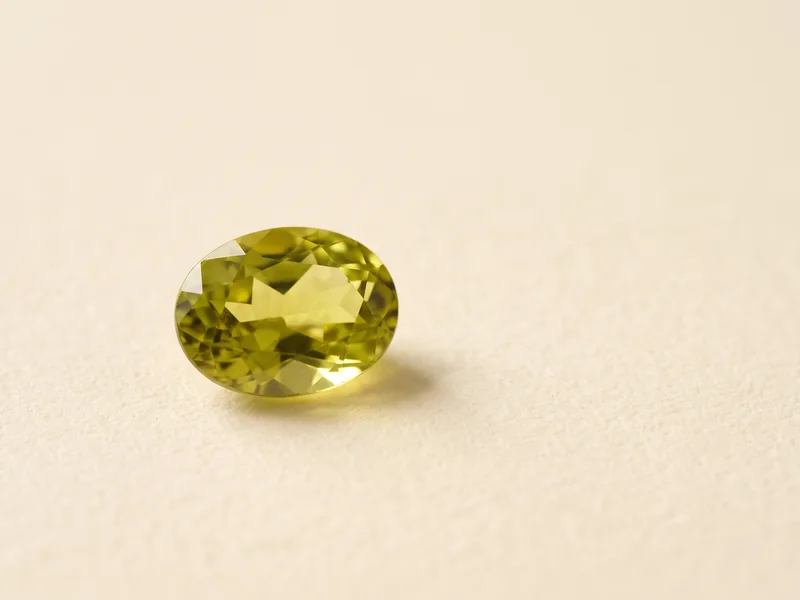 GemstonesPeridot Jewellery: What Makes Its Green Different?
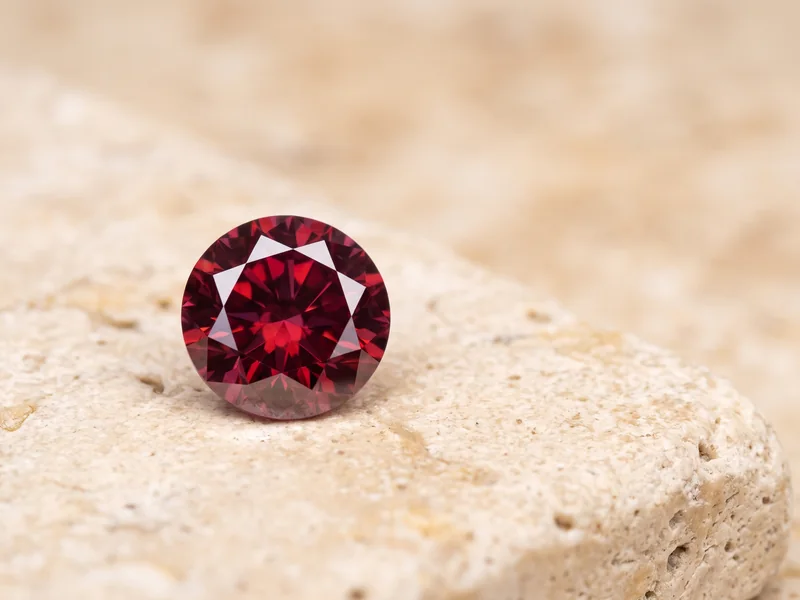 Fancy Colour DiamondsRed Diamonds
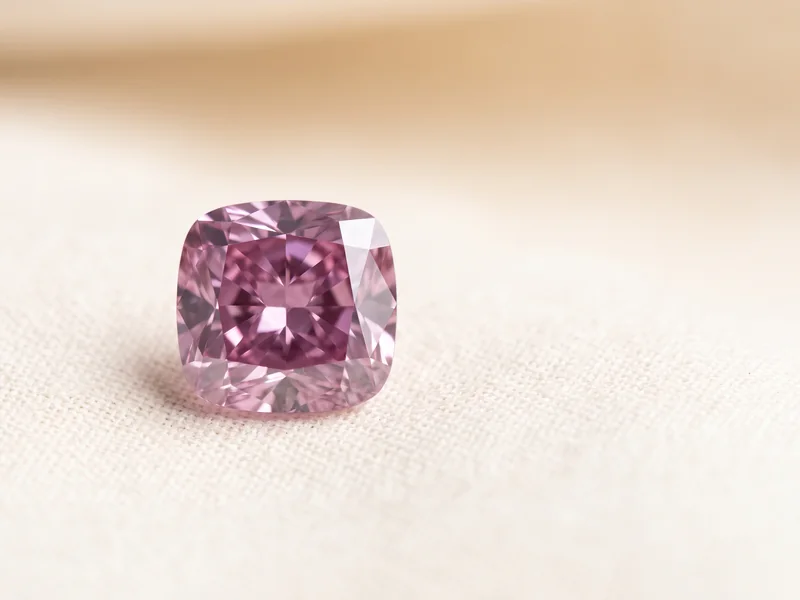 Fancy Colour DiamondsPurple Diamonds
Explore more
More guides on this topic
Education