
Metals
Palladium Rings Guide: Alloys, Colour, Wear, Allergies and Cost
Palladium rings are a naturally white, lightweight alternative to platinum and white gold, but they are much less common in Australian jewellery stores. Here is what the metal is made of, how it wears, who it suits and what to ask before you choose it.
 Reviewed by Raj Sood, Graduate Gemologist (GIA), AJP (GIA)Founder and Graduate Gemologist (GIA) · reviewed 16 November 2026
Quick answer
Palladium rings are made from a naturally white platinum-group metal, usually Pd950 (95% palladium). Palladium is about 40% lighter than platinum, never needs rhodium plating, does not tarnish in normal wear and is nickel-free. It scratches like platinum, suits plain bands and simple settings, and usually costs less than platinum but needs a jeweller experienced with it.
What are palladium rings made of?
Palladium (chemical symbol Pd, atomic number 46) is one of the six platinum group metals, alongside platinum, rhodium, ruthenium, iridium and osmium. It is naturally greyish-white, does not tarnish in normal wear and is far lighter than platinum. Most of the world's palladium is mined in Russia and South Africa, and most of it ends up in car catalytic converters rather than jewellery, which is why its price can move sharply with the car industry.
Pure palladium is too soft for a ring that will be worn every day, so jewellers use an alloy: a blend of palladium with small amounts of harder metals. The alloy is described by its fineness, the number of parts of palladium per thousand. Pd950 means 950 parts in 1,000, or 95% palladium. If any of these terms are new, our plain-English jewellery glossary explains them.
| Alloy | Palladium content | Typical other metals | Where you see it |
|---|---|---|---|
| Pd950 | 95% | Ruthenium, sometimes copper, gallium or indium | Most palladium wedding bands and engagement rings |
| Pd500 | 50% | Mostly silver | Lower-cost jewellery in some overseas markets; softer, and the silver can tarnish |
| Pd999 | 99.9% | None | Bullion bars and coins; too soft for rings |
| Palladium white gold | Usually around 10–15% palladium | Gold plus silver or copper | White gold where palladium replaces nickel as the whitening metal |
That last row trips people up. Some white gold uses palladium as a whitener instead of nickel, but it is still gold, not a palladium ring. Our explainer on 14 carat gold and its alloys covers how the whitening metals change colour and hardness. When people say "a palladium ring" they almost always mean Pd950, and that is what the rest of this guide describes.
What colour is palladium, and does it need rhodium plating?
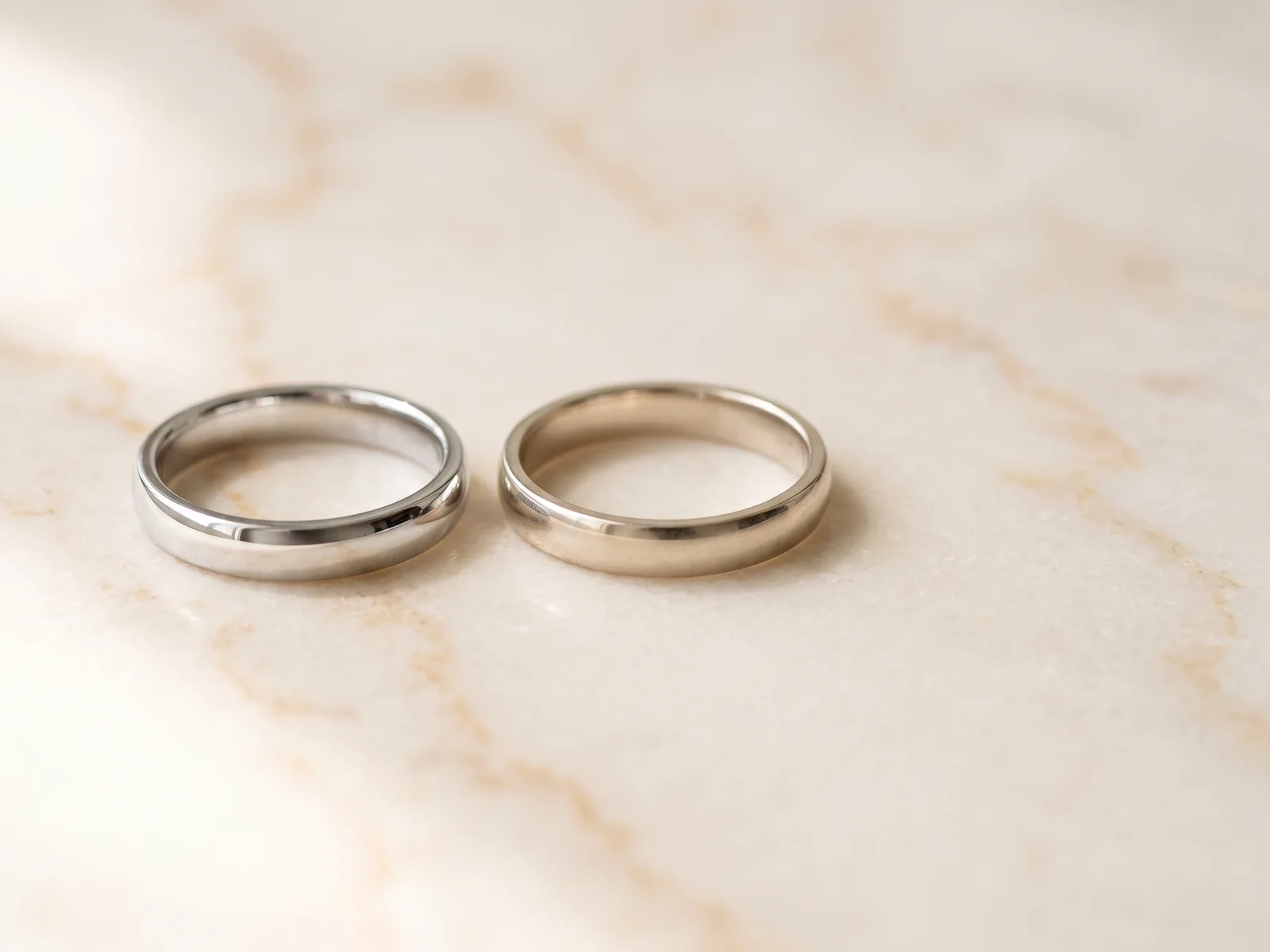
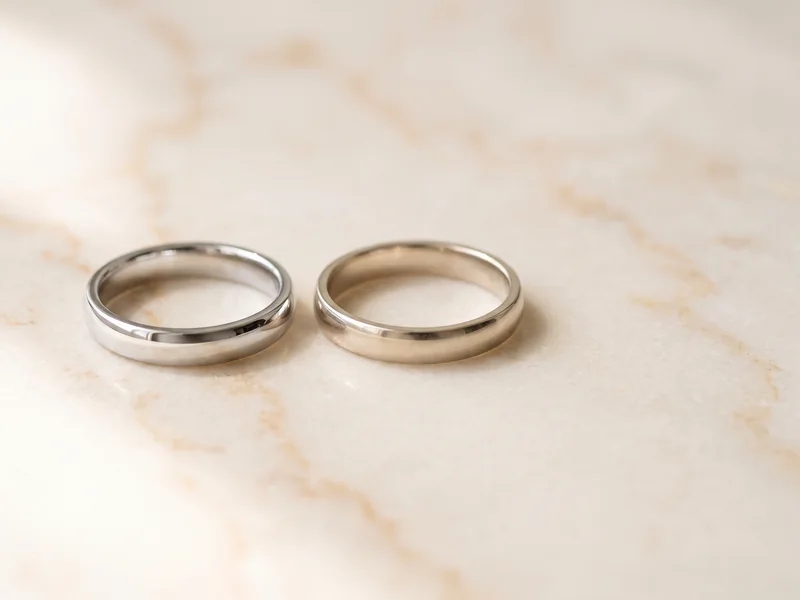
Palladium is white all the way through. Polished Pd950 is a soft grey-white, very close to platinum, though side by side it can look a touch darker and greyer. It is noticeably whiter than unplated white gold, which has a faint yellow or straw tint under its plating.
That means palladium never needs rhodium plating to look white. Rhodium is a hard, bright-white metal electroplated over most white gold, and it wears off on the palm side of a ring within roughly one to three years of daily wear. Our guide to how rhodium plating works and when to replate explains the cycle. With palladium there is nothing to wear through, so a scratch simply shows more palladium. Some people still choose to rhodium plate palladium for an extra-bright finish, but it is optional.
Palladium also does not tarnish at room temperature. That is a real difference from silver, which reacts with sulphur in the air and darkens over months; see our page on why silver tarnishes and how patina forms. The only time palladium discolours is if it is heated strongly, for example under a jeweller's torch, when a bluish oxide film can form. A polish removes it.
Because it stays white without plating, palladium pairs well with yellow or rose gold. A palladium band with a yellow gold inlay, or a yellow gold head on a palladium shank, are both workable designs, and our guide to combining two metals in one ring shows how the joins are made.
How hard is palladium, and does palladium scratch?
Yes, palladium scratches, just as platinum and gold do. On the Mohs scratch scale palladium sits at about 4.75, harder than gold (about 2.5–3) but far below quartz dust (7), which is in ordinary household grit. Jewellers more often measure metal hardness on the Vickers scale (HV), which presses a tiny diamond point into the metal. Annealed (softened) Pd950 is roughly 100–120 HV, similar to many platinum alloys and softer than most white gold.
In daily wear, a polished palladium ring turns to a soft satin look within weeks. Like platinum, much of the metal in a scratch is pushed aside rather than lost, so a ring can be repolished many times. Over decades the band does thin, especially across the palm side, and claws holding a stone wear down.
- Plain bands: palladium suits them well. Choose a reasonable thickness so the band keeps its shape.
- Solitaires: fine with sturdy claws, which should be checked every year or two.
- Pavé and micro-claw settings: workable, but the tiny beads of metal holding each diamond are soft, so these need more checking.
- Heavy daily work: if you garden, lift weights or use tools, expect faster scuffing, as you would with platinum.
Is palladium hypoallergenic?
For most people, yes. Pd950 contains no nickel, the metal behind most jewellery skin reactions, and palladium itself is very stable, so very little dissolves into sweat. That makes palladium rings a common choice for people who react to white gold, which in older or lower-priced alloys can contain nickel.
There are two caveats. First, true palladium allergy does exist. It is uncommon, and patch-test studies show it occurs mostly in people who are already allergic to nickel, because the two metals behave similarly in the skin. Second, check the other 5% of the alloy. Ruthenium and gallium rarely cause problems, but some palladium alloys contain cobalt or copper, which can irritate a small number of people.
- Mild nickel sensitivity: Pd950 is usually comfortable.
- Strong, diagnosed nickel allergy: ask a dermatologist about a palladium patch test before committing.
- Known cobalt or copper sensitivity: ask exactly which alloy will be used.
Our full guide to metal allergies and nickel-free ring options compares every common ring metal for skin reactions. If you react to almost everything, commercially pure titanium rings are another option, though they cannot be resized or hold a diamond in the same way.
Not sure which one is right?
Send us the stones you are looking at and our gemologist will tell you which to choose and why.
How are palladium rings stamped in Australia?
Australia has no government assay office and no compulsory hallmarking system. Instead, the maker or importer stamps the fineness inside the band, and under Australian Consumer Law that stamp must not mislead. For palladium you will usually see one of these:
- PD950 or 950PD: 95% palladium, the usual ring alloy.
- PALL or PALL 950: an older or overseas style of the same mark.
- PD500: 50% palladium, a much lower content.
- A maker's mark: initials or a symbol identifying the workshop that made the ring.
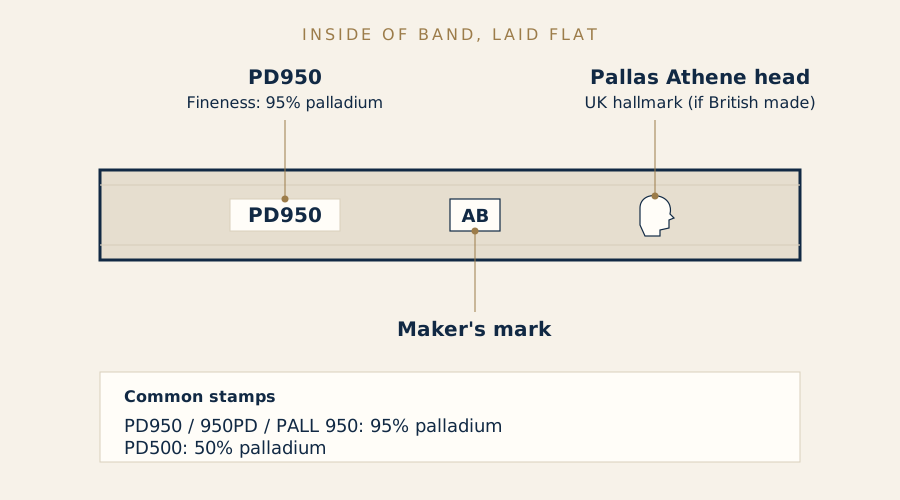
In the United Kingdom, palladium hallmarking has been compulsory since 2010, with a head of the goddess Pallas Athene as the palladium symbol, so a British-made ring may carry that mark. Our page on reading Australian hallmarks and metal stamps shows the common marks for every metal, including how to spot a stamp that does not match the metal.
If a second-hand ring has no stamp, a jeweller can test it with an XRF analyser (a handheld X-ray tool that reads the metal content without damaging it). Palladium and platinum look almost identical, so weight is a quick clue: palladium feels distinctly lighter in the hand.
Palladium vs platinum vs white gold: how do they compare?
Palladium is most often weighed up against platinum and white gold, so here are the numbers side by side.
| Pd950 palladium | Pt950 platinum | 18 ct white gold | 14 ct white gold | Titanium | |
|---|---|---|---|---|---|
| Density (g/cm³) | about 12.0 | about 20–21 | about 14.5–16 | about 12.5–14 | about 4.5 |
| Natural colour | Grey-white | Grey-white | Pale yellow, usually rhodium plated | Pale yellow, usually rhodium plated | Darker grey |
| Needs plating | No | No | Usually | Usually | No |
| Hardness (approx. HV) | 100–120 | 80–140 depending on alloy | 140–220 | 150–230 | about 150–200 |
| Contains nickel | No | No | Sometimes | Sometimes | No |
| Resizable | Yes, with palladium solder | Yes | Yes | Yes | Rarely |
| Melting point | about 1,555 °C | about 1,768 °C | about 900–1,000 °C | about 850–950 °C | about 1,668 °C |
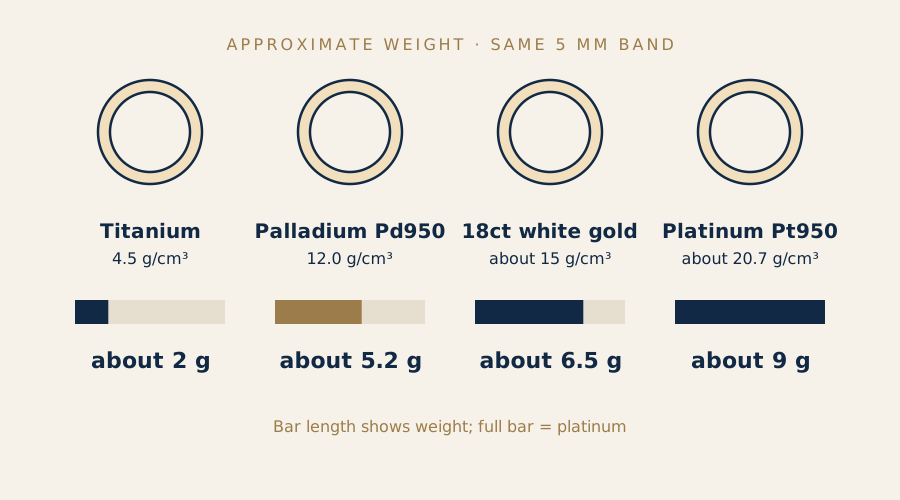
Palladium vs platinum: both are naturally white platinum group metals that wear to a similar satin finish. Platinum is much denser, so it feels heavier and uses more metal per ring, and it is the more established choice for setting diamonds; see our guide to platinum rings and jewellery in Melbourne, and for platinum alloys in detail, the difference between platinum 950 and 900.
Palladium vs white gold: white gold is harder, so it holds a high polish slightly longer, but it needs replating to stay bright white and may contain nickel. Palladium is softer but stays white for life. For an overall view of how each metal suits a centre stone, read our guide to choosing a metal for an engagement ring.
Further afield, tungsten carbide bands are extremely scratch-resistant but brittle and cannot be resized, and our page on cobalt, tantalum and carbon fibre covers the other alternative metals. If you simply want a white metal at a lower price for fashion pieces, sterling silver is softer still and tarnishes, so it is rarely used for wedding rings.
How much do palladium rings cost, and are palladium rings worth it?
Palladium's price per ounce has swung widely. For several years from about late 2017 to 2023 it traded above platinum, and at times above gold, because of car-industry demand. It has since fallen back and in recent years has generally traded near or below platinum. The metal is only part of a ring's price, though; labour, design and finishing often matter more.
Density works in palladium's favour. A ring that needs about 9 g of platinum needs only around 5–5.5 g of palladium, so even at a similar price per gram, a palladium band uses less metal.
| Plain comfort-fit band | Pd950 palladium (approx. AUD) | Pt950 platinum (approx. AUD) | 18 ct white gold (approx. AUD) |
|---|---|---|---|
| 3 mm | about $600–$1,300 | about $900–$2,000 | about $700–$1,600 |
| 5 mm | about $900–$2,000 | about $1,500–$3,200 | about $1,100–$2,500 |
| 7 mm | about $1,300–$2,800 | about $2,200–$4,500 | about $1,600–$3,500 |
These are broad ranges only; they move with metal prices, band profile, finger size and finish. One cost that is easy to miss is workshop experience. Molten palladium absorbs oxygen and hydrogen, which causes porosity (tiny holes) unless it is cast under vacuum or inert gas with induction heating. Fewer workshops cast palladium than gold or platinum, which affects price and availability.
Is it worth it? Palladium makes most sense if you want a white metal that never needs plating, is nickel-free and feels light, especially for a palladium wedding band. If you want maximum heft, the widest choice of settings or the most traditional metal for a diamond, platinum or white gold may suit you better.
Related guideBest Metal for Wedding BandsBrowse ring settings by metal
Can palladium rings be resized, set and repaired?
Yes, but it needs the right tools and solders. Palladium is resized much like platinum: the band is cut, metal added or removed, and the join closed with palladium solder or a laser welder. Laser welding suits palladium well because it heats only a tiny spot, avoiding the discolouration and gas absorption a torch can cause. Most rings can go up or down one or two sizes; bigger changes may need a new section of shank.
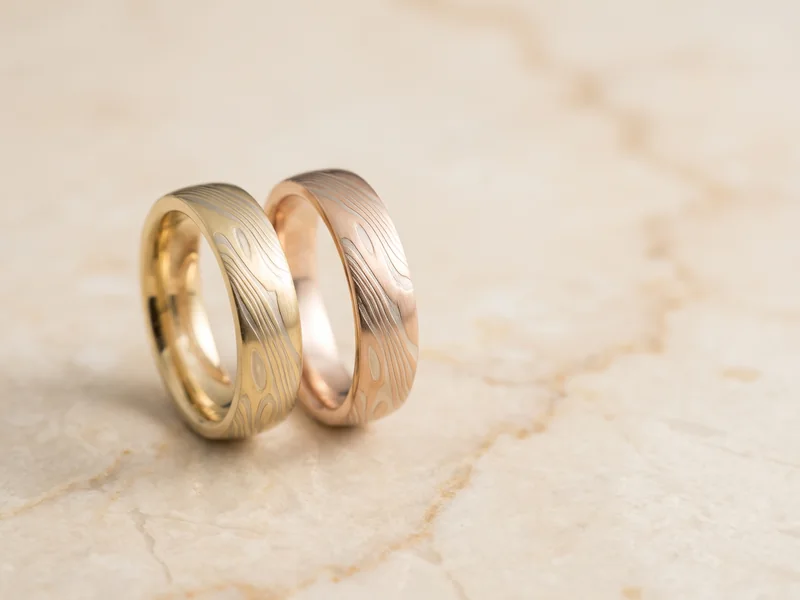
Setting stones in palladium is similar to platinum. Claws are usually made a little thicker than in white gold because the metal is softer, and a re-tip (rebuilding a worn claw) is done with matching palladium. Palladium can also appear in layered designs: some mokume gane rings use palladium or palladium white gold as the white layer between yellow and red gold.
Before any repair, tell the jeweller the ring is palladium. Mistaking it for white gold and using gold solder leaves a visible yellow line at the join, and a torch used at white gold settings can leave the palladium discoloured or porous.
How do you care for a palladium ring? Step by step
- Check the stamp. Confirm it reads PD950 (or 950PD) and note the maker's mark, so any future jeweller knows the metal.
- Clean it gently. Soak in warm water with a drop of mild dishwashing liquid, brush with a soft toothbrush, rinse and dry with a lint-free cloth.
- Take it off for heavy work. Remove it for gym weights, gardening and renovation to slow down scuffing and dents.
- Avoid harsh chemicals. Keep it away from bleach, pool chlorine and strong acids, which can attack solder joins and any stones.
- Store it separately. Keep it in its own pouch or box slot so diamonds and harder metals do not scratch it.
- Have it checked every 12–24 months. A jeweller can inspect claws, measure band thickness and repolish the satin finish back to a mirror shine.
You can also leave the satin finish alone; many people like the softened look it develops, much as with platinum.
Ready to have one made? GemTrove designs and handmakes custom engagement rings in Melbourne in 3 to 5 weeks, from a 3D design you approve first. See how a ring is made around the stone you choose, or start online with our design your own engagement ring page. Related pages: loose diamonds in Melbourne and engagement rings in Melbourne. Raj Sood, Graduate Gemologist (GIA), sees clients by appointment at Unit 903/125 Swanston St, Melbourne VIC 3000.
Free consultation
Talk to a gemologist
Compare stones in person or online with Raj Sood, Graduate Gemologist (GIA), AJP (GIA).
Book a consultationShop this shape
FAQ
Common questions
Are palladium rings good for everyday wear?
Yes. Pd950 is durable enough for daily wear, does not tarnish and never needs rhodium plating. It scratches to a satin finish like platinum, so plan on an occasional repolish.
Is palladium cheaper than platinum?
Usually, at current metal prices, and palladium's lower density means a ring uses less metal by weight. Prices have swapped in the past, though, and labour often makes up much of a ring's cost.
Is palladium hypoallergenic?
For most people, yes, because Pd950 contains no nickel. A small number of people, mostly those already allergic to nickel, react to palladium, so anyone with a strong diagnosed allergy should ask about a patch test.
Can a palladium ring be resized?
Yes, usually by one or two sizes, using palladium solder or a laser welder. Tell the jeweller it is palladium so they do not use gold solder.
What does PD950 mean on a ring?
It means the ring is 950 parts palladium per 1,000, or 95% pure, with the rest usually ruthenium or a similar hardening metal. PD500 means only 50% palladium.
Does palladium turn yellow like white gold?
No. Palladium is white all the way through, so there is no plating to wear off and no yellow tint underneath.
Ask a gemologist
Not sure which diamond to choose?
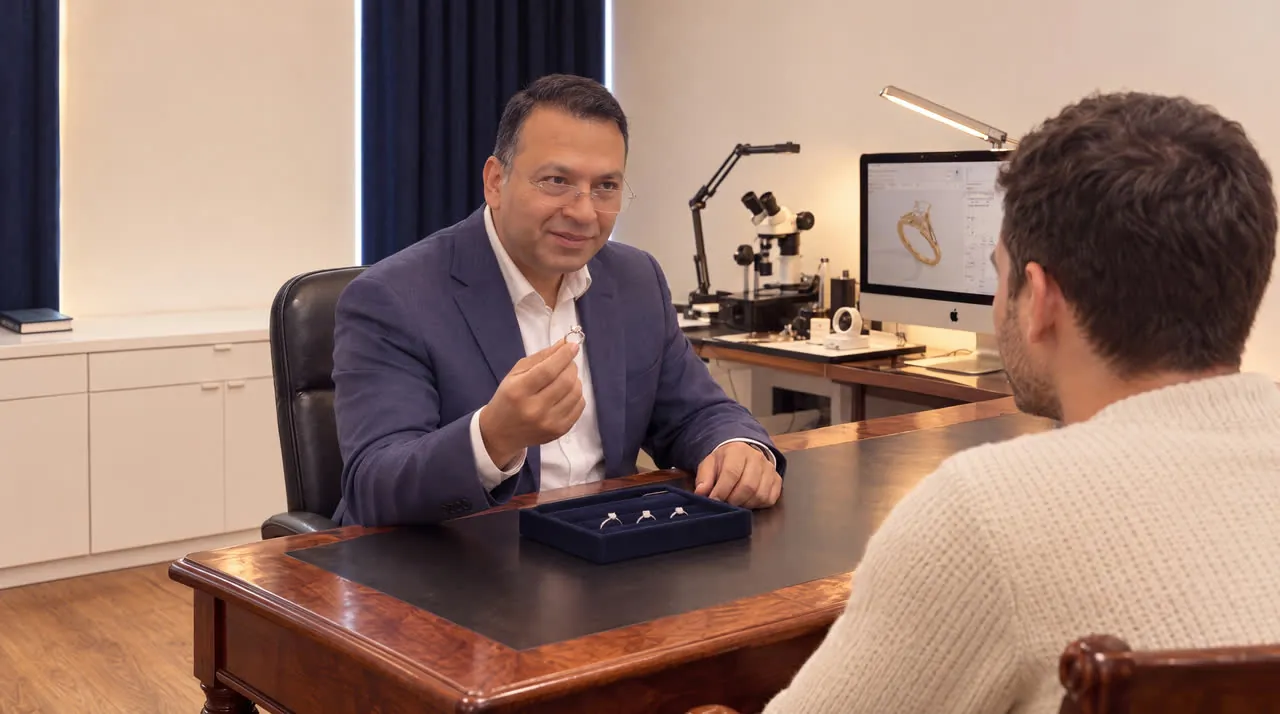
Raj Sood is a Graduate Gemologist (GIA) who works alongside our master jewellers. Bring the stones you are considering, or send the reports, and he will tell you honestly which one is better and why.
Keep learning
Related guides
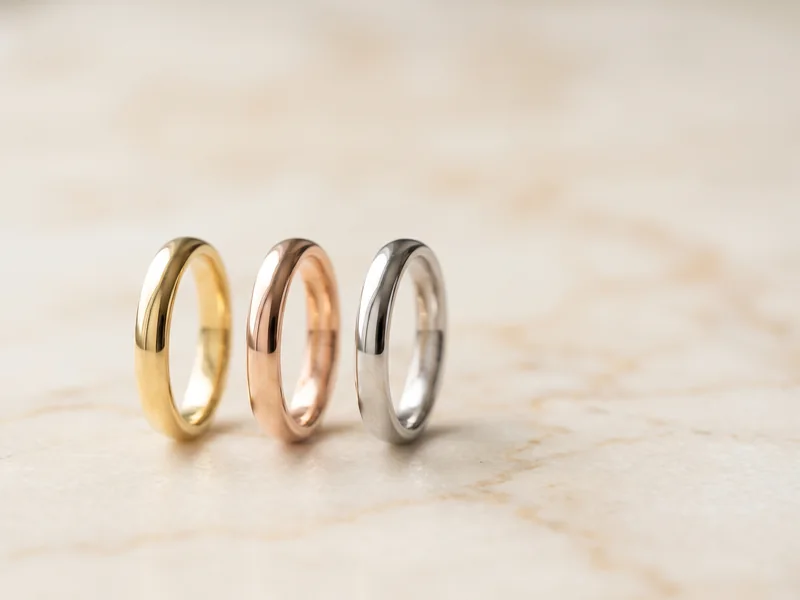 MetalsBest Metal for Wedding Bands
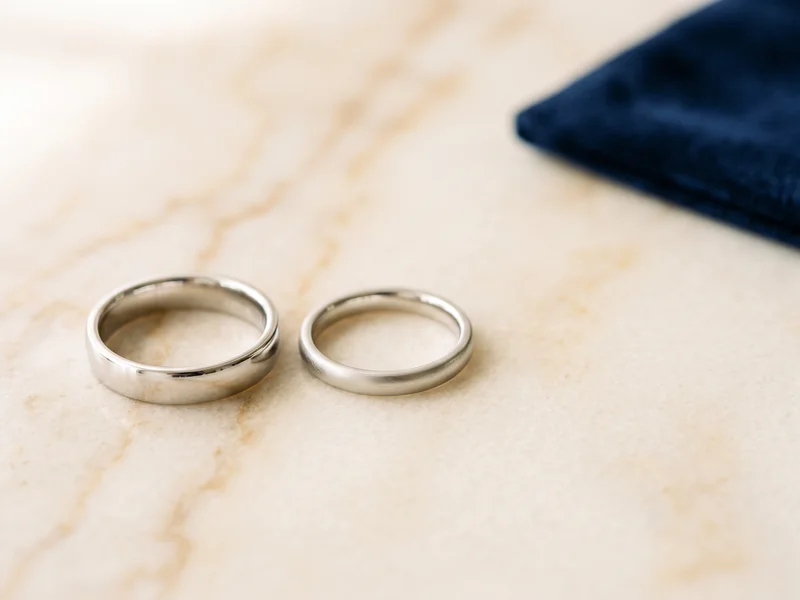 MetalsPlatinum Jewellery Melbourne
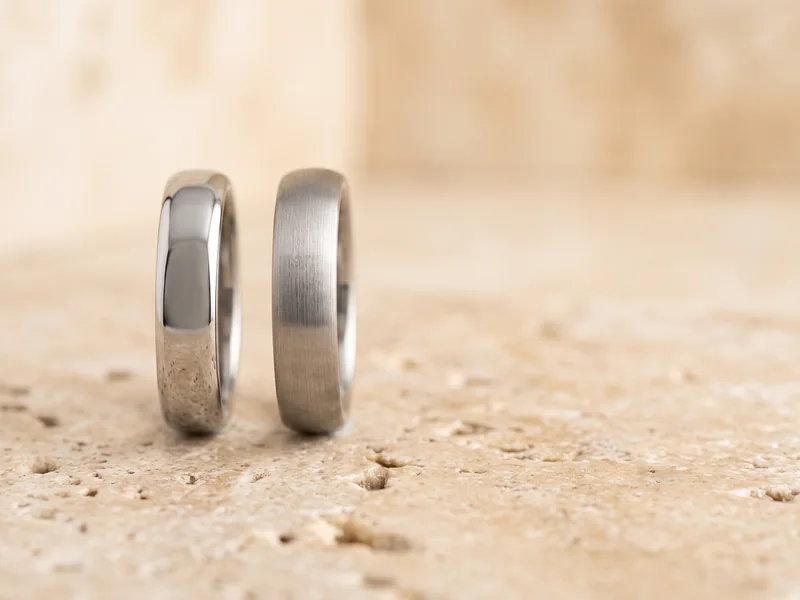 MetalsMetal Allergies and Nickel-Free OptionsMetalsAustralian Hallmarks and Metal StampsMetalsBest Metal for Engagement RingsMetalsCobalt, Tantalum and Carbon Fibre Rings
 MetalsMokume Gane Rings Melbourne
 MetalsRhodium Plating and Replating
Explore more
More guides on this topic
Education