
- Education
- Diamond 4Cs & Grading
- Understanding Diamond Clarity Grades: FL to I3 Explained
Diamond 4Cs & Grading
Understanding Diamond Clarity Grades: FL to I3 Explained
Diamond clarity is the C that is easiest to overspend on, because most of what sets the grade can only be seen under magnification. Here is what each grade really means, and where the smart money sits.
 Reviewed by Raj Sood, Graduate Gemologist (GIA), AJP (GIA)Founder and Graduate Gemologist (GIA) · reviewed 17 November 2026
VS1 and VS2 clarity natural diamonds in stock, 1 carat
See all 7,493 in stock →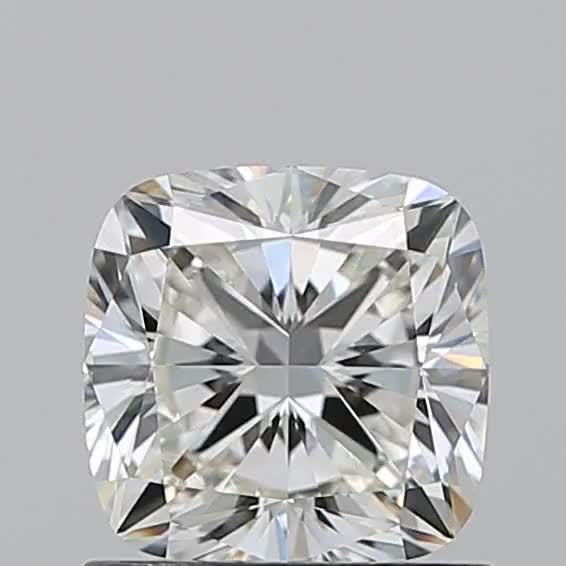 Natural Diamond1.02 ct Cushion DiamondJ · VS1 Clarity · EX · EX · FNT$2,888 AUDAll taxes inclusive
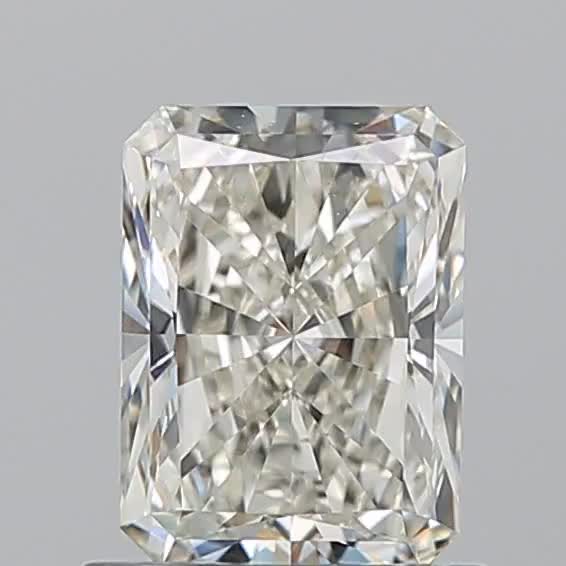 Natural Diamond1.01 ct Radiant DiamondI · VS1 Clarity · EX · EX · NON$2,898 AUDAll taxes inclusive
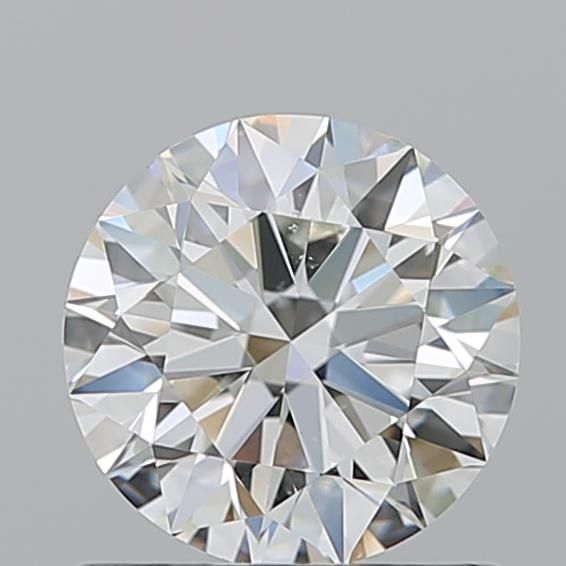 Natural Diamond1.01 ct Round DiamondI · VS2 Clarity · EX · EX · EX · NON$4,688 AUDAll taxes inclusive
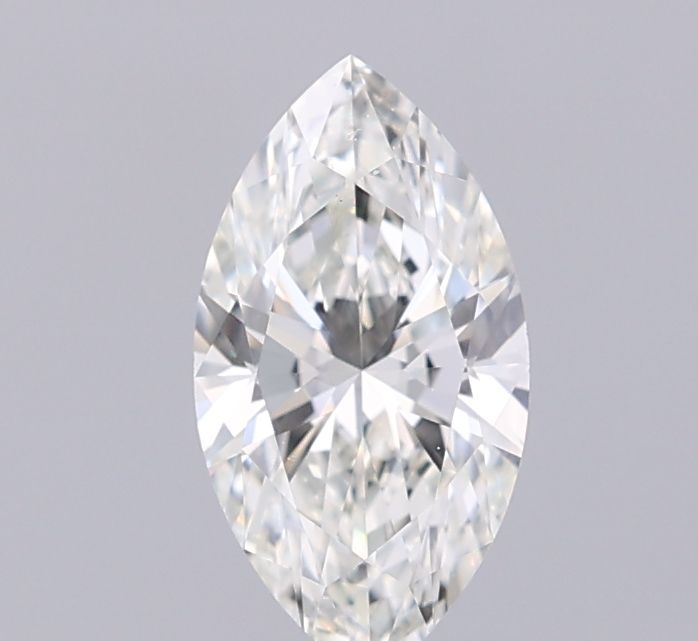 Natural Diamond1.02 ct Marquise DiamondJ · VS2 Clarity · EX · EX · NON$4,688 AUDAll taxes inclusive
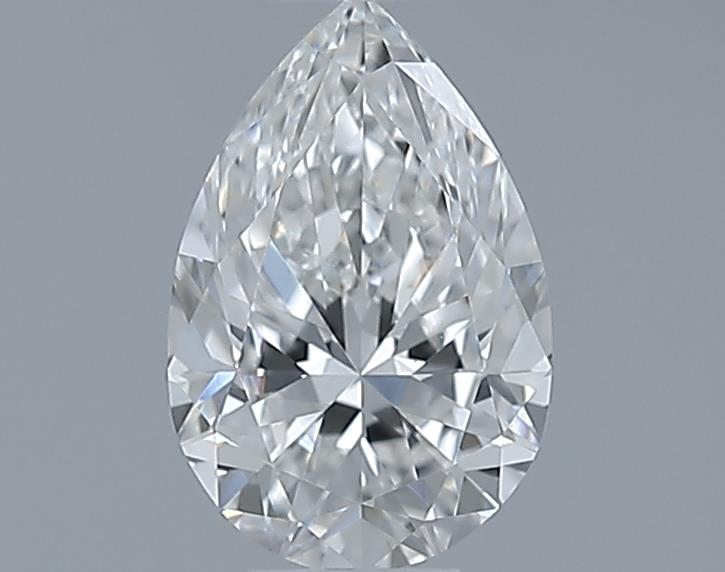 Natural Diamond1.00 ct Pear DiamondF · VS1 Clarity · EX · VG · NON$6,908 AUDAll taxes inclusive
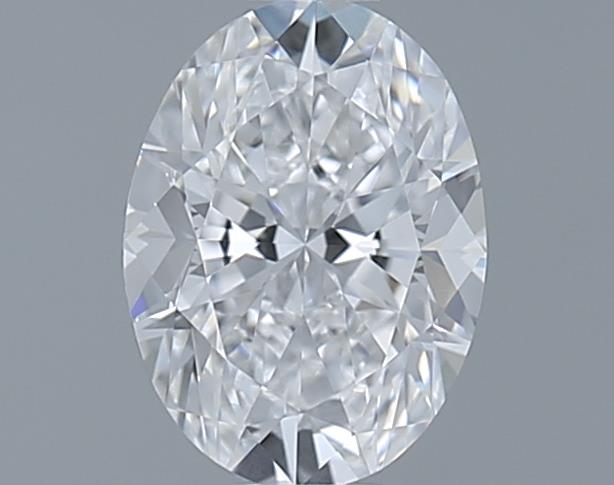 Natural Diamond1.00 ct Oval DiamondD · VS1 Clarity · EX · EX · NON$6,928 AUDAll taxes inclusive
In stock when checked on 23 Nov 2026, 6:13 am. Each diamond’s own page shows its live price and availability. Please check the lab report before you commit.
Quick answer
Diamond clarity grades how free a diamond is from internal inclusions and surface blemishes, judged under 10× magnification. GIA's scale runs 11 grades, from Flawless (FL) down to Included (I3). For most people the smart pick is an eye-clean stone: usually VS2 or a well-chosen SI1 in brilliant cuts, and VS1 or better in emerald and Asscher cuts.
What is diamond clarity?
Diamond clarity is the grade that describes how free a diamond is from inclusions (features inside the stone) and blemishes (marks on its surface). It is one of the four Cs of diamond grading, alongside colour, cut and carat weight. Graders judge it face-up under 10× magnification, the standard power of a jeweller's loupe, so most of what decides the grade is invisible to the naked eye.
Almost every diamond has some clarity characteristics. In a natural diamond they form while the crystal grows deep in the earth: tiny crystals of other minerals are trapped, the lattice strains and cracks, and clusters of minute points gather into hazy clouds. Laboratory-grown diamonds have them too, left by their own growth process. Our jewellery glossary defines every term you will meet on a grading report.
A clarity grade is a measure of rarity and visibility, not beauty. A VS2 and a Flawless diamond of the same cut and colour look the same across a table. Clarity matters for three practical reasons: price, what you can see with your own eyes, and, at the very bottom of the scale, durability. Diamond is 10 on the Mohs hardness scale, so it resists scratching, but it can split along its cleavage planes, and a large crack reaching the surface is a weak point.
What are the diamond clarity grades from FL to I3?
The scale used around the world was set out by GIA (the Gemological Institute of America) and is followed, with small differences in naming and strictness, by IGI, HRD and other laboratories. It has 11 grades in six groups. This is the diamond clarity chart in full:
| Grade | Full name | What a grader sees at 10× | Visible to the naked eye? |
|---|---|---|---|
| FL | Flawless | No inclusions and no blemishes | No |
| IF | Internally Flawless | No inclusions; only minor surface blemishes | No |
| VVS1 | Very, Very Slightly Included 1 | Minute inclusions, extremely difficult to see, often only from the back | No |
| VVS2 | Very, Very Slightly Included 2 | Minute inclusions, very difficult to see | No |
| VS1 | Very Slightly Included 1 | Minor inclusions, difficult to see | No |
| VS2 | Very Slightly Included 2 | Minor inclusions, somewhat easy to see | Almost never in brilliant cuts |
| SI1 | Slightly Included 1 | Noticeable inclusions, easy to see | Often eye-clean; check each stone |
| SI2 | Slightly Included 2 | Noticeable inclusions, very easy to see | Sometimes, especially above 1 ct |
| I1 | Included 1 | Obvious inclusions | Usually |
| I2 | Included 2 | Obvious, larger or more numerous inclusions | Yes |
| I3 | Included 3 | Obvious inclusions that may affect transparency and brilliance | Clearly; may affect durability |
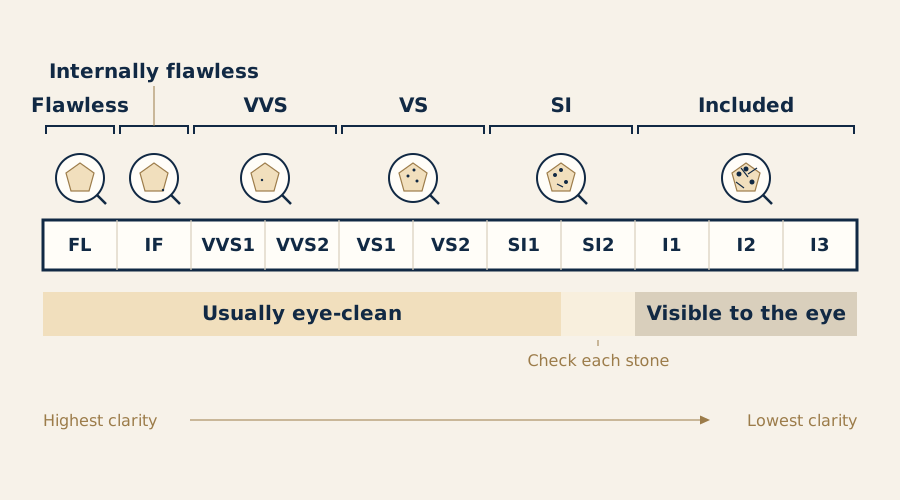
Each grade has its own guide. At the top, Flawless and Internally Flawless diamonds are the rarest. The two VVS grades sit just below: what VVS1 clarity means and how VVS2 differs. In the middle, VS1 clarity is the point where nearly every shape is eye-clean. Lower down, choosing an SI2 diamond takes more care, and the included grades I1 to I3 explains when they still make sense.
Each grade has its own guide: asscher-Cut Diamond Clarity Guide.
How is diamond clarity graded?
A grader examines the diamond face-up with a 10× loupe and a binocular microscope, then decides which single grade best describes the stone as a whole. The decision rests on five factors:
- Size: the bigger the inclusion, the lower the grade. This is usually the deciding factor.
- Number: one small crystal grades higher than a scatter of them.
- Position: an inclusion under the table (the large top facet) is easiest to see and grades lower than the same inclusion near the girdle (the outer edge), where it can hide behind a claw.
- Nature: what kind of inclusion it is, and whether it reaches the surface or poses a durability risk.
- Relief: how much the inclusion contrasts with the diamond. A dark crystal stands out far more than a white or colourless one.
On a full GIA Diamond Grading Report, the inclusions are mapped on a plot: a drawing of the stone with internal features in red and surface blemishes in green, plus a key to symbols. The first item in that key is normally the grade-setting inclusion, the feature that decided the grade. Smaller-format reports, such as GIA's Diamond Dossier, list the grade without a plot, so you rely more on photos and video.
Diamond's high refractive index (about 2.42) and brilliant faceting help here. Light bounces around inside the stone and breaks into many small reflections, which camouflage small inclusions. That is why the same inclusion is harder to see in a round brilliant than in a step cut with long, open facets.
What types of inclusions affect diamond clarity?
Not all inclusions are equal. Two SI1 diamonds can look very different, depending on what the inclusions are and where they sit. These are the ones you will see named on reports:
| Clarity characteristic | What it is | How much it matters |
|---|---|---|
| Crystal | A tiny mineral crystal trapped inside, sometimes another diamond | Little if white or colourless; more if dark and central |
| Pinpoint | A very small crystal that looks like a dot at 10× | Rarely matters on its own |
| Cloud | A cluster of pinpoints that can look hazy | Small clouds are harmless; large ones can dull sparkle |
| Feather | A small internal crack, named for its feathery look | Check size and whether it reaches the surface |
| Needle | A long, thin crystal | Usually minor |
| Twinning wisp | Streaks formed where the crystal grew in two directions | Can look like a faint haze in the middle of the stone |
| Knot | A crystal that reaches the surface | Can catch light and may be felt with a fingernail |
| Cavity or chip | An opening or broken area at the surface | Durability concern if near the girdle or a point |
| Polish lines, scratch, extra facet | Surface blemishes from cutting or wear | Affect polish more than clarity; often removable |
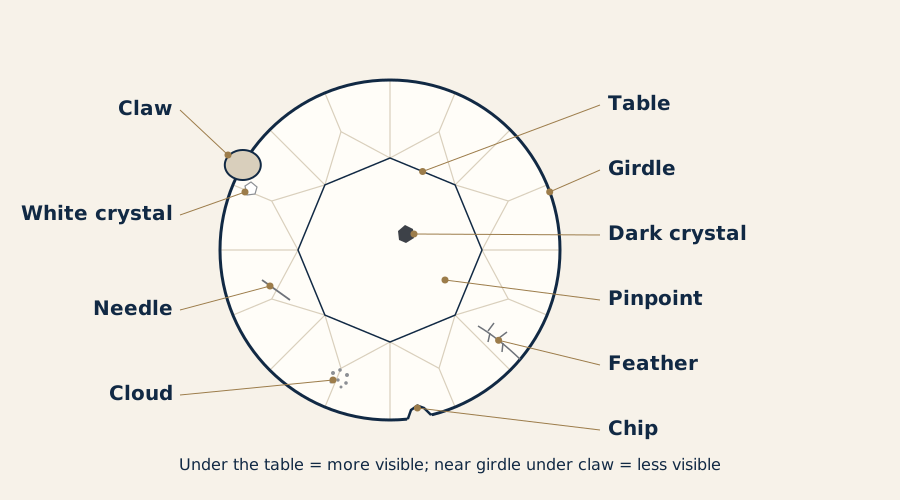
As a gemmologist, the questions I ask about any inclusion are simple: can you see it without magnification, does it change how light moves through the stone, and could it cause a problem in a setting? A small white crystal near the edge answers no to all three, even in an SI1. A feather running to the girdle of a pear or marquise point gets a closer look, whatever the grade.
Not sure which one is right?
Send us the stones you are looking at and our gemologist will tell you which to choose and why.
What is the highest clarity diamond, and is it worth it?
The highest clarity grade is FL (Flawless): no inclusions and no blemishes visible to a skilled grader at 10×. Internally Flawless (IF) is next, with only minor surface blemishes that could often be polished away. Both are a very small fraction of the natural diamonds graded each year, which is why they carry a clear premium.
What you pay for at the top is rarity, not appearance. To the naked eye, a well-cut FL, IF, VVS or VS diamond look identical. Our guide to whether VVS clarity is worth the extra works through the numbers. In short, the top grades make sense when:
- Knowing the stone is near-perfect matters to you personally.
- You are choosing a large emerald or Asscher cut, where open facets show more.
- You are buying lab-grown, where the price gap between clarity grades is much smaller.
- The stone sits in a fine setting worn close to the eye, such as a pendant viewed up close.
For everyone else, the money is usually better spent on cut quality, colour or a little more carat weight.
What clarity diamond should I get?
The target for most people is eye-clean: no inclusions visible to the naked eye when the diamond is viewed face-up from about 25–30 cm, the distance most people look at a ring. Eye-clean is not a grade on the report; it is a judgement about one stone. It depends on the shape, the size and where the inclusions sit.
| Shape group | Faceting | Usually eye-clean from | Notes |
|---|---|---|---|
| Round, princess, cushion, oval, radiant | Brilliant | VS2 to SI1 | Under 1 ct, a carefully chosen SI2 can work |
| Pear, marquise, heart | Brilliant | VS2 to SI1 | Avoid inclusions near the point |
| Emerald, Asscher, baguette | Step cut | VS1 to VS2 | Long open facets act like a window |
| Any shape over 2 ct | Either | Go up about one grade | Larger facets make inclusions easier to see |
For a brilliant cut, the honest answer to which is better for you, VS2 or SI1, is that it depends on the stone. Many VS2s are eye-clean with a margin to spare; our VS2 clarity guide explains why it is such a popular choice. SI1 can be equally clean, but more of them have a visible inclusion, so each one needs a look. For a shape-by-shape view, see the right colour and clarity pairing for each shape.
Clarity is also a trade-off against colour. In white gold or platinum, colour tends to be more noticeable than a small inclusion; in yellow or rose gold the opposite can be true. Our article on whether to prioritise colour or clarity goes through those trade-offs.
Clarity matters differently for each shape and budget. See eye-clean diamonds, whether VVS clarity is worth paying more for, colour vs clarity, the best colour and clarity for each shape and VS2 clarity diamonds.
How much does diamond clarity change the price?
Clarity has a big effect on the price of natural diamonds and a much smaller one on lab-grown. The figures below are approximate Australian price ranges for a 1 carat natural round brilliant, G colour, excellent cut, with an independent report. Real prices move with the market and with each stone's cut, so treat them as a guide to the steps, not a quote.
| Clarity (1 ct natural, G, excellent cut) | Approximate AUD range | Eye-clean? |
|---|---|---|
| FL / IF | $14,000–$22,000 | Yes |
| VVS1 / VVS2 | $11,000–$17,000 | Yes |
| VS1 / VS2 | $8,500–$13,000 | Yes, almost always |
| SI1 | $7,000–$10,000 | Often |
| SI2 | $5,500–$8,000 | Sometimes |
| I1 | $3,500–$5,500 | Rarely |
The jumps are not even. The step from SI1 to VS2 often buys you certainty rather than a visible change, and the step from VS1 to VVS buys rarity alone. Between FL and VS2 the price can climb steeply with no difference you could see across a room. For a comparable laboratory-grown diamond, the whole range from SI to VVS typically spans a few hundred to a couple of thousand dollars.
Related guideColour vs Clarity: Which to PrioritiseClarity is only one of the factors that decide how a diamond looks and what it costs. See diamond Cut Grade, diamond Colour Grading, how to Judge a Diamond From a 360-Degree Video and why Two Diamonds With the Same 4Cs Can Have Different Prices.
Do lab-grown diamonds have better clarity?
Laboratory-grown diamonds are graded by IGI and most other labs on the same 11-grade scale (GIA now describes them more broadly), and they are chemically and optically diamond. They are not flawless by default. Diamonds grown by the HPHT method (high pressure, high temperature) can contain dark metallic flux inclusions from the metal used to grow them. Diamonds grown by CVD (chemical vapour deposition) can show dark pinpoints or graphite specks and growth-related strain. Our guide to typical clarity in lab-grown diamonds covers what to expect.
In practice, most lab-grown stones on the market sit in the VVS to VS range, partly because growers and cutters set aside heavily included material. Because the price gap between clarity grades is small, a high clarity grade is easier to justify in lab-grown. Natural diamonds keep their rarity, and that is what the natural clarity premium reflects.
Browse natural and lab-grown diamonds in our stock
Most lab-grown diamonds sold in Australia are graded by IGI; many natural diamonds by GIA. The scales share the same names, but strictness can vary between labs, so read why grades from different labs are not always equal before comparing two reports side by side. Moissanite is a different mineral and is not graded by diamond labs in the same way; see how moissanite colour and clarity are described.
What are clarity-enhanced diamonds?
Some diamonds are treated to make inclusions less visible. The two main treatments are:
- Laser drilling: a fine laser burns a tiny channel to a dark inclusion, which is then bleached or dissolved. The drill hole stays, and GIA reports note it as a clarity characteristic.
- Fracture filling: a glass-like material is forced into feathers so they show less. GIA does not grade fracture-filled diamonds, and the filling can be damaged by heat from a jeweller's torch during repairs or resizing.
Any treatment must be disclosed by the seller, and a treated diamond should cost considerably less than an untreated stone of the same apparent grade. If you are ever unsure, the report will tell you. Our article on laser drilling and fracture filling explains how to spot each one. Coloured gemstones work differently: inclusions are expected in most emeralds, and oiling is routine, as covered in emerald inclusions and how they are treated.
What does a VS1 and VS2 clarity diamond cost today?
Here is what VS1 and VS2 clarity looks like in real stock rather than on a chart. On 17 November 2026, GemTrove's catalogue listed 7,829 natural 1 carat diamonds in VS1 and VS2 clarity. They started at $1,468, with a mid-range price of $4,898. Across every grade, on 16 November, natural 1 carat diamonds started at $1,468 with a mid-range price of $4,488.
| Natural 1.00 ct, 17 Nov 2026 | Lowest | Mid-range | In stock |
|---|---|---|---|
| VS1 and VS2 clarity | $1,468 | $4,898 | 7,829 |
| SI1 clarity | $1,518 | $3,738 | 3,592 |
| All grades | $1,468 | $4,488 | 21,365 |
These are loose diamond prices from GemTrove's live stock on 17 November 2026, in Australian dollars with taxes included, for diamonds from 1.00 to 1.09 carats in every shape. The mid-range figure is the price at the middle of that stock. Prices change daily, and each diamond's own page shows its current price. Compare sizes in our diamond price index for Australia. Please check the lab report before you commit.
SI1 clarity natural diamonds in stock, 1 carat
See all 3,740 in stock →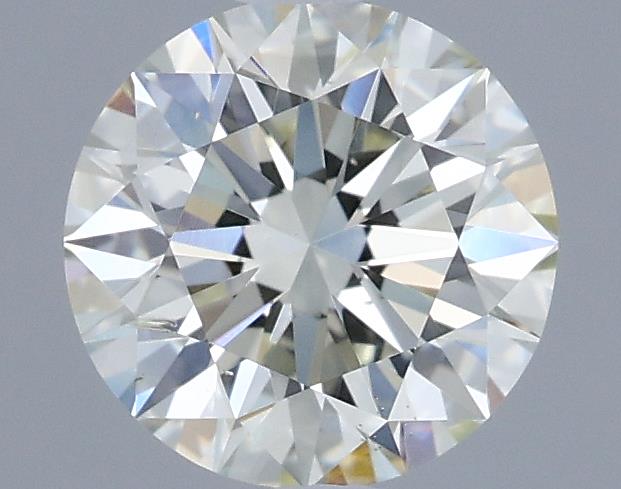 Natural Diamond1.00 ct Round DiamondL · SI1 Clarity · EX · EX · EX · NON$2,338 AUDAll taxes inclusive
 Natural Diamond1.00 ct Oval DiamondJ · SI1 Clarity · EX · VG · FNT$2,368 AUDAll taxes inclusive
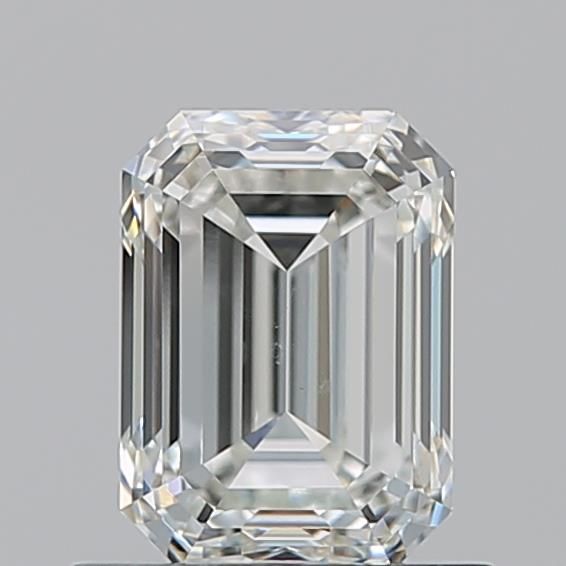 Natural Diamond1.01 ct Emerald DiamondI · SI1 Clarity · EX · EX · NON$3,368 AUDAll taxes inclusive
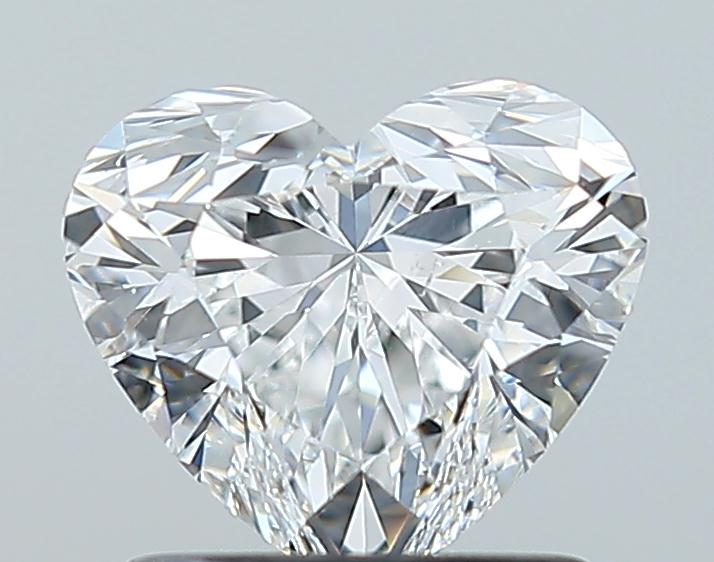 Natural Diamond1.05 ct Heart DiamondE · SI1 Clarity · EX · EX · NON$3,368 AUDAll taxes inclusive
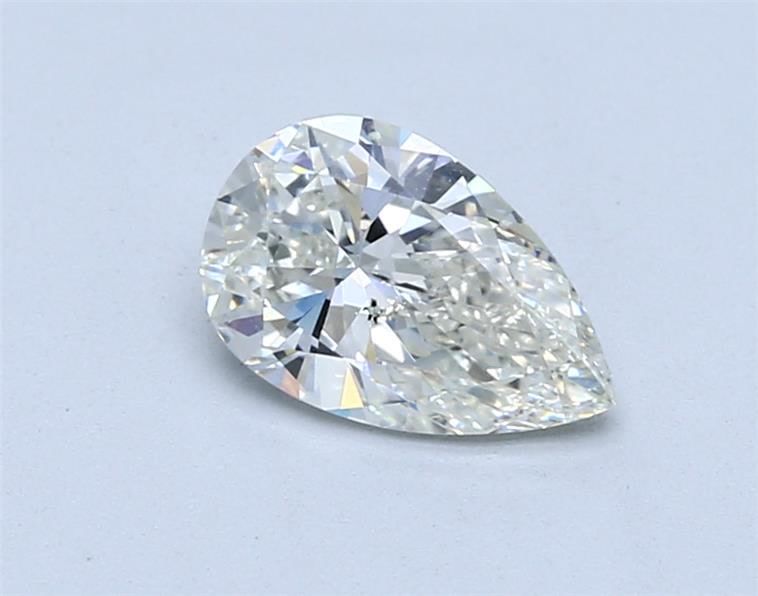 Natural Diamond1.06 ct Pear DiamondH · SI1 Clarity · VG · VG · SLT$5,158 AUDAll taxes inclusive
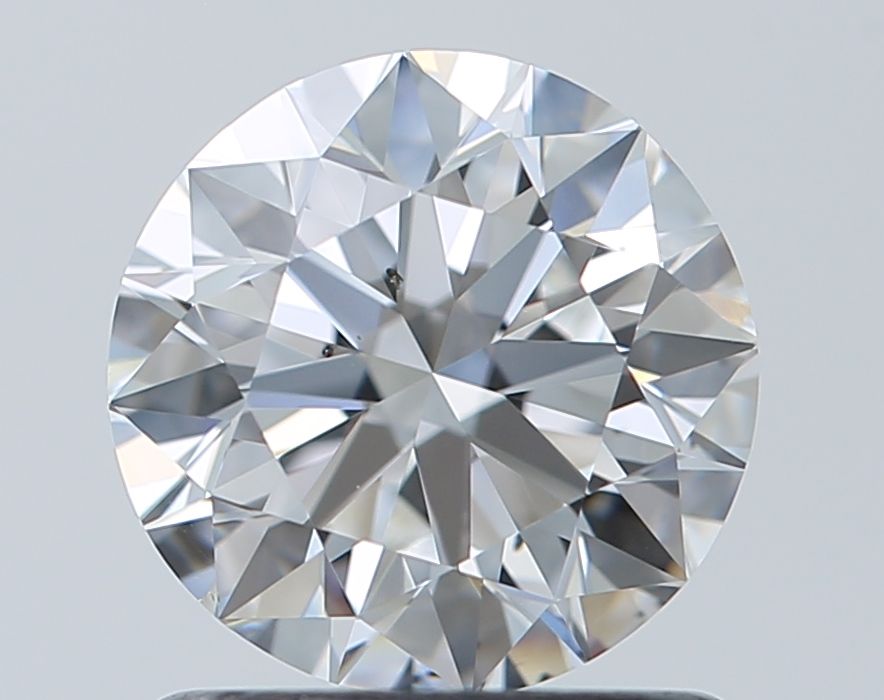 Natural Diamond1.06 ct Round DiamondE · SI1 Clarity · EX · EX · EX · NON$5,178 AUDAll taxes inclusive
In stock when checked on 23 Nov 2026, 7:29 am. Each diamond’s own page shows its live price and availability. Please check the lab report before you commit.
How to choose diamond clarity: step by step
- Start with the shape. Brilliant cuts hide inclusions well; step cuts such as emerald and Asscher show them more.
- Set an eye-clean target. Aim for VS2–SI1 in most brilliant cuts and VS1–VS2 in step cuts, raising it about one grade above 2 carats.
- Read the report. Check the grading lab, the clarity grade and, if there is one, the plot and key to symbols. Note the grade-setting inclusion.
- Find the inclusion. Under the table is more visible than near the girdle; near a point or cleft deserves a closer look for durability.
- Look at the real stone. Ask for a 360° video and view it at actual size, not only magnified, or see the stone in person.
- Check for treatment. Confirm the diamond is not fracture-filled, and note any laser drill holes on the report.
- Compare the price steps. If two grades look the same to you, the lower one frees budget for cut, colour or carat.
Next step. The grades in this guide are easiest to judge on real stones. GIA diamonds in Melbourne shows graded diamonds in stock and what they cost today; lab-grown diamonds in Melbourne covers laboratory-grown stones separately. See GIA-graded diamonds in person at our CBD showroom. Please check the lab report before you commit. Related pages: loose diamonds in Melbourne and engagement rings in Melbourne. Raj Sood, Graduate Gemologist (GIA), sees clients by appointment at Unit 903/125 Swanston St, Melbourne VIC 3000.
Free consultation
Talk to a gemologist
Compare stones in person or online with Raj Sood, Graduate Gemologist (GIA), AJP (GIA).
Book a consultationShop this shape
FAQ
Common questions
What is the highest clarity grade for a diamond?
Flawless (FL) is the highest clarity grade, with no inclusions or blemishes visible at 10× magnification. Internally Flawless (IF) is next. Both are rare and priced accordingly.
What clarity diamond should I get for an engagement ring?
For most brilliant cuts, an eye-clean VS2 or a carefully chosen SI1 gives the best balance of appearance and price. For emerald and Asscher cuts, aim for VS1 or VS2, because their open facets show inclusions more.
Is SI1 clarity good?
SI1 can be a very sensible choice. Many SI1 round and oval diamonds are eye-clean, but not all, so check where the inclusion sits in a video or in person before deciding.
Can you see inclusions in a VS2 diamond?
Almost never in a brilliant cut viewed face-up at normal distance. In a large emerald or Asscher cut, a VS2 inclusion can occasionally be visible, so look at the stone itself.
Does diamond clarity affect sparkle?
Across most of the scale, no; sparkle depends mainly on cut. Only large clouds or heavy inclusions in the I grades noticeably reduce brilliance and transparency.
Do lab-grown diamonds have better clarity than natural diamonds?
Most lab-grown diamonds on the market are VVS or VS, and higher grades cost little extra. Most labs grade them on the same scale, and they can still have inclusions, such as metallic flux in HPHT stones.
What is diamond clarity?
Diamond clarity describes how free a diamond is from internal features, called inclusions, and surface marks, called blemishes, judged under 10x magnification. Grades run from Flawless (FL) to Included (I3). Most buyers choose a diamond that looks clean to the eye rather than the highest grade.
Ask a gemologist
Not sure which diamond to choose?
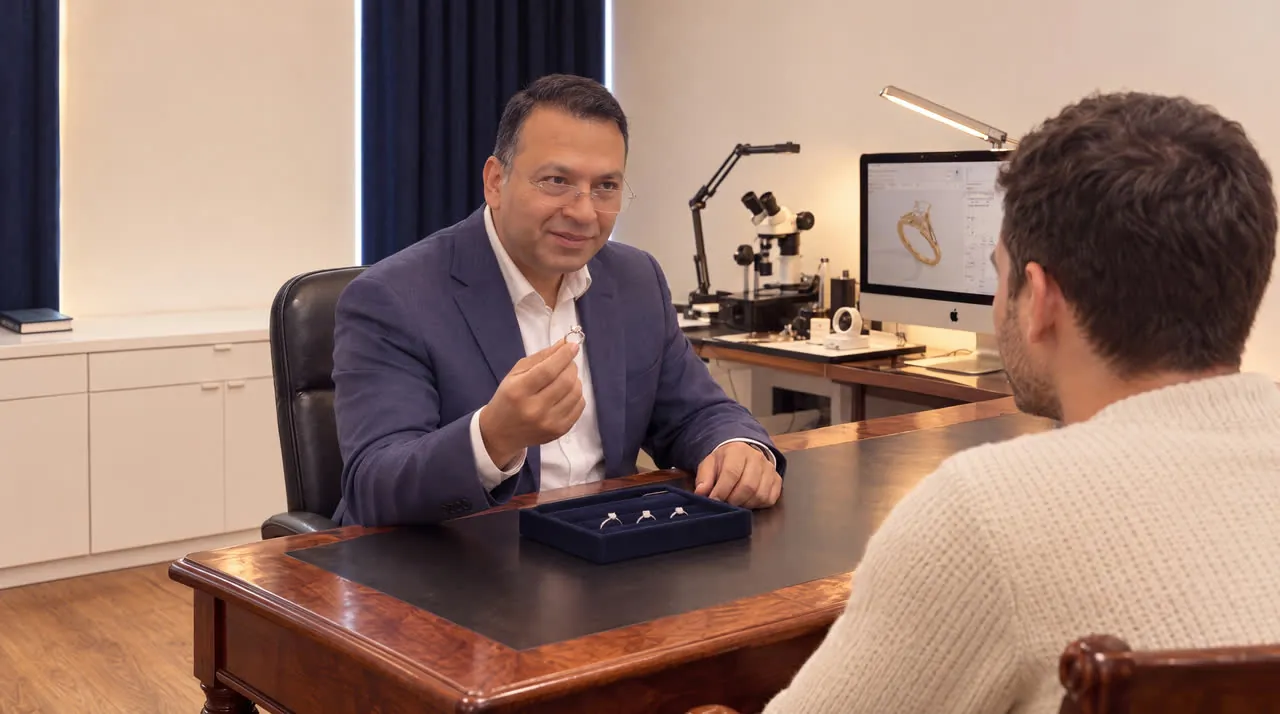
Raj Sood is a Graduate Gemologist (GIA) who works alongside our master jewellers. Bring the stones you are considering, or send the reports, and he will tell you honestly which one is better and why.
Keep learning
Related guides
 Diamond 4Cs & GradingFL and IF Clarity DiamondsDiamond 4Cs & GradingVS2 Clarity DiamondsDiamond 4Cs & GradingSI2 Clarity Diamonds
 Diamond 4Cs & GradingColour vs Clarity: Which to PrioritiseDiamond 4Cs & GradingDiamond 4Cs
 Diamond 4Cs & GradingI1 to I3 Clarity Diamonds
 Diamond 4Cs & GradingVS1 Clarity DiamondsDiamond 4Cs & GradingVVS2 Clarity Diamonds
Explore more
More guides on this topic
Education