
- Education
- Care, Repairs & Remodelling
- Jewellery Remodelling: What Can Be Reused Safely, and What Can't
Care, Repairs & Remodelling
Jewellery Remodelling: What Can Be Reused Safely, and What Can't
Jewellery remodelling turns pieces you no longer wear into something you will, but not every stone or scrap of metal survives the process equally well. Here is what a bench jeweller checks before anything is taken apart.
 Reviewed by Raj Sood, Graduate Gemologist (GIA), AJP (GIA)Founder and Graduate Gemologist (GIA) · reviewed 17 November 2026
Quick answer
In jewellery remodelling, most diamonds, sapphires and rubies can be reused safely after a jeweller checks them for chips and cracks. Gold and platinum can usually be refined or recast into new metal, though old solder and mixed carats complicate it. Soft or treated stones, such as opals, emeralds, pearls and fracture-filled gems, need individual assessment first.
What is jewellery remodelling?
Jewellery remodelling means taking parts of an existing piece, usually the stones and sometimes the metal, and making them into a new design. It sits between a simple repair (fixing what is there) and a completely new commission (starting from nothing). A common example is lifting the diamonds out of a grandmother's ring and setting them into a modern band, or turning a single earring into a pendant.
The word people often confuse it with is resetting: moving a stone from one setting into another without changing much else. Remodelling is broader. It can involve resetting, recutting, refining old gold and redesigning the whole piece. If terms like shank, gallery and claw are new to you, the shank is the band, the gallery is the metalwork under the stone and the claws (also called prongs) are the small metal tips that grip it.
Today most remodels are designed in CAD (computer-aided design). The jeweller measures or scans your stones so the new mount fits them to a fraction of a millimetre; our guide to scanning your stones and ring for a CAD redesign explains how that works. The question that comes first, though, is always the same: what in the old piece is actually safe to reuse?
Which gemstones can be reused safely in jewellery remodelling?
Two properties decide how well a stone handles being taken out and reset. Hardness, measured on the Mohs scale from 1 (talc) to 10 (diamond), tells you how well it resists scratching. Toughness and stability tell you how well it resists chipping, cracking, heat and chemicals. A stone can be hard and still fragile: topaz is 8 on the Mohs scale but splits easily along one direction, called a cleavage plane.
| Gem | Mohs | Reuse outlook | What the jeweller checks |
|---|---|---|---|
| Diamond (natural or lab-grown) | 10 | Very good | Chips at the girdle under old claws; fracture filling; feathers near the edge |
| Ruby and sapphire | 9 | Very good | Old chips; lead-glass filling in some rubies, which heat and acids damage |
| Aquamarine, morganite | 7.5–8 | Good | Abrasion on facet edges; liquid inclusions |
| Topaz | 8 | Good with care | Cleavage cracks; pressure when tightening claws |
| Amethyst, citrine, quartz | 7 | Good | Worn facets; heat can fade amethyst colour |
| Garnet | 6.5–7.5 | Good | Surface wear, often easily repolished |
| Peridot | 6.5–7 | Fair | Heat sensitivity; scratched table facet |
| Tanzanite | 6–7 | Fair, with care | Cleavage; sudden temperature changes |
| Emerald | 7.5–8 | Assess first | Oil or resin filling; brittleness; existing fractures |
| Opal | 5.5–6.5 | Assess first | Crazing (fine cracks); doublet or triplet layers glued together |
| Pearl | 2.5–4.5 | Assess first | Worn nacre, drill holes, dried or damaged surface |
| Glass or paste, foil-backed stones | about 5–6 | Often poor | Foil backing that is destroyed once the stone leaves a closed setting |
Diamonds, rubies and sapphires are the easy cases. They are hard, tough enough for everyday wear and stable when the jeweller's torch is nearby. Even so, the jeweller will usually remove them before any soldering, because torch heat can mark a diamond's surface and will damage any filled fracture. Lab-grown diamonds and lab-created sapphires behave the same way as their natural counterparts and reuse just as well.
The harder cases are stones that have been treated, contain water or are organic. Most emeralds are clarity-enhanced with oil or resin, which can be drawn out by heat or an ultrasonic cleaner. Natural opal holds some water in its structure (typically about 3–10%, occasionally more), so heat or sudden temperature change can make it craze. Pearls are soft and react to heat, acids and solvents. None of these rule a stone out; they mean it should be set cold, by hand, with the claws or bezel adjusted gently. The same sensitivity is why chlorine and sunscreen affect soft gems and metals more than people expect.
Families often want to add stones during a remodel, such as children's birthstones around an heirloom centre. If you are mixing gems, choose ones with similar durability to the original, or put the softer stones in protected positions. Our page on family birthstone pieces lists the hardness of each month's stone.
How do you know what stones are in old jewellery?
Before anything is reused, it needs to be identified. Old pieces regularly contain surprises. Synthetic spinel and flame-fusion synthetic corundum have been made since the early 1900s and were widely used in mid-century rings, so a blue stone thought to be sapphire may be lab-created sapphire or synthetic spinel. Clear stones may be diamond, white sapphire, zircon or glass. Antique paste (cut glass) is often foil-backed, meaning a thin metallic layer behind the stone gives it extra sparkle; once the stone is removed, that effect is usually lost.
A gemmologist uses a loupe (a 10× magnifier), a microscope, a refractometer (which measures refractive index; sapphire reads about 1.76–1.77, while diamond, at about 2.42, is above a standard refractometer's limit) and a thermal or multi-tester to tell these apart. Natural, treated, lab-grown and lab-created stones all have legitimate places in a remodel. What matters is that you know which is which, because it changes how the stone is handled and what it is worth.
It also helps to have the pieces cleaned first. Years of soap and lotion build-up can hide chips and make stones look dull; a professional clean before assessment shows the true condition. If a piece has not been looked at in years, ask about when to get jewellery revalued, because a remodel is a natural point to update the record.
Can old gold be melted down and reused?
Yes, but how it is reused matters. Old jewellery is rarely one clean alloy. A ring may have an 18ct band, a 9ct head added at a later repair, lower-carat solder at every join and, in some older work, solder containing cadmium. Melt all of that together and you get an unknown alloy, often with porosity (tiny gas holes) and grit that make the metal weak and hard to polish.
There are two sound approaches. The first is refining: the old metal is sent to a refiner, the pure gold is recovered, and you are credited for its fine gold content, less refining costs, against new certified alloy. The second is careful recasting of clean, known metal, which some jewellers will do for sentimental reasons when the original metal is in good condition. Many people choose a middle path and keep one meaningful element, such as an engraved section of band, intact within the new design.
| Metal | Purity | Can it be reused? | Notes |
|---|---|---|---|
| 18ct gold (yellow, white or rose) | 75% gold | Yes | Usually refined; pure gold melts at about 1,064 °C |
| 14ct and 9ct gold | 58.5% and 37.5% gold | Yes | Less gold to recover; mixed carats should not be melted together |
| White gold | 75% gold in 18ct | Yes | Usually rhodium plated; nickel or palladium alloys must not be mixed |
| Platinum | usually 95% | Yes, via refiner | Melts at about 1,768 °C, so rarely recast at the bench |
| Sterling silver | 92.5% silver | Yes, as silver only | Never melted with gold; much lower metal value |
| Gold-plated or gold-filled | thin gold layer | Not as gold | Base metal underneath; little to recover |
| Tungsten carbide, titanium | n/a | No | Cannot be cast, soldered or resized at the bench |
Silver is a separate category. It can be remodelled into new silver pieces, and our guide to how sterling silver is made explains its 92.5% standard. Tarnish is only surface sulphide and is not a reason to discard a piece; cleaning tarnished silver safely brings most of it back. Hard modern metals are different again: tungsten carbide has an extremely high melting point and is formed by sintering, which is why tungsten rings can't be recast or resized.
Not sure which one is right?
Send us the stones you are looking at and our gemologist will tell you which to choose and why.
What parts of an old ring are worth keeping?
Stones and precious metal value are the obvious things to keep. The structural parts of an old setting are another matter, because they are usually the most worn.
- Claws: decades of wear thin and flatten them. Worn claws are retipped or replaced, not reused as the main grip in a new design.
- Shank: the base of the band (the part against your palm) wears thinnest. A shank worn to about 1 mm or less is at risk of cracking and is rarely worth keeping as structure.
- Heads and galleries: these are sized to the old stones and old style; they are usually replaced so the new mount fits exactly.
- Engraving and hallmarks: an inscription, a date or an old hallmark or purity mark such as 18ct or 750 can often be preserved by keeping that section of metal, or recreated by hand or laser.
- Hand-made details: milgrain (a fine beaded edge), filigree or carved shoulders can sometimes be incorporated if the metal is sound.
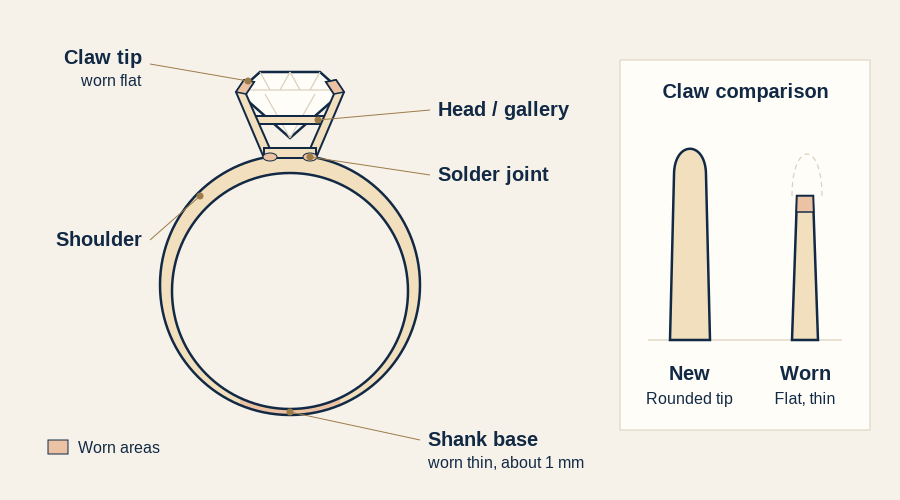
Old gold can also hide stress cracks, especially in lower-carat alloys that have spent years in pools and spas, because chlorine attacks the alloy at its grain boundaries. Regular routine claw checks and maintenance catch this early on the pieces you still wear, and the same inspection is the starting point for any remodel.
What can go wrong when stones are removed and reset?
Removing a stone is careful work but not risk-free. The main issues a jeweller looks for:
- Hidden chips: damage under old claws only shows once they are lifted. A chipped diamond or sapphire can often be repolished, losing a little weight, and the grading details should then be updated.
- Existing fractures: a feather (a small internal crack) that reaches the surface can spread under setting pressure, particularly in emerald, tanzanite and topaz.
- Treatments: fracture-filled diamonds and lead-glass-filled rubies are damaged by torch heat and some cleaning chemicals, so they must come out before any soldering.
- Glued stones: opal doublets and triplets, and some pearls, are held partly by adhesive that can fail if heated or soaked.
- Old cuts: Old Mine and Old European cut diamonds can be recut to a modern round, but this removes a significant amount of weight and the antique character. Most people keep them as they are.
Once stones are out, they are small and easy to lose. They should be bagged individually, labelled with weight and measurements, and photographed. If you are keeping loose stones at home for a while, our guide to storing loose stones and old pieces covers padded, separated storage so harder stones do not scratch softer ones.
Remodel, reset or repair: which is right for your piece?
Not every old piece needs a full remodel. Sometimes a repair keeps a ring wearable without changing its character, and that is worth considering for genuinely antique work.
| Option | What happens | Keeps original metal? | Best for |
|---|---|---|---|
| Repair | Retip claws, rebuild shank, replace lost stones | Mostly | Pieces you love as they are |
| Reset | Move stones into a new head or mount | No, or partly | Sound stones in a worn or dated setting |
| Remodel | New design using your stones and metal value | Refined or partly kept | Inherited pieces, several pieces combined into one |
| Keep as is | Clean, check, store or wear occasionally | Yes | Antique pieces with historical value |
If your pieces are coming from another city or state for the job, read our notes on carrying heirlooms safely to an appointment before you set off, and photograph everything first.
How much does jewellery remodelling cost in Australia?
Cost depends on the metal, the complexity of the design, how many stones need setting and how much of your old metal can be credited. These are broad ranges only and vary between jewellers and with the gold price.
| Job | Approximate range (AUD) |
|---|---|
| Retip or replace claws on an existing ring | about $150–$500 |
| Reset one stone into a new head on the existing band | about $300–$900 |
| Reset stones into a standard new mount, 18ct | about $1,000–$3,000 |
| Fully custom CAD remodel using your stones, 18ct | about $2,000–$6,000+ |
| Fully custom CAD remodel in platinum | about $3,000–$8,000+ |
Old gold credit is based on the fine gold content, so 18ct metal (75% gold) returns more than the same weight of 9ct (37.5%), less the refiner's costs. Small stones add setting labour per stone, so a remodel with dozens of melee (tiny diamonds under about 0.20 carat) can cost more in labour than one with a single centre stone. When the piece is finished, the new design is a different item for insurance, so plan for updating your insurance valuation after the remodel.
Jewellery remodelling service
How do you plan a jewellery remodel? Step by step
- Gather and photograph. Collect every piece you might use and note what matters most: a stone, an engraving, the gold itself.
- Clean and inspect. Have the pieces cleaned and checked under magnification for chips, cracks, worn claws and thin shanks.
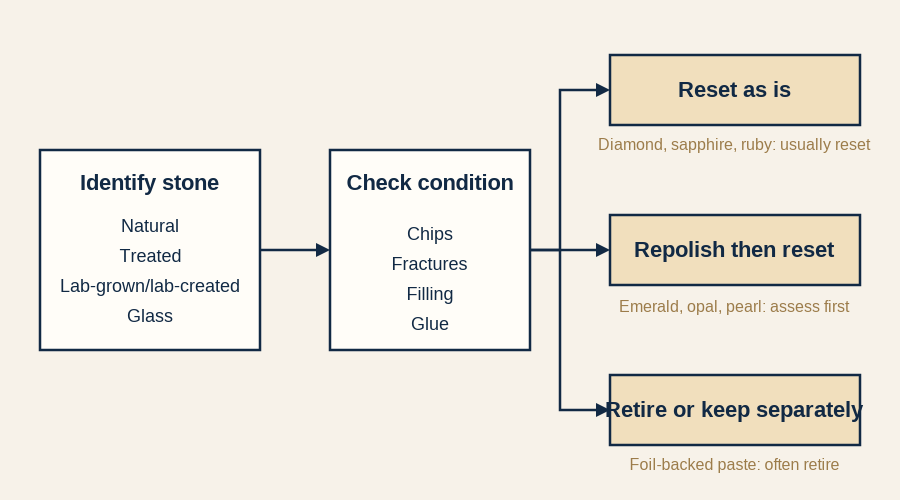
- Identify the stones. Confirm which are natural, treated, lab-grown or lab-created, and which are glass or paste.
- Decide what to reuse. Mark each stone as reset, repolish or retire, and decide whether metal is refined, recast or partly kept.
- Measure or scan and design. The stones are measured to the hundredth of a millimetre and the new mount is drawn in CAD; approve the render or a resin print.
- Remove, make and set. Stones are removed, bagged and weighed, the new piece is cast and finished, then the stones are set cold.
- Check, record and care. Inspect the finished piece, get a new valuation and keep a record of every stone's weight and identity.
After that, the new piece needs the same attention as any ring you wear daily. Our guide to caring for the finished piece covers six-monthly claw checks, and any unfamiliar word in your valuation will be in our glossary of jewellery words.
Next step. Our jewellery remodelling Melbourne page covers heirloom redesign, old gold and what can safely be reused. Book a remodelling consultation, or see setting your own stone. Related pages: jewellery repairs in Melbourne, ring repair in Melbourne, ring resizing in Melbourne, claw retipping in Melbourne, custom jewellery, custom made wedding bands and custom earrings. Raj Sood, Graduate Gemologist (GIA), sees clients by appointment at Unit 903/125 Swanston St, Melbourne VIC 3000.
Free consultation
Talk to a gemologist
Compare stones in person or online with Raj Sood, Graduate Gemologist (GIA), AJP (GIA).
Book a consultationShop this shape
FAQ
Common questions
Can I reuse my grandmother's diamonds in a new ring?
Usually yes. Diamonds are hard and tough enough to be removed and reset many times; the jeweller first checks for chips under the old claws and for any fracture filling, which needs special handling.
Can my old gold be melted into my new ring?
It can be reused, but mixed carats and old solder make a direct melt unreliable. Most jewellers refine the old gold and credit its fine gold value against new certified alloy, or keep a meaningful section of the original metal intact.
Can opals and emeralds be reset?
Often, but they need individual assessment. Opals can craze with heat and many are glued doublets or triplets, while most emeralds are oil or resin filled, so both are set cold and handled gently.
Will remodelling damage my stones?
Sound diamonds, sapphires and rubies are rarely harmed by careful removal. The risk is higher for stones with existing fractures, treatments or cleavage, which is why every stone is checked under magnification before it comes out.
Can I combine silver and gold pieces in a remodel?
Not in the same melt. Silver and gold are handled separately, though a design can use stones from silver pieces in a new gold setting.
Can a tungsten ring be remodelled?
No. Tungsten carbide cannot be cast, soldered or resized at the bench, so any stones can be reused but the band itself cannot.
Ask a gemologist
Not sure which diamond to choose?
Raj Sood is a Graduate Gemologist (GIA) who works alongside our master jewellers. Bring the stones you are considering, or send the reports, and he will tell you honestly which one is better and why.
Keep learning
Related guides
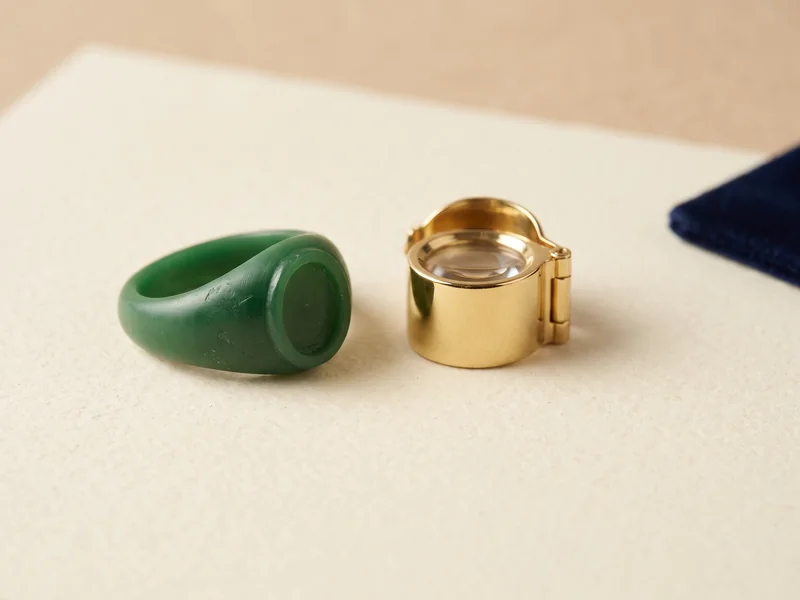 GemstonesGemstone and Ring Scanning for CAD RemodellingCare, Repairs & RemodellingJewellery Care and Maintenance
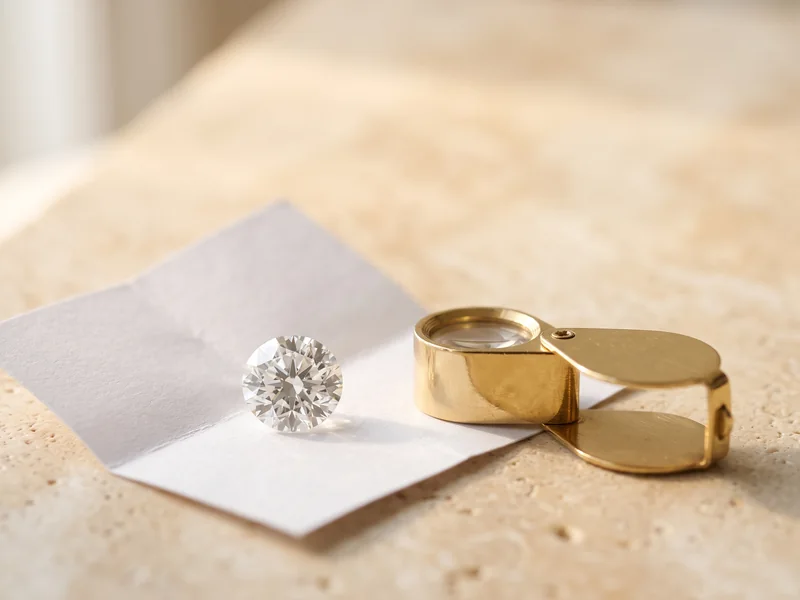 Certificates & ValuationsHow Often to Revalue Jewellery
 Care, Repairs & RemodellingProfessional Jewellery Cleaning vs Home Cleaning
 Care, Repairs & RemodellingHow to Store Jewellery
 Care, Repairs & RemodellingHow to Clean Silver JewelleryCare, Repairs & RemodellingSunscreen, Chlorine and Your Jewellery
 MetalsSterling Silver Jewellery
Explore more
More guides on this topic
Education