
- Education
- Engagement Rings & Settings
- Promise Rings Explained: What a Promise Ring Means, Which Finger and How to Choose One
Engagement Rings & Settings
Promise Rings Explained: What a Promise Ring Means, Which Finger and How to Choose One
A promise ring carries a lot of meaning in a small piece of metal, and there are no fixed rules about it. Here is what a promise ring stands for, where the idea came from, how it differs from an engagement ring, and what to check in the design.
 Reviewed by Raj Sood, Graduate Gemologist (GIA), AJP (GIA)Founder and Graduate Gemologist (GIA) · reviewed 16 November 2026
Quick answer
A promise ring is a ring given as a sign of commitment that is not yet an engagement. It usually marks a serious relationship, but can also mark friendship or a personal vow. Most are worn on the left or right ring finger, are smaller and simpler than engagement rings, and cost roughly AUD $250–$3,000.
What is a promise ring?
A promise ring is a ring one person gives another as a token of commitment. Most often it is given between partners who are serious about each other but not ready to become engaged, perhaps because one is still studying, they live in different cities, or they simply want to wait. The ring says, in effect, "I am committed to you, and I mean it."
Unlike an engagement ring, a promise ring has no set meaning, no fixed finger and no expected budget. That freedom is part of its appeal, but it also means the two people involved should agree on what the ring stands for. A promise ring is not a halfway engagement, and it does not oblige anyone to propose later. If an engagement is on the horizon, our hub for engagement rings and how to choose them covers the next step.
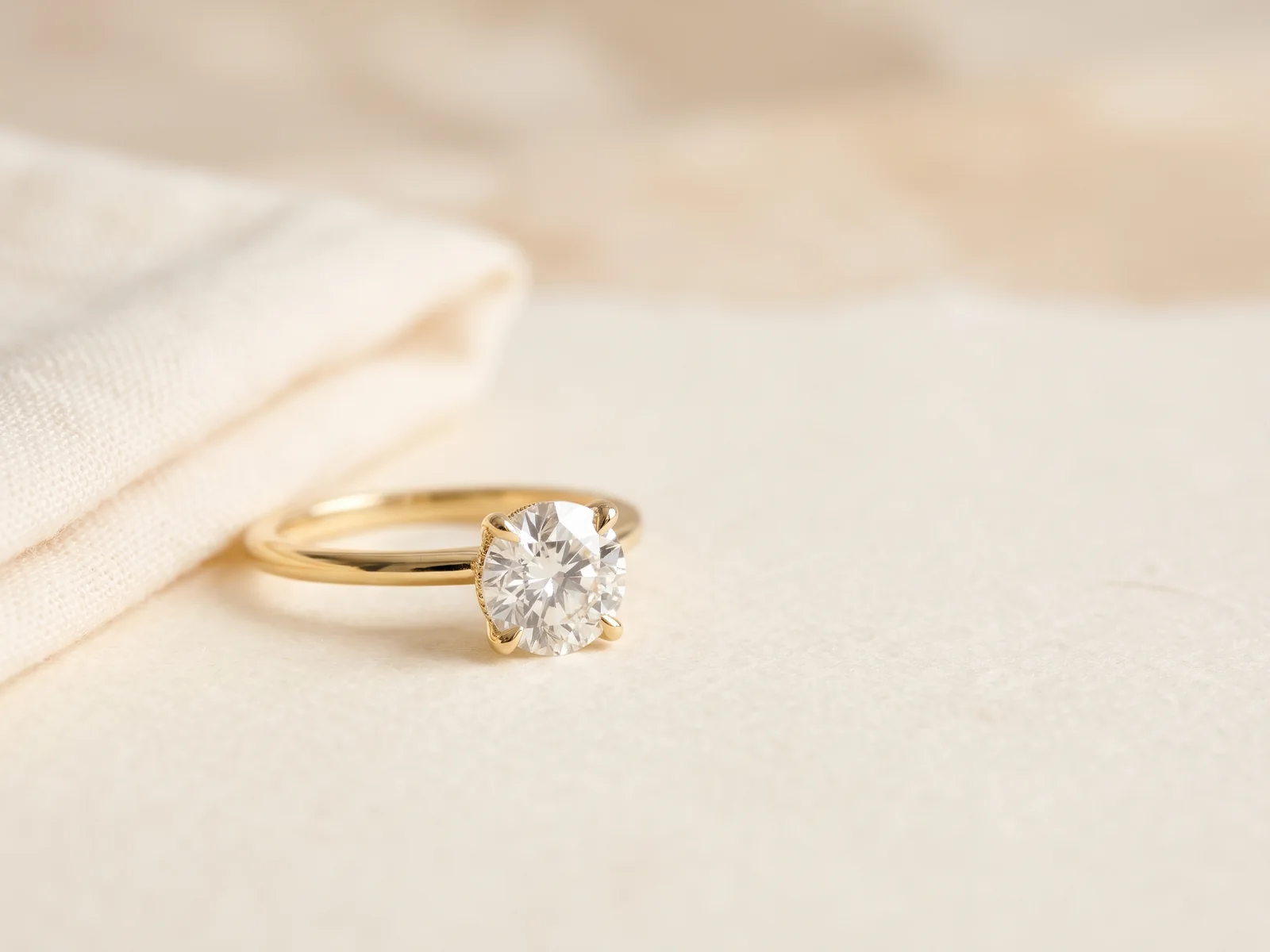
Physically, a promise ring is usually smaller and simpler than an engagement ring: a slim band, sometimes with a small diamond or coloured gemstone, sometimes engraved, sometimes plain. Any ring term in this guide that you have not met before, such as shank, gallery or claw, is also explained in our A to Z of jewellery terms.
What does a promise ring mean?
The promise ring meaning depends entirely on the people exchanging it. The commonest meanings we hear across the counter are:
- Commitment before engagement: a couple who intend to marry, or might, and want a visible sign of that now.
- Exclusivity: a statement that the relationship is serious and monogamous, without any talk of marriage yet.
- Distance: something to wear while apart, for couples in long-distance relationships or with one partner working away.
- Friendship: matching rings between close friends, often with a shared engraving.
- A personal vow: a ring given to yourself, to mark sobriety, a recovery, a milestone or a commitment to your own values.
- Purity or faith: in some communities, a ring that marks a religious promise. This is one specific use, not what most promise rings mean.
A promise ring for him is just as common as one for her. Men's promise rings tend to be plain or textured bands about 4–6 mm wide, sometimes with a single flush-set stone, while women's are often 1.5–2.5 mm wide. Many couples now exchange a pair, which takes the pressure off one person choosing for the other.
Where did promise rings come from? A short history
The phrase "promise ring" is fairly modern, but rings given as pledges of love and loyalty go back at least two thousand years. Several older styles still influence promise ring design today, and antique examples regularly come through workshops like ours for resizing or remodelling, so it helps to know what the original details looked like.
| Style | Era (approximate) | What it looks like | What it meant |
|---|---|---|---|
| Fede ring | Roman, revived in medieval and Renaissance Europe | Two clasped right hands on the front of the band | Agreement and faithfulness; used for betrothals and friendships |
| Gimmel ring | 16th–17th centuries | Two or three hoops that interlock to form one ring | A couple could each keep a hoop before marriage, then rejoin them |
| Posy ring | About the 15th–17th centuries, England and France | Plain gold band engraved with a short verse, often inside | A private message of love; the ancestor of the engraved promise band |
| Claddagh ring | From about the 17th century, Galway, Ireland | Two hands holding a crowned heart | Friendship (hands), love (heart) and loyalty (crown) |
| Acrostic ring | Georgian and Victorian | A row of gems whose first letters spell a word, such as REGARD | A coded sentiment: Ruby, Emerald, Garnet, Amethyst, Ruby, Diamond |
| Modern promise ring | Late 20th century onwards | Slim band, small diamond or gemstone, engraving | Commitment before or instead of engagement |
Victorian jewellery added sentimental motifs you still see in promise rings now: forget-me-not flowers made of small turquoise or diamond clusters, hearts, knots and snakes biting their own tails as a symbol of eternity. Era-accurate details matter if you are recreating one. Georgian clusters, for example, were often closed-backed and foiled, while later Victorian settings opened up to let light through the stone.
The engagement ring has its own, separate story, from Roman iron betrothal rings to the twentieth-century diamond solitaire. Our history of engagement rings through the centuries traces how the two traditions overlap and split apart.
Promise ring vs engagement ring: what is the difference?
The key difference is the commitment. An engagement ring means you have agreed to marry. A promise ring means you are committed, but the shape of that commitment is up to you. That usually shows in the design and the budget too.
| Promise ring | Engagement ring | |
|---|---|---|
| What it signals | Commitment, exclusivity, friendship or a personal vow | An agreement to marry |
| Usual finger in Australia | Left or right ring finger, or any finger | Left ring finger |
| Typical stone | None, or a small diamond or gemstone, about 0.10–0.50 ct | Often a centre stone of about 0.50–1.50 ct |
| Typical band width | 1.5–2.5 mm (women's), 4–6 mm (men's) | Usually 1.8–2.5 mm |
| Setting height | Usually low, so it sits close to the finger | Ranges from low to tall |
| Approximate cost (AUD) | About $250–$3,000 | Usually several thousand dollars or more |
| Worn with a wedding band? | Often moves to the other hand later | Usually stacked with the wedding band |
Because a promise ring is usually smaller, the same principles that make a good engagement ring matter even more: a secure setting, a band thick enough not to bend, and a design that works with whatever might come next. The styles in our guide to every engagement ring setting style apply to promise rings too, simply scaled down.
Not sure which one is right?
Send us the stones you are looking at and our gemologist will tell you which to choose and why.
What finger does a promise ring go on?
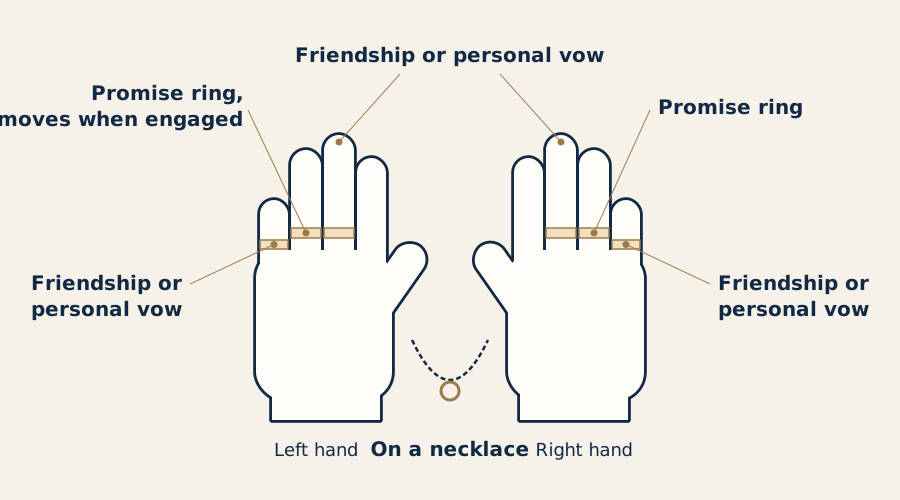
There is no official finger. In Australia, engagement and wedding rings go on the left ring finger (the fourth finger of the left hand), so the promise ring usually goes on one of these:
- Left ring finger: the most traditional choice for a couple promise ring. It is then moved to the right hand, or retired, when an engagement ring arrives.
- Right ring finger: avoids any confusion with an engagement and leaves the left hand free.
- Middle finger or little finger: common for friendship rings, personal vows and men's promise rings.
- On a chain: practical for people who cannot wear rings at work, such as nurses, tradies and chefs.
The left ring finger tradition comes from the old Roman idea of the vena amoris, a vein said to run straight from that finger to the heart. Anatomically it is not true, since every finger has a similar pattern of veins, but the custom stuck. Our guide to which finger engagement and wedding rings go on explains how this varies between countries, including those where the right hand is traditional.
Sizing matters more than you might expect. Your dominant hand is usually up to half a size larger, and fingers swell in Melbourne's summer heat and shrink in winter. If the ring is a surprise, a ring borrowed from the correct finger gives a much better guide than guessing.
What are the parts of a promise ring?
A promise ring has the same parts as any other gem-set ring, just usually smaller. Knowing the names makes it far easier to describe what you want and to judge whether a ring is well made.
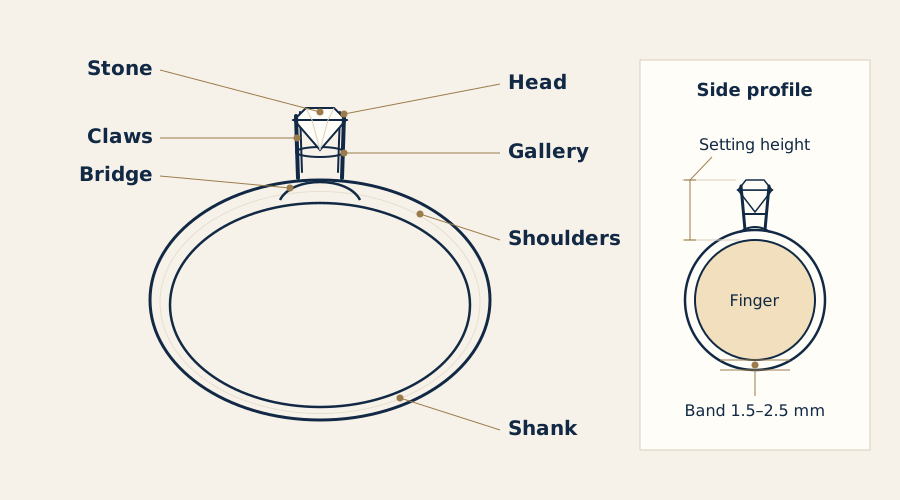
- Shank: the band that goes around the finger. Under about 1.5 mm wide, a gold shank can bend out of round over time.
- Shoulders: the upper part of the shank on either side of the stone. They may be plain, set with small diamonds or tapered.
- Head: the part that holds the stone. It might be claws (small metal prongs), a bezel (a metal rim) or a flush setting.
- Claws: usually four or six for a round stone. Pointed shapes need a claw on each tip.
- Gallery: the metalwork under the stone, seen from the side. It can be plain or decorated.
- Bridge: the piece connecting the head to the shank beneath the stone.
For a full labelled breakdown, see our page on the anatomy of a ring, part by part. If your promise ring has a small centre stone, the choice between a basket, trellis or peg head changes how high it sits and how easily it catches; how basket, trellis and peg heads compare covers the trade-offs.
The side view is where a lot of character hides. Antique-inspired promise rings often have pierced galleries, small scrolls or a hidden stone, and our guide to decorative under-gallery details shows the options. If you choose a pear or marquise gem, read up on where claws go on pointed stones first, because an unprotected tip is the most likely part to chip.
What styles of promise ring are there?
Most promise rings fall into a handful of styles. Many are scaled-down versions of engagement designs, which is useful if you want a matching look later.
- Small solitaire: a single diamond or gemstone of about 0.10–0.30 ct on a slim band. Simple and easy to stack later.
- Cluster: several small stones grouped to look like one larger stone or a flower, very much in the Victorian tradition. See our page on cluster rings and how they are built.
- Bypass: the two ends of the band pass each other instead of meeting, often with a stone on each end. Our guide to bypass rings and their crossover bands explains the variations.
- Toi et moi: French for "you and me", two stones side by side, often two birthstones. Read more on two-stone toi et moi designs.
- East-west: an oval, pear or emerald cut set sideways across the finger, which keeps the ring low and modern. See stones set east-west across the finger.
- Flush set: the stone sits in a drilled seat level with the band, with no claws to catch. Ideal for a promise ring for him or for active work; our page on flush or gypsy settings explains how they are cut.
- Knife-edge band: the band rises to a fine ridge, so it looks slimmer from above. Learn more about the knife-edge band profile.
- Split shank: the band divides into two as it reaches the stone, adding width without weight. See split shank rings and how the band divides.
- Engraved band: a modern posy ring, with initials, a date or a short phrase inside the band.
- Claddagh, heart and knot designs: symbolic motifs with a long history of their own.
Which stones and metals suit a promise ring?
A promise ring is often worn every day for years, so durability matters. Gem hardness is measured on the Mohs scale, from 1 (talc) to 10 (diamond). For daily wear on the hand, 7 or above is a sensible minimum, because household dust contains quartz at about 7 and will slowly scratch anything softer.
| Stone | Mohs hardness | Daily wear on a ring | Notes |
|---|---|---|---|
| Diamond (natural or lab-grown) | 10 | Excellent | Lab-grown and natural diamond have the same hardness and refractive index (about 2.42) |
| Sapphire and ruby | 9 | Excellent | Sapphire comes in blue, pink, yellow and more; lab-created versions are widely available |
| Moissanite | 9.25 | Excellent | Lab-created silicon carbide, with more fiery flashes than diamond |
| Aquamarine and morganite | 7.5–8 | Good | Softer colours; may need cleaning more often |
| Emerald | 7.5–8 | Fair | Usually included and brittle; best in a protective bezel |
| Amethyst and citrine | 7 | Fair to good | Affordable birthstone options; can scratch over time |
| Opal | 5.5–6.5 | Occasional wear | Popular in Australia; choose a bezel and remove for sport |
| Pearl | 2.5–4.5 | Occasional wear | Soft; avoid perfume and hand sanitiser |
A diamond promise ring can use either a natural or a lab-grown diamond. Lab-grown diamonds are real diamond grown in a laboratory rather than mined, and a lab-grown diamond promise ring costs much less than a natural one of the same size. Natural diamonds are rarer. Both should be disclosed as such, and both look identical without lab testing.
For metal, gold in Australia is marked by carat (the gold content): 9ct is 37.5% gold, 14ct is 58.5% and 18ct is 75%. 9ct is harder and less expensive but can tarnish slightly over many years; 18ct is richer in colour. Platinum (usually 95% pure) is dense and hard-wearing. Sterling silver (92.5% silver) is affordable but soft and tarnishes, so it suits a first or occasional ring better than one meant to last decades. If an engagement ring may follow, choosing the same metal now makes it easier to wear the two together.
How much does a promise ring cost in Australia?
There is no expected budget, and anyone who tells you there is a correct amount to spend on a promise ring is guessing. Most people we speak to spend somewhere between a few hundred and a few thousand dollars. The figures below are broad, approximate ranges only; prices move with gold and diamond markets and with the exact specifications.
| Promise ring type | Approximate price range (AUD) |
|---|---|
| Sterling silver band or simple gemstone ring | about $80–$300 |
| 9ct gold plain or engraved band | about $250–$800 |
| 9ct or 18ct gold with a small gemstone (amethyst, sapphire) | about $500–$2,000 |
| 18ct gold with a 0.20–0.30 ct lab-grown diamond | about $800–$1,800 |
| 18ct gold with a 0.20–0.30 ct natural diamond | about $1,500–$3,500 |
| Platinum or 18ct ring with a 0.50 ct natural diamond | about $3,000–$6,000 |
What moves the price most is the metal (18ct and platinum cost more than 9ct), the weight of the band, and the stone. In diamonds, carat weight matters more than anything: a 0.50 ct round is about 5.1 mm across, roughly double the weight of a 0.25 ct at about 4.1 mm, and the price climbs faster than the size. Small accent diamonds along the shoulders add cost too, mainly through setting labour.
Design a promise ring or browse ring settings
How do you choose a promise ring? Step by step
- Agree on the meaning. Talk about what the ring stands for, so neither of you reads it as an engagement when it is not, or the reverse.
- Decide the finger. Left ring finger, right ring finger, another finger or a chain. This affects the size and how low the setting should be.
- Get the size right. Measure the actual finger, ideally at the end of the day; remember the dominant hand is often slightly larger.
- Choose a durable stone, or none. Aim for Mohs 7 or above for everyday wear, and check whether any diamond is natural or lab-grown.
- Pick a metal that will last. Gold of 9ct or more, or platinum, with a band of at least about 1.5 mm so it keeps its shape.
- Think ahead. If an engagement ring may follow, match the metal and keep the profile low so the rings can be worn together.
- Add a personal touch. An engraving inside the band, a birthstone or a hidden detail in the gallery makes the ring unmistakably yours.
Shopping for the ring itself? Our engagement rings in Melbourne page shows certified diamonds in stock with today's prices, and explains how a ring is designed and handmade in 3 to 5 weeks. You can also read about custom engagement rings in Melbourne, or go straight to choosing a diamond for your engagement ring. Related pages: loose diamonds in Melbourne and lab-grown diamonds in Melbourne. Raj Sood, Graduate Gemologist (GIA), sees clients by appointment at Unit 903/125 Swanston St, Melbourne VIC 3000.
Free consultation
Talk to a gemologist
Compare stones in person or online with Raj Sood, Graduate Gemologist (GIA), AJP (GIA).
Book a consultationShop this shape
FAQ
Common questions
What does a promise ring mean?
A promise ring is a sign of commitment that is not an engagement. Most often it marks a serious, exclusive relationship, but it can also mark friendship, faith or a personal vow.
What finger does a promise ring go on?
There is no fixed rule. Most people wear it on the left ring finger and move it to the right hand when they become engaged, or wear it on the right ring finger from the start.
Is a promise ring the same as an engagement ring?
No. An engagement ring means you have agreed to marry, while a promise ring signals commitment without that agreement. Promise rings are usually smaller, simpler and less expensive.
How much should you spend on a promise ring?
There is no expected amount. Most promise rings in Australia cost roughly AUD $250–$3,000, depending on the metal and whether there is a diamond or gemstone.
Can men wear promise rings?
Yes. A promise ring for him is often a plain or textured band about 4–6 mm wide, sometimes with a flush-set stone, and many couples exchange a matching pair.
Can a promise ring become an engagement ring?
It can if you both want it to, though most promise rings are smaller than a typical engagement ring. Some couples later have the promise ring remodelled, or wear it on the right hand beside a new engagement ring.
Terms in this guide
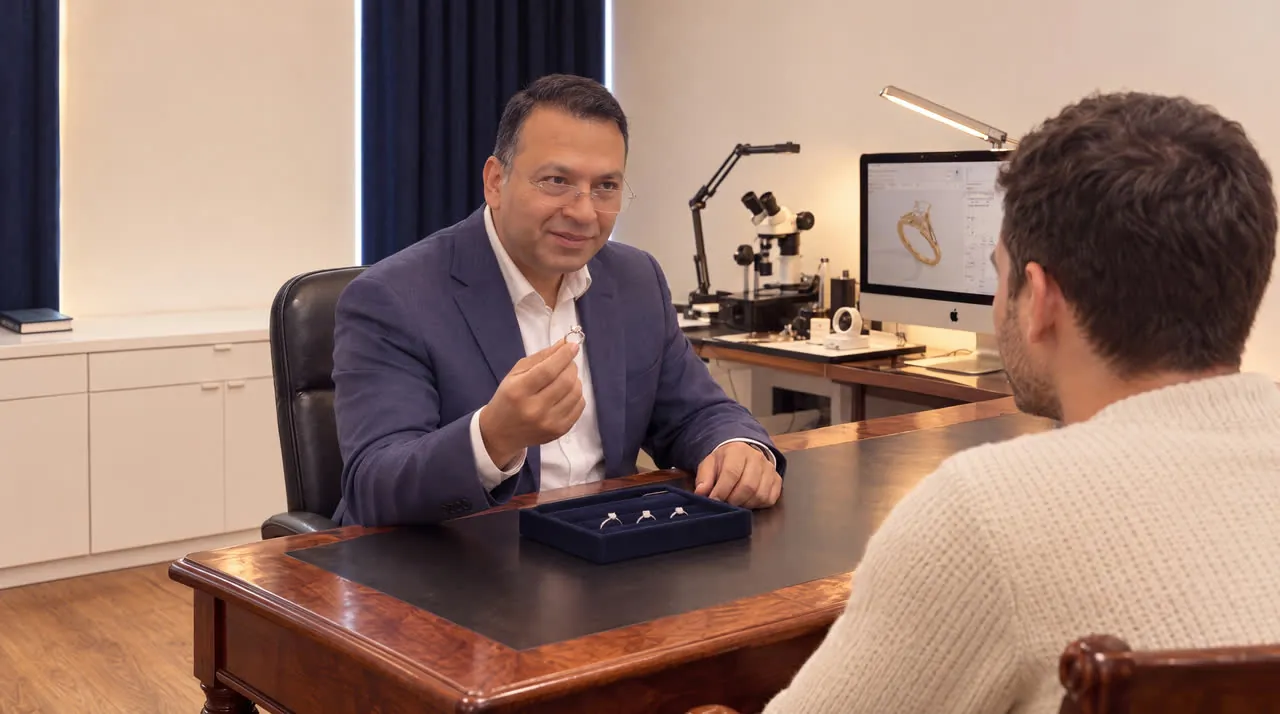
Ask a gemologist
Not sure which diamond to choose?
Raj Sood is a Graduate Gemologist (GIA) who works alongside our master jewellers. Bring the stones you are considering, or send the reports, and he will tell you honestly which one is better and why.
Keep learning
Related guides
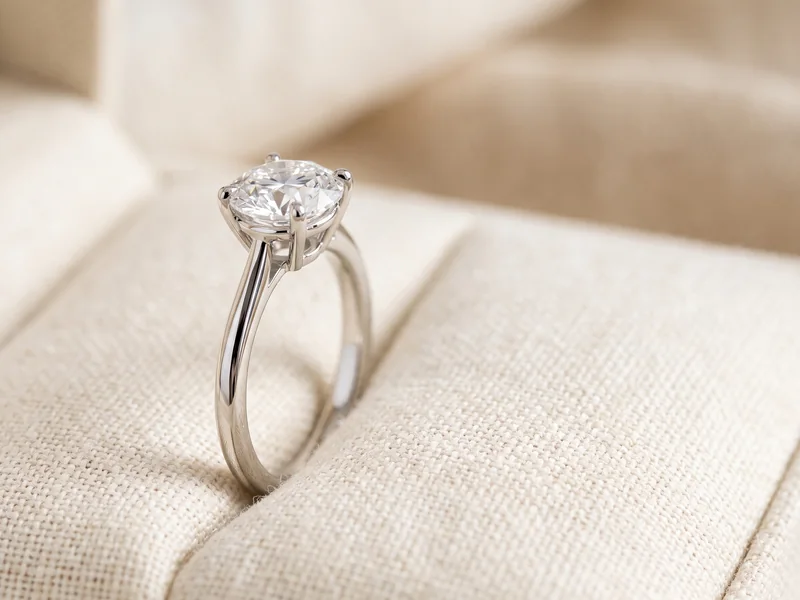 Engagement Rings & SettingsEngagement Ring AnatomyEngagement Rings & SettingsWhich Finger Does an Engagement Ring Go On?
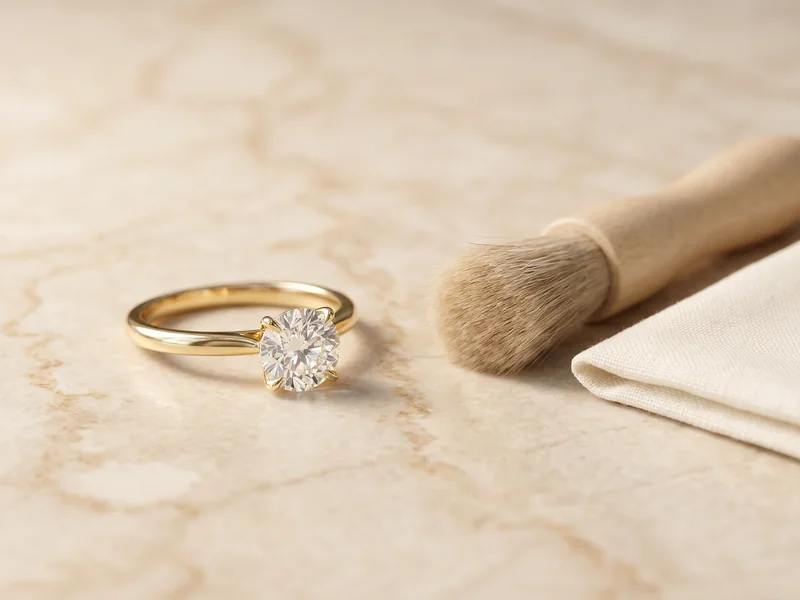 Engagement Rings & SettingsHistory of Engagement RingsEngagement Rings & SettingsEngagement Ring Setting Styles GuideEngagement Rings & SettingsEngagement Rings & Education
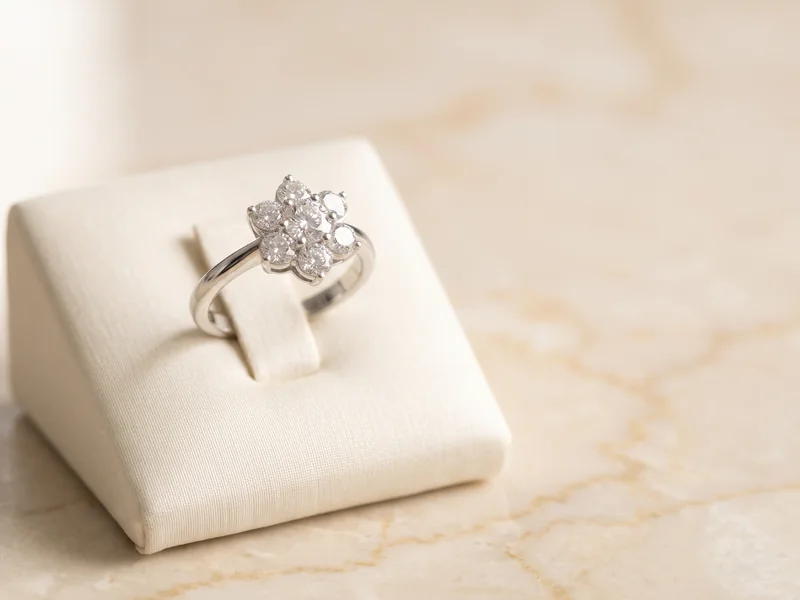 Engagement Rings & SettingsCluster Engagement RingsEngagement Rings & SettingsBypass Engagement Rings
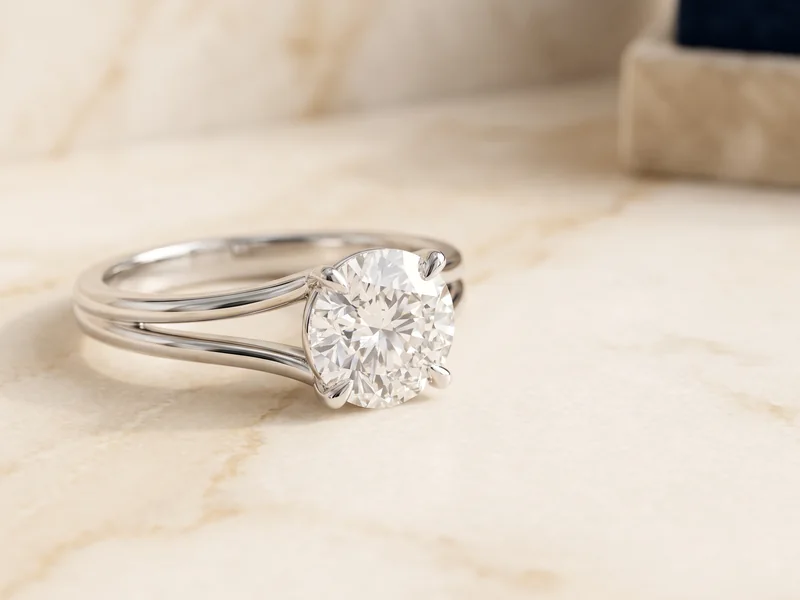 Engagement Rings & SettingsSplit Shank Engagement Rings
Explore more
More guides on this topic
Education