
- Education
- Care, Repairs & Remodelling
- Re-Shanking a Ring: When Your Band Needs Replacing and How It's Done
Care, Repairs & Remodelling
Re-Shanking a Ring: When Your Band Needs Replacing and How It's Done
A ring worn every day slowly loses metal from the bottom of the band. Re-shanking a ring replaces that worn section before it cracks, so you keep the original setting, stone and story.
 Reviewed by Raj Sood, Graduate Gemologist (GIA), AJP (GIA)Founder and Graduate Gemologist (GIA) · reviewed 17 November 2026
Quick answer
Re-shanking a ring means cutting away a worn, thin or cracked band and joining new metal to the shoulders or the setting. A half shank replaces the bottom of the band; a full shank replaces it up to the head. It is worth doing once the band drops below about 1 mm thick or shows cracks.
What is re-shanking a ring?
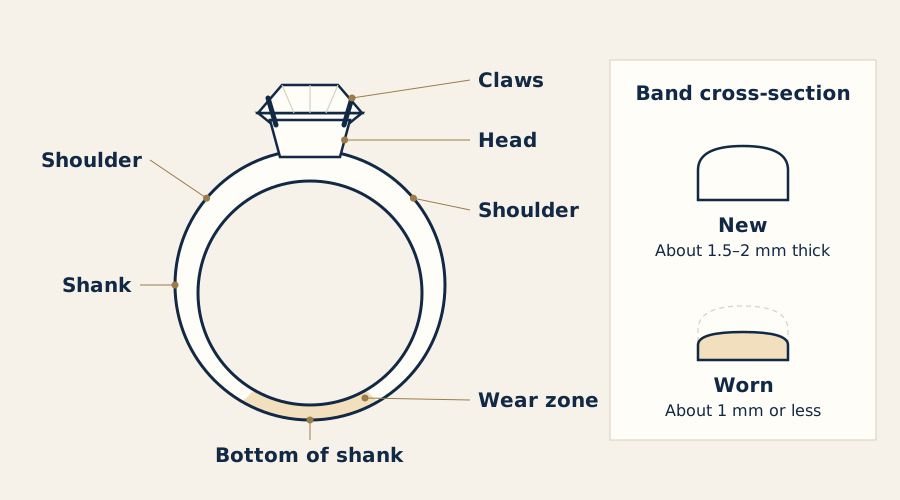
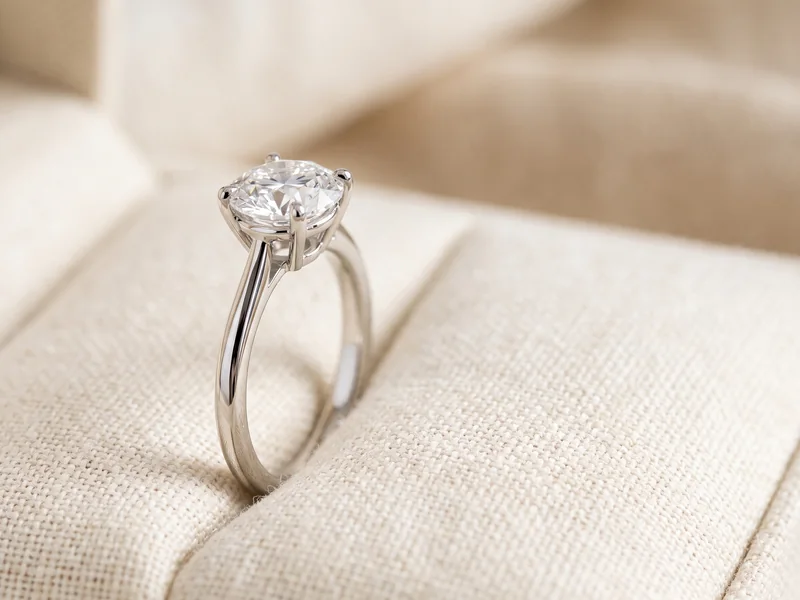
The shank is the band of a ring: the part that circles your finger. It runs from the shoulders (where the band rises towards the stone) around to the bottom of the ring, opposite the setting. The head is the setting itself, the claws or bezel that hold the stone. Re-shanking a ring means removing some or all of the worn shank and joining new metal in its place, while the head, the stone and usually the shoulders stay exactly as they were.
It is one of the most common bench repairs a jeweller does, and one of the least understood. Many people assume a thin band means a new ring. In most cases it doesn't. A new shank keeps the original setting, which is often the part with the most hand work and sentiment in it, and gives the ring many more years of wear. If any term here is new, our plain-English jewellery glossary explains it, and our guide to everyday jewellery care and maintenance covers the wider picture.
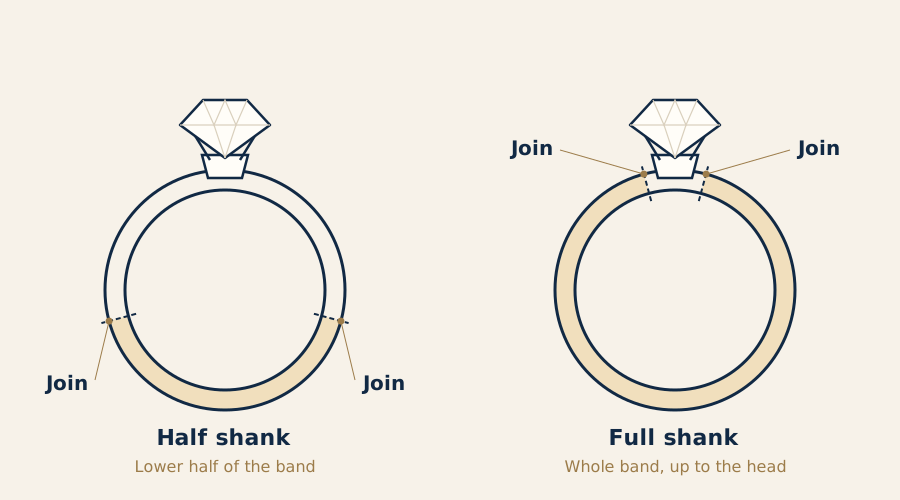
There are two main kinds of ring shank replacement. A half shank replaces the lower half of the band, cut on each side roughly between the 3 and 4 o'clock and the 8 and 9 o'clock positions when you hold the ring with the stone at the top. A full shank replaces the whole band up to the head, and is used when the shoulders are worn or cracked as well. A smaller job, sometimes called a bottom patch or partial shank, replaces only a short worn section at the base.
How do you know your ring needs a new shank?
Wear happens slowly, so it is easy to miss. The bottom of the band takes the most contact: door handles, steering wheels, bench tops, gym bars and the ring beside it. Look for these signs of a thin ring band:
- Thin metal: many engagement ring shanks start at about 1.5–2 mm thick. Once the bottom is down to about 1 mm, or close to the thickness of a bank card (about 0.76 mm), it is time to act.
- A flat spot or pinch: the band looks flattened at the bottom, or narrower there than at the sides.
- Out of round: the ring has bent into an egg shape, often because thin metal flexes when you grip something hard.
- A hairline crack: usually at the bottom, or at an old solder join from a previous resize. Cracks grow, and a thin cracked band can snap.
- A sharp edge: the ring catches on clothing or feels rough where it once felt smooth.
- Several past resizes: each cut and join adds a seam, and repeated sizing can leave the base uneven and weak.
Check the setting at the same time. A shank that has worn thin usually means the claws have worn too, because both have had the same years of wear. A loose stone in a ring with a thin band is two repairs, not one; our guide to checking for loose stones and worn claws explains what to look for. If the band is damaged all the way round, read about deciding whether to repair or replace a band before you choose.
Why do ring bands wear thin?
Metal wears in two ways. Gold is mostly abraded: tiny amounts are scraped away and lost each time it rubs on something harder. Platinum tends to be pushed around on the surface rather than lost, forming the soft grey sheen called patina, though it still thins over years of wear. Either way, the bottom of the band hits surfaces first and wears fastest.
Rings worn together also wear each other. An engagement ring and wedding band rubbing side by side lose metal where they touch, and a harder alloy will often wear a softer one faster. Heavy use of your hands speeds it up too; our pages on wearing your ring to the gym or to bed and taking your ring to the beach, pool or shower explain which habits cost the most metal. Sand is an abrasive, and chlorine can weaken some gold alloys over time, as covered in how sunscreen and chlorine affect jewellery.
| Metal | Precious metal content | How it wears | Re-shanking notes |
|---|---|---|---|
| 9ct gold | 37.5% gold | Hard alloy; wears slowly but can turn brittle with age | Common and economical to re-shank |
| 14ct gold | 58.5% gold | Balance of hardness and colour | Straightforward; the alloy colour must be matched |
| 18ct gold | 75% gold | Softer and richer in colour; wears faster than 9ct | The most common re-shank; white gold needs re-plating afterwards |
| Platinum 950 | 95% platinum | Dense; metal moves into a patina rather than being lost quickly | Needs platinum solder or welding and higher heat; costs more |
| Palladium 950 | 95% palladium | Light, white and fairly durable | Possible, but fewer workshops work it regularly |
| Sterling silver | 92.5% silver | Soft; wears and bends easily | Possible, but often costs more than the ring is worth |
Palladium is a platinum-group metal that can be re-shanked, but it absorbs gases when heated with a torch flame, so it needs careful soldering or laser welding; our guide to palladium rings and how they wear goes further. Silver rings can be re-shanked too, though for most fashion pieces a new ring makes more sense, and caring for sterling silver properly helps slow wear in the first place.
Half shank or full shank replacement: which do you need?
The choice depends on where the wear stops. The jeweller measures the band at the bottom, at the sides and at the shoulders. If only the lower half is thin, a half shank replacement is enough. If the shoulders are thin, or there are cracks near the head, a full shank replacement is the safer repair.
| Half shank | Full shank | |
|---|---|---|
| What is replaced | Lower half of the band | Whole band, up to the head |
| Where the joins sit | Two, low on each side | Two, at the base of the head |
| Usually needed when | Wear is limited to the base | Shoulders are thin, cracked or misshapen |
| Resize at the same time? | Yes | Yes |
| Change the band style? | Partly; the new section matches the old | Yes; a whole new profile is possible |
| Stone removal | Often not needed for diamonds | More often needed, as heat is close to the stone |
| Relative cost | Lower | Higher, often roughly double |
| Typical workshop time | About 1–2 weeks | About 2–3 weeks |
Because new metal is being made anyway, re-shanking is a good moment to fix other things. The ring can be resized in the same job. You can also ask for a slightly thicker base than the original, a comfort fit (a gently curved inside edge), or a squared base, often called a European shank, that helps a top-heavy ring sit upright. If your ring spins on your finger, a squared base can work alongside, or instead of, sizing beads and sizing bars.
Not sure which one is right?
Send us the stones you are looking at and our gemologist will tell you which to choose and why.
How does a jeweller re-shank a ring?
A re-shank is a full bench repair, done by hand. The method varies with the metal and the stones, but the workshop sequence usually looks like this:
- Assess and measure. The jeweller checks band thickness with a gauge, inspects claws and stones under magnification and confirms your finger size.
- Protect or remove the stones. Diamonds can often stay in place if the jeweller judges it safe, but heat-sensitive gems such as emerald, opal, pearl and tanzanite are removed first, or the joins are laser welded.
- Cut away the worn metal. The old section is sawn out at a point where the band is still at full thickness.
- Make the new shank. Metal of the same carat and colour is shaped from wire or a cast section to match the original width and profile.
- Join it. The new piece is soldered with a torch, or joined by laser welding, which melts a tiny spot of metal with very little heat travelling towards the stone.
- Round, size and finish. The ring is trued on a steel mandrel (a tapered rod), then filed, sanded and polished until the joins disappear.
- Check the setting. Claws are tightened or re-tipped if needed, and white gold is rhodium plated.
Inside stamps are worth raising before work starts. The carat or metal stamp (such as 18ct or PT950) and any engraving usually sit at the bottom of the band, which is the part being replaced. Ask if you want the stamp or an engraved name or date put back.
White gold has one more step. Most white gold is plated with rhodium, a bright white metal, and the new shank and joins need a fresh coat so the colour is even. Our guide to how often white gold needs rhodium replating explains the cycle. If you are thinking about upgrading the centre diamond in the next few years, it can make sense to plan both jobs together, since a new head and a new shank can be done in one visit.
Can a platinum ring be reshanked, and which rings can't be?
Most precious-metal rings can be re-shanked. A few need extra care, and a few can't be done at all.
- Platinum: yes. Platinum melts at about 1,768 °C, so it needs higher working temperatures and platinum solder or welding to keep the joins white.
- White gold: yes, followed by rhodium plating so the new metal matches.
- Yellow and rose gold: yes, as long as the alloy colour matches. Rose gold varies between makers, so an exact match can take testing.
- Two-tone rings: yes. A white head on a yellow band is common; the new shank only needs to match the band metal.
- Pavé, channel or eternity bands: possible but costly, because the small diamonds in the worn section must be removed and reset in new metal.
- Hollow or very thin fashion rings: often not worth it; the remaining metal may be too thin to join to.
- Tungsten carbide, ceramic and most titanium: no. They can't be soldered or resized in the usual way, so a worn band is replaced.
- Gold-plated base metal: generally no, because solid gold can't be blended into plating.
Antique and family rings deserve care. Older rings may be in alloys that are hard to match exactly, and some have hand-engraved or pierced shoulders. A careful half shank keeps the original shoulders and detail, which is usually the right approach for a piece you want to hand on.
How much does re-shanking a ring cost in Australia?
Cost depends on the metal, how much of the band is replaced, its width and thickness, whether stones must be removed and reset, and the metal price on the day. Gold and platinum prices move daily, so jewellers usually quote after inspecting the ring.
| Repair (plain band, about 2 mm wide) | Approximate price range (AUD) |
|---|---|
| Half shank, 9ct gold | about $150–$350 |
| Half shank, 18ct gold | about $250–$600 |
| Full shank, 18ct gold | about $450–$1,000 |
| Half shank, platinum | about $400–$900 |
| Full shank, platinum | about $800–$1,800 |
| Rhodium plating, if not included | about $60–$120 |
| Pavé or channel-set shank | Quoted individually; resetting stones adds to the cost |
These are broad ranges only. A wider or heavier band uses more metal and costs more, and so does a ring that needs claws re-tipped at the same time. Compared with making a new ring of the same design, a re-shank usually costs much less, especially when the setting holds a significant stone or has detailed hand work.
Jewellery repairs service
How long does re-shanking take, and how often is it needed?
Most re-shanks take about one to three weeks, longer if stones are being reset, special alloy has to be ordered or the ring is part of a larger remodel. The bench work itself is often a few hours; the rest is workshop scheduling, finishing, plating and quality checks.
How often depends almost entirely on how you wear the ring. As a rough guide, an 18ct gold engagement ring worn every day may go 15–25 years or more before it needs a new shank. Worn for manual work, gardening or weights, it can be under 10 years. A ring worn only on special occasions may never need one. A yearly check as part of a normal engagement ring care routine lets a jeweller catch thinning early, when a half shank is still enough.
What not to do while the band is thin:
- Don't squeeze it back into shape yourself. Thin metal bent back and forth work-hardens and cracks.
- Don't have it stretched to size up. Stretching makes a thin band thinner.
- Don't wait for a crack to open. A snapped shank lets the head twist and claws lift, which is how stones are lost.
- Don't use glue or DIY solder kits. They leave residue that must be removed before a proper repair.
- Don't wear it for heavy lifting or rough work until it has been repaired.
How do you prepare for re-shanking a ring? Step by step
- Look closely. Check the bottom of the band for thinning, flat spots and cracks, and compare it with the thickness at the sides.
- Ease off rough wear. Take the ring off for the gym, garden and building work until it is fixed.
- Clean it gently. Use warm water, mild dish soap and a soft brush; follow our steps for cleaning a diamond ring at home, or safe cleaning methods for each gemstone if it holds coloured stones.
- Bring the rings you wear together. The jeweller can shape the new shank to sit neatly against your wedding band.
- Decide on extras. Resizing, a thicker base, comfort fit, a replacement stamp or engraving, and claw re-tipping can all be done at once.
- Ask for a written quote. It should say half or full shank, the metal, whether stones are removed, rhodium plating and the expected timing.
- Check the finished ring. The joins should be invisible, the ring perfectly round, the size right, the claws tight and the stone sitting level.
- Store it well. Keep it in its own compartment, away from harder stones; our guide to storing rings so they don't scratch explains how.
Handled this way, re-shanking a ring is a routine repair rather than a worry, and the setting you chose can keep going for another generation of wear.
Does your ring need work? See ring repair in Melbourne for worn claws, bent bands, thin shanks and loose stones, inspected before anything is quoted. Have your ring repaired, or see ring resizing and claw retipping. Raj Sood, Graduate Gemologist (GIA), sees clients by appointment at Unit 903/125 Swanston St, Melbourne VIC 3000.
Free consultation
Talk to a gemologist
Compare stones in person or online with Raj Sood, Graduate Gemologist (GIA), AJP (GIA).
Book a consultationShop this shape
FAQ
Common questions
What does re-shanking a ring mean?
It means replacing the worn band of a ring, either the lower half (a half shank) or the whole band up to the setting (a full shank). The stone, setting and usually the shoulders stay as they were.
How much does it cost to reshank a ring?
In Australia, roughly AUD $150–$600 for a half shank in gold and about $400–$1,800 for platinum or full shanks, depending on metal weight and extra work. A jeweller can only quote accurately after inspecting the ring.
Can a ring be resized and reshanked at the same time?
Yes. Because new metal is being made, the jeweller can make it to your new size in the same job, and can also thicken the base or add a comfort fit.
Will re-shanking damage my diamond?
Diamond usually handles bench heat well when protected, though treated diamonds (such as fracture-filled stones) should come out first, and jewellers protect or remove stones when needed. Heat-sensitive gems such as emerald, opal, pearl and tanzanite are removed first or the joins are laser welded.
How do I know if my ring band is too thin?
If the bottom of the band is about 1 mm thick or less, looks flattened, has bent out of round or shows a hairline crack, have it checked. A jeweller can measure it in seconds with a gauge.
Is it worth reshanking a ring or should I buy a new one?
For a solid gold or platinum ring with a good setting, a re-shank is usually far less costly than a new ring and keeps the original piece. For hollow, plated or tungsten rings, replacement is usually the only option.
Terms in this guide
Ask a gemologist
Not sure which diamond to choose?
Raj Sood is a Graduate Gemologist (GIA) who works alongside our master jewellers. Bring the stones you are considering, or send the reports, and he will tell you honestly which one is better and why.
Keep learning
Related guides
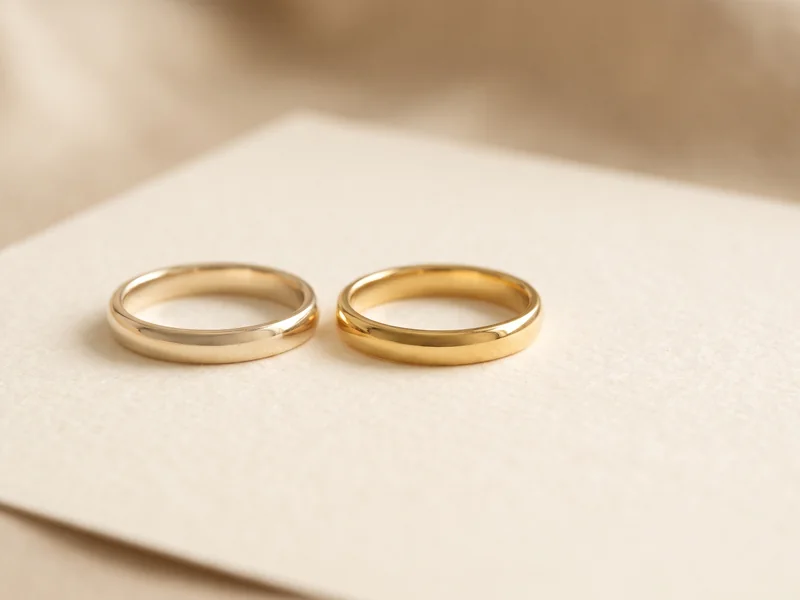 Care, Repairs & RemodellingWhen to Repair vs Replace a Band
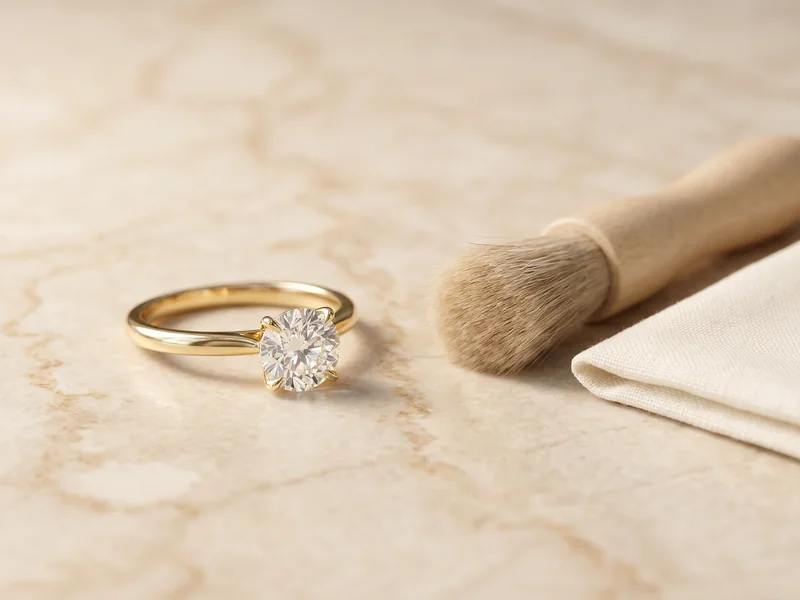 Care, Repairs & RemodellingLoose Stones and Stone TighteningCare, Repairs & RemodellingJewellery Care and Maintenance
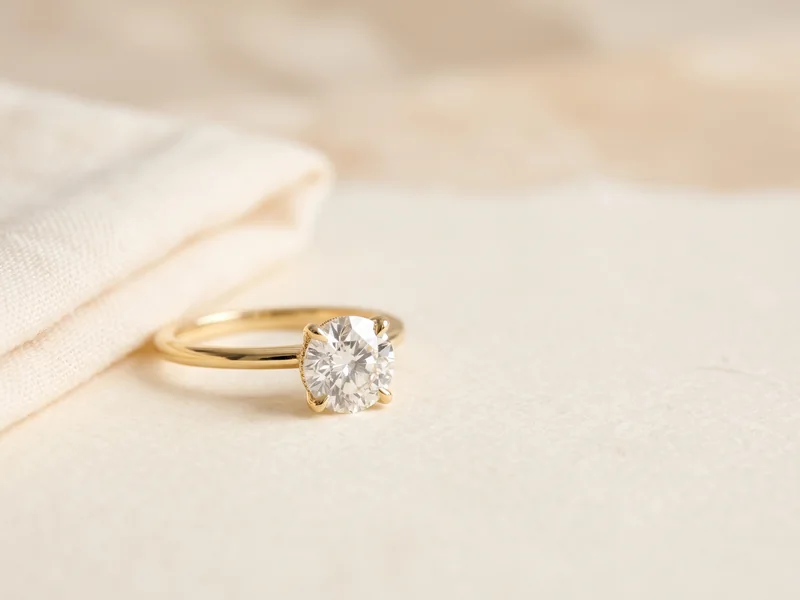 Care, Repairs & RemodellingRing Sizing Beads and Sizing BarsCare, Repairs & RemodellingHow to Clean a Diamond Ring at Home
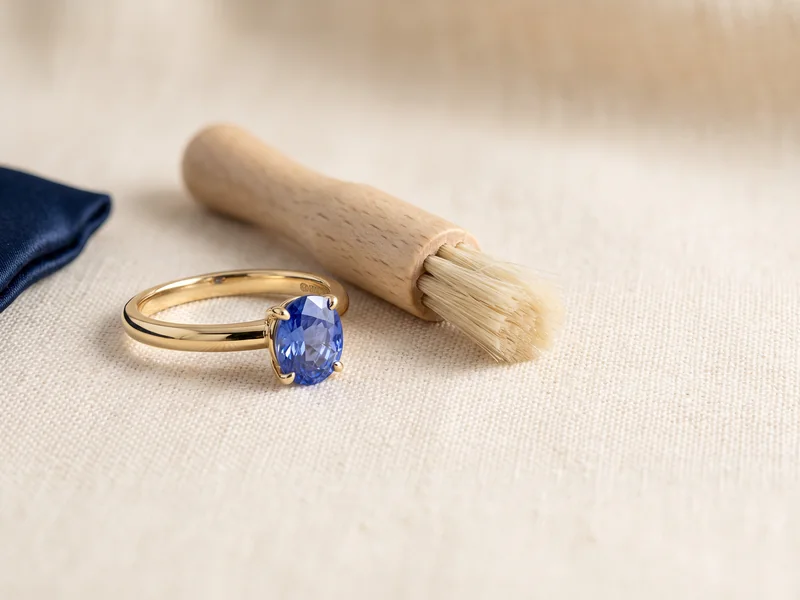 Care, Repairs & RemodellingCleaning Gemstones by Type
 Care, Repairs & RemodellingRhodium Replating ScheduleCare, Repairs & RemodellingUpgrading Your Diamond
Explore more
More guides on this topic
Education